
Last updated: 27 June 2026
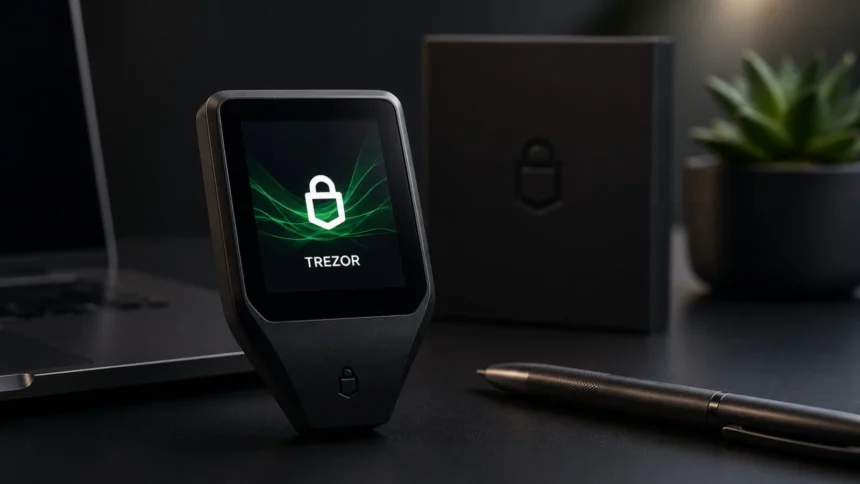
Trezor invented the hardware wallet category in 2014. The Model T is its flagship device in 2026: a touchscreen hardware wallet with fully open source firmware, open source hardware schematics, and a decade of independent security research conducted on it publicly. For users who need to verify what runs on their security device, Trezor is the only major hardware wallet that provides this.
Key Highlights
- Fully open source: both firmware and hardware designs are publicly available on GitHub
- Color touchscreen for approving transactions and entering PIN directly on the device
- Shamir Backup (SLIP39): split your recovery phrase into multiple shares for distributed storage
- CoinJoin privacy built into Trezor Suite for Bitcoin transaction mixing
- Works natively with MetaMask, Electrum, Wasabi Wallet, and most major interfaces
- 1,000+ supported cryptocurrencies including Bitcoin, Ethereum, and all ERC-20 tokens
The Verdict
Trezor Model T is the right hardware wallet for users who place the highest priority on verifiable, open source security. The touchscreen interface is a genuine usability improvement over button-only devices. The trade-off is a smaller asset list than Ledger Nano X and no mobile Bluetooth connectivity. For Bitcoin-first users and anyone who needs privacy tools, Trezor is the stronger choice.
Why Open Source Matters for Security
Hardware wallets are security-critical devices. When firmware is closed source, you must trust the manufacturer’s claims about how your keys are handled. When firmware is open source, anyone can verify those claims by reading the code. The Trezor firmware repository on GitHub has received contributions and security reviews from independent researchers worldwide. Known vulnerabilities have been responsibly disclosed and patched publicly. This transparency is a meaningful security advantage that closed source wallets cannot offer, regardless of their marketing claims.
The absence of a Secure Element chip in the Trezor Model T (unlike Ledger’s CC EAL5+ chip) is the standard criticism. Trezor’s response is that a Secure Element running closed source code provides less verifiable security than open source code running on a standard chip. Both positions are technically defensible. The choice ultimately depends on your threat model and your willingness to trust hardware black boxes.
Trezor Suite Interface
Trezor Suite is the desktop and browser companion app for managing your portfolio, sending transactions, and accessing advanced features. It is cleaner than most hardware wallet software and does not require a third-party app for most operations. Portfolio tracking, account labeling, transaction notes, and CSV export are all available natively. For Bitcoin users, Trezor Suite includes full node connection, Tor routing for privacy, and the CoinJoin integration via the Wasabi Wallet backend.
CoinJoin and Privacy Features
Trezor Suite includes CoinJoin integration, allowing Bitcoin users to mix transactions for privacy without leaving the Trezor interface. CoinJoin works by coordinating multiple users to create a single transaction with multiple inputs and outputs, breaking the transaction graph that blockchain analytics tools use. The implementation uses the WabiSabi protocol from the Wasabi Wallet team. This is the most accessible privacy-preserving Bitcoin tool available to mainstream users and is a meaningful differentiator over Ledger.
Shamir Backup
Standard hardware wallets use a 12 or 24 word recovery phrase. If you lose that phrase, you lose your funds. Shamir Backup, supported only on Trezor Model T, lets you split the recovery phrase into multiple shares. You can set a threshold such as 3 of 5 shares required to recover the wallet. Store shares in separate physical locations. An attacker needs to compromise multiple locations to access your funds. This is a genuinely better backup model than a single seed phrase stored in one location and is one of the Model T’s strongest practical advantages for anyone with significant holdings.
Trezor Model T vs Ledger Nano X
Ledger wins on asset breadth (5,500+ vs Trezor’s 1,000+), mobile Bluetooth connectivity, and the security argument for dedicated Secure Element chips. Trezor wins on open source verification, CoinJoin privacy integration, Shamir Backup, and independence from any proprietary ecosystem. For most users holding primarily Bitcoin and major EVM tokens, both cover everything needed. For users holding many altcoins or needing mobile pairing, Ledger is more practical. For Bitcoin-focused users who need privacy tools and open source verification, Trezor Model T is the superior choice.
The TCB View
Trezor built the hardware wallet category and remains the gold standard for open source security. The lack of a certified Secure Element is a legitimate trade-off, but the argument that open source firmware on a standard chip is more trustworthy than closed source firmware on a certified chip is credible. Shamir Backup and CoinJoin are features Ledger cannot match. For Bitcoin-first users who want the most privacy-preserving and openly verifiable cold storage available, Trezor Model T is the right device in 2026.