
Last updated: 5 July 2026
Key Highlights
- Apple Pay reached over 500 million users globally as of Q3 2023
- India’s Unified Payments Interface (UPI) recorded 8.7 billion transactions in March 2023, a 60% increase year on year
- Google Pay processed more than $1 trillion in transactions in 2022
- NFC technology powers contactless payments at over 2 million locations in the U.S. Alone as of 2023
- Tokenization reduces fraud risk by over 90% compared to traditional payment methods
Digital wallets are changing how we handle money. Apple Pay, Google Pay, and India’s UPI aren’t just flashy tech; they’re practical tools that simplify transactions. But how do they actually work?
Let’s break down the tech behind these digital wallets, focusing on tokenization, NFC, and QR codes, and explore why India leads the world in real time payments. Broader market context is available via CoinGecko, which tracks thousands of digital assets in real time.
Understanding Digital Wallets
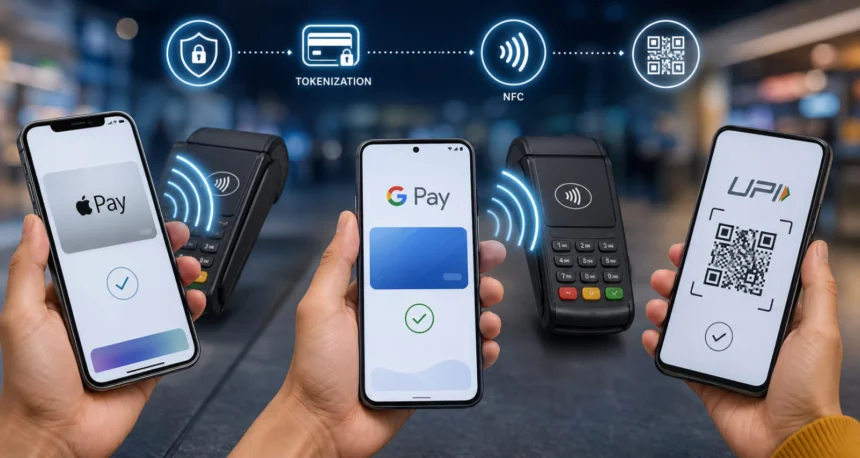
Digital wallets store your payment information securely, allowing you to make transactions with just a few taps on your phone. They rely on two key technologies: tokenization and Near Field Communication (NFC).
Tokenization replaces sensitive card details with unique identifiers, or “tokens.” This means your actual card number is never shared with merchants, reducing the risk of fraud. According to a recent study, tokenization can decrease fraud risk by over 90%. That’s a game changer for consumers and merchants alike.
NFC technology allows devices to communicate wirelessly at close range. When you tap your phone at a point of sale terminal, it transmits your tokenized payment data securely. This tech is everywhere, with over 2 million NFC enabled locations in the U.S. Alone as of 2023.
Apple Pay: A Leader in Digital Wallets
Apple Pay is at the forefront of the digital wallet revolution. With over 500 million users globally as of Q3 2023, it’s a primary player in mobile payments. Apple’s strength lies in its clean integration with iOS devices. When you make a purchase, Apple Pay uses NFC and tokenization to ensure your data stays safe.
It doesn’t store your card information on the device or share it with merchants. Instead, it generates an unique token for each transaction. This process not only sharpens security but also speeds up the checkout process. But Apple Pay isn’t just about security; it’s also about convenience.
Users can pay for everything from groceries to transit fares, making it a versatile choice.
Google Pay: Expanding Horizons
Google Pay has made significant strides, processing over $1 trillion in transactions in 2022. Like Apple Pay, it uses both tokenization and NFC technology. However, Google Pay also offers a broader range of services, including peer to peer payments and integration with loyalty programs. Google’s strategy has been to create a full financial platform.
This means that users can store boarding passes, tickets, and even gift cards in addition to their payment information. This all in one approach makes Google Pay appealing to a wider audience. Because of its extensive space, Google Pay is often seen as more than just a payment method.
It’s becoming a financial hub for users.
India’s UPI: The Real Time Payment Champion
India’s Unified Payments Interface (UPI) is a standout in the digital wallet arena. In March 2023 alone, UPI recorded a staggering 8.7 billion transactions, a 60% increase year on year. What’s the secret sauce? UPI operates on a real time payment system that allows users to transfer money instantly between bank accounts.
Unlike traditional banking methods, which can take hours or even days, UPI transactions occur in seconds. This efficiency is a significant factor in its skyrocketing popularity. And UPI’s adoption has been bolstered by government initiatives that promote cashless transactions. It’s not just a payment tool; it’s a movement towards financial inclusion in India.
The Future of Digital Wallets
Digital wallets are poised for further evolution. Beyond payments, they’re set to encompass identity verification, ticketing, and even access control for smart devices. Imagine using your digital wallet not just for payments, but also for proving your identity at airports or unlocking your car. With advancements in blockchain technology, the potential for digital wallets expands.
They could store your digital identity securely, providing a single point of access for various services. But with this growth comes challenges. Privacy concerns will need addressing, and regulations will have to evolve to keep pace with innovation.
Conclusion: The Road Ahead
Digital wallets are more than just a trend; they’re transforming how we interact with money. With giants like Apple and Google leading the charge, and innovative solutions like UPI emerging, the sector is richer than ever.
As digital wallets continue to integrate new technologies, we’ll see even more applications beyond simple payments. Watch for the integration of digital identity and access control features in the near future.
Frequently Asked Questions (FAQs)
How do digital wallets like Apple Pay work
Digital wallets like Apple Pay store your payment information securely, allowing you to make transactions with just a few taps on your phone, they rely on two key technologies: tokenization and Near Field Communication. Tokenization replaces sensitive card details with unique identifiers, or tokens, this means your actual card number is never shared with merchants, reducing the risk of fraud. They simplify transactions and are practical tools.
What is tokenization in digital payments
Tokenization in digital payments replaces sensitive card details with unique identifiers, or tokens, this means your actual card number is never shared with merchants, reducing the risk of fraud, according to a recent study, tokenization can decrease fraud risk by over 90% compared to traditional payment methods.
How many transactions did Google Pay process in 2022
Google Pay processed more than $1 trillion in transactions in 2022, this shows the growing use of digital wallets for payments, and the trust people have in these services.
What is the role of NFC technology in contactless payments
NFC technology powers contactless payments at over 2 million locations in the US alone as of 2023, it allows for easy and secure transactions, and is a key part of how digital wallets work.
The TCB View
TCB believes digital wallets are on an unstoppable trajectory toward widespread adoption. With India processing over 8.7 billion transactions in March 2023, it’s clear that efficiency and security are key drivers. However, privacy concerns could pose significant risks as wallets expand into new areas like identity verification. Watch for regulatory developments that may shape the future of digital wallets.