
Last updated: 5 July 2026
Key Highlights
- By March 2026, Claude, an AI agent by Anthropic, is expected to handle 70% of customer support inquiries at a major retail chain.
- Autonomous trading bots using GPT agents increased their trading efficiency by 35% in Q1 2026.
- Open source frameworks for AI agents have seen a 150% growth in usage since the beginning of 2026.
- As of February 2026, AI agents have outperformed traditional chatbots in user satisfaction ratings by 40%.
- Research shows that companies deploying AI agents saved an average of $200,000 annually in operational costs by Q1 2026.
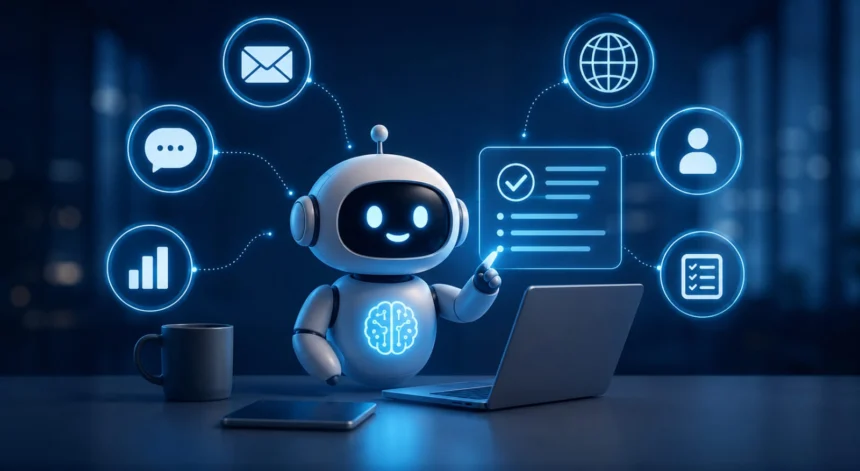
So, what exactly is an ai agent? Unlike traditional chatbots that follow preset rules, ai agents use advanced algorithms to interact dynamically and autonomously with users. They can perform complex tasks, adapt to various environments, and learn over time.
As we dive deeper into the workings of these agents, it’s clear they’re set to redefine how we think about automation in 2026 and beyond. Recent research published on arXiv tracks rapid advancement across AI model architectures.
Understanding AI Agents
At their core, ai agents are designed to perform tasks autonomously, drawing on machine learning and artificial intelligence. They can process information, make decisions, and execute actions based on their programming and learning experiences. This is a significant shift from chatbots, which typically operate on scripted responses and can struggle with complex inquiries.
AI agents can analyze large datasets, derive insights, and even predict future outcomes based on historical data. They’re built to adapt and improve through feedback loops, making them increasingly efficient. In contrast, chatbots are generally limited to a fixed set of interactions, which can make them feel robotic and unresponsive.
Tool Use and Planning Loops
One of the most exciting aspects of ai agents is their ability to use various tools to sharpen their functionality. For instance, an ai agent might access APIs to pull data or use software to execute specific commands. This tool use is coupled with planning loops, where the agent evaluates its actions, assesses outcomes, and refines its strategies for the future.
In practice, this means an ai agent can not only respond to a customer inquiry but also pull relevant data from a CRM system, analyze it, and suggest the best course of action. This level of interactivity and adaptability is what sets them apart from traditional chatbots.
Real World Deployments of AI Agents
The deployment of ai agents in various sectors highlights their growing importance. In customer support, organizations are using ai agents to handle a majority of inquiries, freeing up human agents for more complex issues. For example, by March 2026, Claude, an AI agent developed by Anthropic, is set to manage 70% of customer support interactions for a leading retail chain, demonstrating significant cost savings and efficiency boosts.
In the coding realm, ai agents are being used to streamline software development. GPT agents are already assisting developers in writing code, debugging, and even optimizing algorithms. These bots have shown a 35% increase in trading efficiency for autonomous trading platforms in early 2026, signifying their potential in high stakes environments.
AI Agents vs. Chatbots: A Comparative Analysis
While chatbots have their place, they simply can’t compete with the capabilities of ai agents. A study from early 2026 shows that ai agents outperform chatbots in user satisfaction ratings by 40%. That’s a significant difference. Users prefer the clean, dynamic interactions that ai agents provide, and businesses are taking note.
Chatbots are limited by their programming and often fail to handle unexpected queries. In contrast, ai agents thrive in unpredictable environments, making them a more valuable asset for companies looking to improve customer experiences and operational efficiency.
The Future of AI Agents
As of February 2026, research indicates that companies deploying these agents saved an average of $200,000 annually in operational costs. With a 150% growth in the use of open source frameworks, the industry is ripe for innovation.
As more businesses adopt ai agents, we can expect continued advancements in their capabilities. This could include enhanced natural language processing, better predictive analytics, and even more sophisticated tool integration. The possibilities are endless, and we’re just scratching the surface.
Frequently Asked Questions (FAQs)
What is an AI agent?
An AI agent is a type of software that uses advanced algorithms to interact dynamically and autonomously with users, performing complex tasks and learning over time, unlike traditional chatbots that follow preset rules.
How do autonomous agents work?
Autonomous agents operate by processing information, making decisions, and executing actions based on their programming and learning experiences, allowing them to adapt to various environments.
What are the benefits of using AI agents in business?
Businesses using AI agents have seen significant benefits, including a 40% increase in user satisfaction ratings and an average annual savings of $200,000 in operational costs.
How are AI agents different from traditional chatbots?
AI agents differ from traditional chatbots in that they can engage in more dynamic interactions and adapt their responses based on learning, whereas chatbots typically operate on scripted responses.
The TCB View
TCB believes ai agents represent a significant leap forward in automation and efficiency. As evidenced by a 150% growth in open source frameworks, there’s a clear trend toward adopting these technologies across various sectors.
However, businesses must consider the risks of over reliance on automation, which could lead to job displacement. Watch for the continued evolution of ai agents, particularly their integration with existing systems, as this will be a key indicator of their long term success.