
Last updated: 9 July 2026
Key Highlights
- Enterprises processing over $200 million in annual payments can achieve 5% to 15% savings on processing fees by implementing payment orchestration.
- Dynamic routing and smart retry logic, core features of orchestration, typically boost payment authorization rates by 3% to 7%.
- Leading payment orchestration platforms, such as Spreedly and Primer, integrate with over 150 global payment gateways and processors.
- Merchants can reduce their PCI DSS compliance scope by up to 75% by offloading sensitive card data to an orchestration layer through tokenization.
- A single API integration with an orchestrator can unlock access to dozens of new payment methods, including cryptocurrencies and buy now pay later (BNPL) options, within weeks.
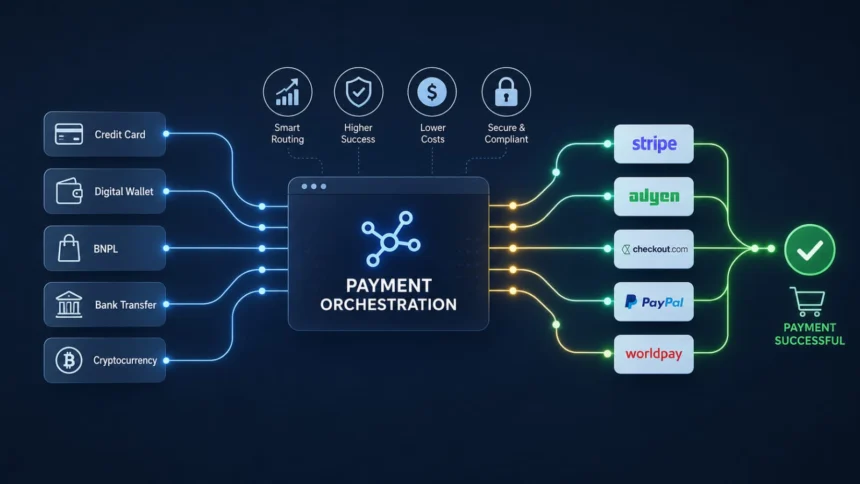
Payment orchestration is a sophisticated technology layer designed to help online merchants manage and optimize their payment flows across multiple gateways and processors. This strategic approach allows businesses to enhance authorization rates, reduce processing costs, and improve overall payment resilience, moving beyond the limitations of a single payment provider.
For large e commerce operations, payment orchestration acts as an intelligent traffic controller for transactions. Instead of funneling all payments through one system, it intelligently routes each transaction to the most appropriate processor based on a predefined set of rules. This could mean choosing a processor with lower fees for a specific card type, or one with a higher success rate in a particular geographic region.
The Imperative for Multi Gateway Strategies
Historically, many online merchants relied on a single payment gateway to handle all their transactions. While seemingly simple, this approach often leads to significant drawbacks: vendor lock in, suboptimal authorization rates, and inflated processing fees. A single point of failure also poses a substantial risk to business continuity.
Consider a merchant like “Global Gadgets,” processing $300 million in online sales annually. If their primary payment gateway experiences an outage or a sudden dip in authorization rates, Global Gadgets faces immediate revenue loss. On top of that, being tied to one provider limits their ability to negotiate competitive rates or adapt quickly to new payment trends.
This challenge prompted the development of payment orchestration. It emerged as a solution to give merchants greater control and flexibility. By abstracting the payment logic from the individual processors, orchestration platforms provide a centralized hub for managing all payment related operations.
Boosting Authorization Rates Through Intelligent Routing
One of the most compelling benefits of payment orchestration is its ability to significantly improve authorization rates. This is achieved through two primary mechanisms: dynamic routing and smart retry logic. Each plays a critical role in minimizing declined transactions and maximizing revenue.
Dynamic routing involves sending each transaction to the payment gateway or processor most likely to approve it. This decision is made in real time, considering factors such as the card issuer, card type, customer location, transaction amount, and even the historical performance of different processors for similar transactions. For example, a transaction from a European customer using a Visa card might be routed to Adyen, while a domestic American Express transaction goes to Stripe, if historical data suggests higher success rates with those pairings.
Smart retry logic addresses transactions that are initially declined. Instead of simply failing the transaction, an orchestration layer can automatically reattempt the payment, often through a different processor or with slight modifications to the request. For instance, if a transaction fails due to a temporary network issue with Processor A, the orchestrator can immediately route it to Processor B. Data from industry reports suggests smart retries can recover an additional 5% to 10% of initially declined payments, directly impacting a merchant’s bottom line.
Significant Cost Savings and Fee Optimization
Payment orchestration empowers merchants to reduce their payment processing costs substantially. By working with multiple processors, businesses gain significant use to negotiate better rates. They can direct high volume transactions to processors offering the most competitive interchange plus pricing, rather than being beholden to a single provider’s fee structure.
Imagine “Fashion Forward,” an online apparel retailer processing $150 million per year. If they can reduce their blended processing fee from 2.9% to 2.6% through strategic routing and negotiation, that 0.3% difference translates to an annual saving of $450,000. Over several years, these savings compound into millions, a direct boost to profitability.
Orchestration platforms also allow for rule based routing that considers transaction cost. A merchant might configure their system to route all debit card transactions under $50 to a processor with a fixed low fee, while higher value credit card transactions go to a processor with better percentage rates. This granular control over routing decisions ensures that each transaction is processed in the most cost efficient manner possible.
Enhanced Security and Compliance with Payment Orchestration
Security and regulatory compliance, particularly PCI DSS (Payment Card Industry Data Security Standard), represent significant burdens for online merchants. Payment orchestration offers robust solutions that can simplify compliance efforts and bolster overall transaction security, reducing the merchant’s exposure to sensitive data.
A core security feature of orchestration platforms is tokenization. When a customer enters their card details, the orchestration layer intercepts this sensitive information, converts it into a non sensitive “token,” and stores the actual card data securely in its own PCI compliant vault. The merchant then only handles this token for subsequent transactions, never the raw card data.
This approach dramatically reduces the merchant’s PCI DSS compliance scope. Instead of having to secure entire systems that handle card numbers, expiration dates, and CVVs, the merchant’s environment only interacts with tokens. This can shrink the scope of audits, lower compliance costs, and significantly mitigate the risk of data breaches. Companies like Spreedly and Finix offer advanced tokenization services that are central to their orchestration offerings.
Future Proofing Your Payment Infrastructure
The digital payment landscape is in constant flux, with new payment methods, regional preferences, and regulatory changes emerging regularly. A payment orchestration layer provides a flexible, future proof infrastructure that allows merchants to adapt quickly without extensive re engineering of their core systems.
By integrating with an orchestration platform through a single API, merchants gain immediate access to a vast network of payment gateways, alternative payment methods like cryptocurrencies or BNPL, and fraud prevention tools. Adding a new payment method, such as Solana Pay or Affirm, can be configured within the orchestration layer in days or weeks, rather than months of direct integration work.
This agility is critical for global expansion. A merchant entering a new market can quickly activate local payment options and processors through their orchestrator, catering to local consumer preferences and improving conversion rates. Beyond that, the centralized data offered by orchestration platforms provides a unified view of all payment activity, empowering better analytics and strategic decision making.
Key Players in the Orchestration Ecosystem
The payment orchestration market has matured, with several prominent players offering distinct services. Spreedly, for example, is a veteran in the space, known for its extensive gateway integrations and robust tokenization capabilities. Their “Payments Orchestration Platform” allows businesses to connect to over 120 gateways, providing unparalleled flexibility.
Primer, a newer entrant, focuses on a highly customizable, no code platform for building payment flows. They emphasize a modular approach, allowing merchants to easily add and subtract services from their ecosystem. Finix, on the other hand, specializes in “payments as a service,” enabling businesses to become their own payment processors through their orchestration layer, offering deeper control and potentially greater cost savings for very large enterprises.
Other notable players include Akurateco, which offers a white label solution, and Paydock, known for its focus on subscription payments and recurring billing. Each platform caters to slightly different merchant needs, but all share the core goal of centralizing, optimizing, and securing the payment process for online businesses.
The TCB View
TCB believes payment orchestration is no longer a luxury but a strategic necessity for any enterprise scale online merchant. We see this technology as a critical enabler for maximizing revenue and efficiency in a complex global payment environment. Large merchants, particularly those processing over $100 million annually, are the clear winners, gaining millions in savings and significant boosts to their authorization rates, sometimes exceeding a 5% increase.
The losers are single processor dependent merchants who remain vulnerable to outages, high fees, and limited market reach. Our read is that the trend towards multi gateway strategies, facilitated by orchestration, will only accelerate. Watch for increased consolidation among orchestration providers and greater integration with AI driven fraud prevention tools, aiming for a consistent 99.5% authorization rate across all major payment types by 2026.