
Last updated: 27 June 2026
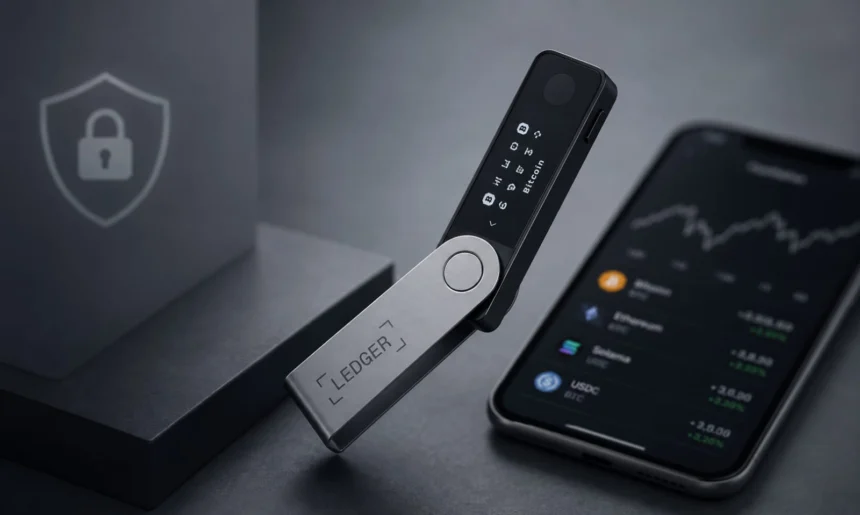
The Ledger Nano X is the most widely used hardware wallet in the world. Its core security model: private keys generated and stored entirely on the device, never exposed to the internet, never transmitted to Ledger’s servers, never visible to any software you connect it to. When you connect the Nano X to a computer or phone, only signed transactions leave the device. The keys stay inside.
For anyone holding meaningful crypto value, a hardware wallet is not optional. The Nano X is where most people should start.
Key Highlights
- 5,500+ supported cryptocurrencies across 50+ blockchains
- Bluetooth connectivity: works with iOS and Android without a cable
- Secure Element chip (ST33K1M5) certified at CC EAL5+: same security standard as passports and bank cards
- Ledger Live app handles portfolio management, staking, and swaps without compromising key security
- Battery built in: use without a computer via mobile app
- Supports up to 100 apps installed simultaneously
The Verdict
The Ledger Nano X is the right hardware wallet for most users. Its combination of broad asset support, mobile connectivity, and a decade-plus security record makes it the practical default for cold storage. The 2023 customer data breach (email and mailing addresses, not private keys) is important context but does not change the device’s security model. Your keys were never at risk from that incident.
How the Security Model Works
The Nano X uses a dual-chip architecture. The Secure Element chip stores private keys and handles cryptographic operations. A separate microcontroller manages the display and connectivity. No private key data passes through the connectivity layer. When Ledger Live or a connected MetaMask wallet requests a signature, the Nano X shows the transaction details on its screen and waits for your physical button confirmation. A malicious site that hijacks your browser cannot sign a transaction without your physical approval on the device.
The Secure Element is certified at CC EAL5+. This is the same certification class used in biometric passports and SIM cards. It is not a marketing claim. It is a third-party tested standard.
The 2023 Data Breach
In 2023, a former Ledger employee left a contractor with access to Ledger’s e-commerce and marketing databases. That database was breached, exposing names, email addresses, phone numbers, and mailing addresses of 272,000 Ledger customers. Private keys were not exposed. The device’s security model was not compromised. The breach was a customer data management failure, not a device security failure. Ledger has since shut down third-party data processors for marketing use and deleted all remaining user data from former vendors. The incident is relevant context for privacy. It is not relevant context for key security.
Ledger Live and Ecosystem
Ledger Live is the companion app that manages your portfolio, installs coin apps to the device, handles staking, and connects to DeFi services. It works on macOS, Windows, Linux, iOS, and Android. Through Ledger Live, you can stake Ethereum, Solana, Cosmos, and other assets while keeping keys on the device. The swap feature aggregates from Changelly, ParaSwap, and 1inch. Services are non-custodial: Ledger Live is an interface, not a custodian.
For DeFi use, the Nano X pairs with MetaMask, WalletConnect, and most major browser wallets. Your hardware key controls the connected wallet. No transaction can be signed without device approval.
Nano X vs Nano S Plus vs Trezor Model T
The Nano S Plus is cheaper ($79 vs $149) but has no Bluetooth, a smaller screen, and limited app storage. For desktop-only use with a few coins, the S Plus is sufficient. For mobile use or a large portfolio across many chains, the Nano X is worth the price difference. Against the Trezor Model T, the Nano X wins on asset support and mobile connectivity. Trezor wins on open-source firmware. Both are excellent. The Ledger vs Trezor choice is ultimately about whether you require auditable open-source code or prefer the broader Ledger ecosystem.
Who the Nano X Is For
The Ledger Nano X is right for anyone holding Bitcoin, Ethereum, or any serious crypto position long-term. Anyone using a software wallet like Phantom or MetaMask as their primary storage should move to hardware. The Nano X is the best default recommendation for the vast majority of users who want broad asset support, mobile connectivity, and a proven track record.
The TCB View
Hardware wallets are not optional for anyone holding meaningful value. The question is which one. The Nano X earns its market-leading position through genuine depth: the asset support is unmatched, the mobile workflow via Bluetooth is genuinely convenient, and the Secure Element chip provides a security foundation that software wallets cannot replicate. The 2023 data breach was a wake-up call about marketing data hygiene, not device security. The core product remains the benchmark for hardware cold storage in 2026.