
Last updated: 21 July 2026
Bitcoin holders
Key Highlights
- The FTX exchange collapse in November 2022 led to an estimated $8 billion in customer losses, starkly illustrating the risks of third party custody.
- Hardware wallet shipments, a proxy for self custody adoption, grew by over 30% in 2023, reaching an estimated 4 million units globally.
- The 2014 Mt. Gox hack resulted in the loss of approximately 850,000 BTC, affecting over 24,000 creditors globally.
- A recent survey by The Block Research indicated that only 28% of bitcoin holders actively use self custody solutions for the majority of their holdings.
- The average transaction fee on the Bitcoin network reached $30 in late 2023, making frequent small transfers from self custody less practical for some users.
The fundamental choice facing every bitcoin holder is how to secure their digital assets: through `bitcoin self custody vs exchange` custody. This decision carries significant implications for security, control, and accessibility, presenting a trade off between convenience and true ownership that can mean the difference between financial independence and devastating loss.
The Allure of Exchange Custody: Convenience and Perceived Safety
For many new entrants to the crypto space, centralized exchanges like Coinbase, Binance, or Kraken represent the path of least resistance. These platforms offer a familiar user experience, akin to traditional banking or brokerage services, making it easy to buy, sell, and trade bitcoin with fiat currency. The convenience of instant liquidity, integrated trading tools, and simplified tax reporting is undeniable.
Exchanges also often project an image of security, touting robust cybersecurity measures, multi factor authentication, and in some cases, insurance policies. While these measures protect against certain types of attacks or internal errors, they primarily safeguard the exchange’s infrastructure, not necessarily the user’s funds from the exchange’s own insolvency or malfeasance. Users often conflate these security assurances with absolute safety for their assets.
The regulatory landscape also plays a role, with many exchanges operating under licenses requiring Know Your Customer (KYC) and Anti Money Laundering (AML) checks. For some, this regulatory oversight offers a sense of legitimacy and protection. However, it also means relinquishing a degree of financial privacy and subjecting holdings to potential seizure or freezing by authorities if deemed necessary.
The Core Principle: `Bitcoin Self Custody vs Exchange` Control
The mantra “not your keys, not your coin” encapsulates the essence of bitcoin self custody. When you hold your own private keys, you are the sole owner and controller of your bitcoin. This means no third party can freeze your funds, prevent transactions, or confiscate your assets, upholding the foundational principles of censorship resistance and true digital property rights.
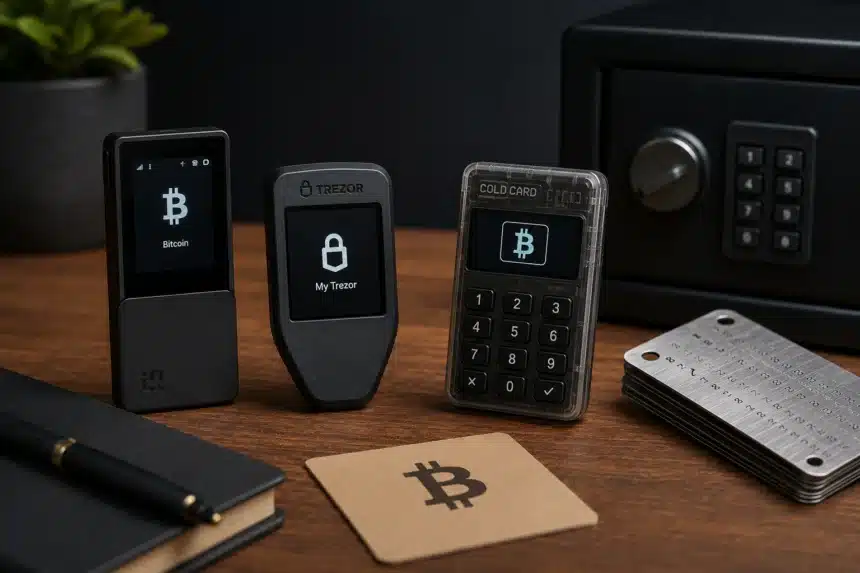
Self custody typically involves storing private keys on a hardware wallet like a Ledger Nano X or a Trezor Model T, or through more advanced multisignature (multisig) solutions. These devices keep your private keys isolated from internet connected computers, significantly reducing the risk of online theft. The user is responsible for safeguarding a seed phrase, a sequence of 12 or 24 words that can recover their wallet.
The shift from exchange custody to self custody is a philosophical one. It represents a rejection of the traditional financial system’s reliance on intermediaries and an embrace of individual sovereignty over one’s wealth. This control extends beyond mere security, offering unparalleled privacy and the freedom to transact without permission, a core tenet of the Bitcoin network.
The Risks of Trusting a Third Party
History is replete with examples of centralized exchanges failing, often with catastrophic consequences for their users. The most infamous case remains the FTX collapse in November 2022, where an estimated $8 billion in customer funds vanished due to mismanagement and alleged fraud. Users who trusted FTX with their bitcoin found their assets inaccessible, becoming unsecured creditors in a lengthy bankruptcy process.
Prior to FTX, the Mt. Gox exchange suffered a devastating hack in 2014, losing approximately 850,000 BTC, which at the time represented a significant portion of all bitcoin in circulation. More recently, incidents like the Bitfinex hack in 2016 (120,000 BTC stolen) and the Binance hack in 2019 (7,000 BTC stolen) demonstrate that even large, well funded exchanges are not immune to sophisticated cyberattacks.
Beyond hacks and insolvency, users face counterparty risk from regulatory actions. Governments can compel exchanges to freeze accounts, restrict withdrawals, or share user data. This power dynamic directly contradicts the decentralized ethos of bitcoin. For instance, during periods of geopolitical tension, accounts linked to certain regions or individuals have been blocked, highlighting the vulnerability of exchange held funds.
The Burdens of Self Custody: Responsibility and Complexity
While self custody grants ultimate control, it also places the entire burden of security squarely on the individual. The responsibility of safeguarding a seed phrase is paramount. Losing this phrase, or having it compromised, means permanent loss of funds, with no customer support line to call. This level of responsibility can be daunting, particularly for those new to digital assets.
Securely storing a seed phrase often involves physical backups, such as engraving it on metal or storing it in a fireproof safe, away from digital vulnerabilities. However, this introduces new risks: physical theft, fire, flood, or simply misplacement. The complexity of setting up and using hardware wallets, understanding transaction fees, and verifying addresses can also be a barrier for less technically inclined individuals.
Inheritance planning for self custodied bitcoin presents a unique challenge. Unlike traditional assets with established legal frameworks, passing on digital wealth requires careful foresight. Without a clear, secure, and accessible plan, heirs may find themselves unable to access funds after the owner’s passing, effectively locking away the bitcoin forever. Solutions like multi signature schemes with trusted beneficiaries or specialized inheritance services are emerging but add layers of complexity.
A Decision Framework for Bitcoin Holders
The optimal choice between bitcoin self custody and exchange custody depends heavily on individual circumstances, technical proficiency, and the amount of bitcoin held. There is no one size fits all answer, but a structured approach can guide the decision.
For very small amounts, perhaps under $1,000, that are primarily used for speculative trading or casual experimentation, exchange custody might be acceptable due to its convenience. The risk of loss, while present, is proportionally lower to the individual’s overall wealth. However, even for these amounts, the principle of self custody is a valuable lesson to learn early.
For medium amounts, ranging from $1,000 to $10,000, a hybrid approach is often advisable. Keep a small portion on an exchange for liquidity and trading, but move the majority to a hardware wallet. This balances accessibility with enhanced security. As holdings grow, the percentage held in self custody should increase significantly.
For any substantial amount of bitcoin, typically over $10,000, self custody becomes non negotiable. The potential for catastrophic loss from exchange failure far outweighs the inconvenience of managing private keys. For very large sums, exploring advanced multi signature solutions, which require multiple keys to authorize a transaction, adds an extra layer of security against single points of failure.
Ultimately, the decision rests on a personal risk assessment. Those prioritizing ease of use and immediate access might tolerate higher counterparty risk. Those prioritizing absolute control and censorship resistance will embrace the responsibilities of self custody. Education and a clear understanding of the technology are crucial for making an informed choice, regardless of the amount involved.
The TCB View
TCB believes that for any significant bitcoin holding, self custody is non negotiable. The shadow of FTX’s $8 billion collapse looms large, proving that even seemingly robust centralized exchanges carry unacceptable counterparty risk. Those who prioritize convenience over fundamental ownership principles risk losing everything, while those who master seed phrase management protect their wealth from both external threats and centralized failures. We see the current low adoption rate of self custody, at only 28% according to The Block Research, as a significant vulnerability for the broader crypto ecosystem. Watch for the emergence of clearer, legally sound inheritance solutions for digital assets as a key indicator of maturation in the self custody ecosystem, making this critical practice more accessible to a wider audience.