
Last updated: 27 June 2026
Bitcoin turned lower
Key Highlights
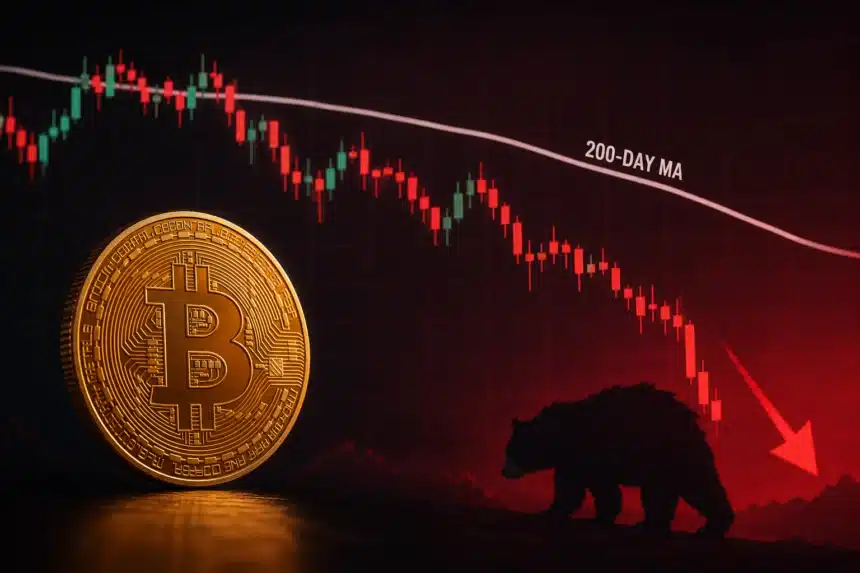
- Bitcoin’s price turned lower from its 200-day moving average, a key level around $82,400, after failing to break above it.
- The current bitcoin price is $77,955.00, representing a 1.55% increase over the past 24 hours.
- The fear and greed index is currently at 29/100, indicating a state of fear in the market, with bitcoin’s block height at 950,334 and a difficulty of 1.37e+14.
Here’s why bitcoin turned lower from the 200-day average, a significant level that analysts consider a barometer of long term trends. The focus keyword “here’s bitcoin turned lower” is particularly relevant in this context, as it highlights the importance of understanding the factors driving bitcoin’s price movements. With bitcoin currently trading near $77,900, its failure to break above the 200-day moving average has significant implications for the market.
Background
The 200-day moving average is a widely watched indicator that helps analysts gauge the long term trend of an asset. In the case of bitcoin, this level has proven to be a crucial test of the market’s sentiment. When bitcoin fails to break above this level, it can indicate a lack of conviction among buyers, leading to a decline in price.
According to market data, bitcoin’s price has been struggling to break above the $82,400 level, which is seen as a key resistance point. The fact that the price turned lower from this level suggests that the market is not yet ready to push higher, and that the bears are still in control.
Market Analysis
The current market conditions are characterized by a state of fear, with the fear and greed index at 29/100. This indicates that investors are cautious and risk averse, which can contribute to a decline in bitcoin’s price. The low fear and greed index also suggests that the market is not yet oversold, which could lead to further declines if the price continues to turn lower.
The bitcoin network’s block height and difficulty are also important metrics to watch. The current block height of 950,334 and difficulty of 1.37e+14 indicate that the network is still functioning smoothly, but the price decline may be a sign of underlying issues.
Technical Indicators
From a technical perspective, the failure to break above the 200-day moving average is a bearish sign. The fact that the price turned lower from this level suggests that the bulls are not strong enough to push the price higher, and that the bears are gaining control. The relative strength index (RSI) and moving average convergence divergence (MACD) are also important indicators to watch, as they can provide insights into the market’s momentum and trend.
The current RSI and MACD readings are not available, but the fact that the price turned lower from the 200-day moving average suggests that the momentum is bearish. The MACD is a particularly important indicator, as it can help identify trends and predict future price movements.
Market Implications
The implications of bitcoin’s price turning lower from the 200-day average are significant. If the price continues to decline, it could lead to a further decline in investor confidence, which could have a ripple effect on the entire cryptocurrency market. The fact that the fear and greed index is already at 29/100 suggests that investors are cautious, and a further decline in price could exacerbate this fear.
The current market trends, including the rise of Hyperliquid (HYPE), Pudgy Penguins (PENGU), and Nexus (NEX), may also be affected by bitcoin’s price decline. If the price continues to turn lower, it could lead to a decline in investor interest in these alternative cryptocurrencies, which could have significant implications for the market as a whole.
The TCB View
TCB believes that the current decline in bitcoin’s price is a bearish sign, and that the failure to break above the 200-day moving average is a significant indicator of the market’s sentiment. We see the current fear and greed index of 29/100 as a sign that investors are cautious, and that the market is not yet ready to push higher. The real losers in this scenario are the long term investors who are holding onto their bitcoin, as the decline in price could lead to significant losses. Watch for the next quarterly filing for updated bitcoin holdings, as this will be a key indicator of the market’s trend. TCB is bearish on the current market conditions, and we expect the price to continue to decline in the short term.