Last updated: 27 June 2026
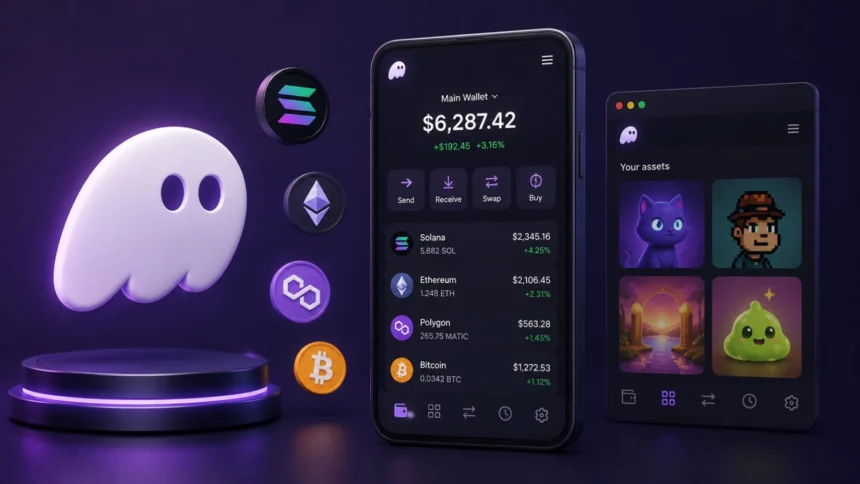
Phantom is the dominant wallet for Solana and one of the cleanest multi-chain wallet experiences available today. It started as a Solana-only browser extension in 2021 and has since added Ethereum, Polygon, and Bitcoin support while keeping the user experience significantly simpler than most competitors. For anyone active in Solana DeFi, Phantom is the default starting point.
Key Highlights
- Native Solana wallet with the deepest integration across Solana DeFi and NFT protocols
- Multi-chain: Ethereum, Polygon, and Bitcoin now supported alongside Solana
- Built-in token swap powered by Jupiter for best execution on Solana
- Phishing detection: warns users before connecting to known malicious sites
- NFT gallery with spam filter that hides unsolicited token airdrops
- Available as browser extension and iOS and Android mobile app
The Verdict
Phantom is the right wallet for Solana users and anyone who wants the cleanest possible DeFi interface across Solana and EVM chains. The UI quality is noticeably better than MetaMask for non-technical users. Hardware wallet support is more limited than MetaMask. For multi-chain power users who need deep Ethereum L2 support, MetaMask remains more flexible. For Solana-primary users, Phantom is the clear choice.
User Interface and Onboarding
Phantom’s onboarding is faster and cleaner than any competing multi-chain wallet. The extension installation takes under two minutes. The account creation process surfaces key security steps clearly without the confusing UX patterns common to older wallet designs. The portfolio view shows token balances, NFTs, and transaction history in a single clean screen. Price data, recent activity, and sending functions are accessible in two taps from the main screen.
Built-In Swap
Phantom integrates Jupiter as its Solana swap router, which means swap execution routes through the same aggregation logic that powers the leading standalone aggregator. For Solana, this is the optimal setup. For Ethereum swaps via Phantom, the aggregation uses 0x protocol. Phantom charges a 0.85% protocol fee on swaps. This is transparent and reasonable for users who want simplicity. Active traders who prioritize maximum savings on swap fees should use Jupiter directly for Solana and Uniswap via MetaMask for Ethereum.
Security Architecture
Phantom is a noncustodial wallet: your private keys are encrypted and stored locally in your browser or device. Phantom does not have access to your keys. The wallet uses industry-standard key derivation and encrypts the stored key with your password using AES-256. The phishing protection feature maintains a blocklist of known malicious dApps and warns users before connecting, a meaningfully valuable feature in an ecosystem where phishing is a primary attack vector. The NFT spam filter automatically hides tokens sent to your wallet by unknown parties, reducing the risk of clicking malicious NFT links. Always verify you are on the official phantom.app domain before installing.
Multi-Chain Support
Phantom added Ethereum and Polygon support in 2023, followed by Bitcoin in 2024. The multi-chain expansion works well for users who want a single interface for their Solana and Ethereum activity. The Ethereum integration is functional but does not have the same depth as the native Solana experience. Hardware wallet pairing on the Ethereum side is more limited than MetaMask, which supports Ledger and Trezor natively across all EVM chains. Phantom supports Ledger on Solana but EVM hardware wallet support is still limited.
Staking and DeFi Access
Phantom lets you stake SOL directly from the wallet to any validator without leaving the interface. Native staking from inside the wallet, with validator selection and reward tracking, is one of the strongest wallet-native staking experiences available. The dApp browser connects to the full Solana DeFi ecosystem including Marinade, Orca, Raydium, and Drift Protocol. The NFT management is built for the Metaplex standard with collection grouping and floor price display.
Phantom vs MetaMask
For Solana, Phantom wins on every dimension: deeper protocol support, better UI, native staking, and more reliable dApp connectivity. For Ethereum and L2s, MetaMask wins on flexibility, hardware wallet support depth, and the size of the ecosystem that has been built specifically for MetaMask compatibility. Most Solana-primary users should use Phantom. Most Ethereum-primary users should use MetaMask. Users who are active on both chains regularly may want both installed.
The TCB View
Phantom set the standard for what a consumer crypto wallet should feel like. The design decisions, phishing protection, and spam filter show a team that has thought carefully about real attack vectors rather than just feature lists. The multi-chain expansion has been executed well without degrading the Solana experience. The swap fee at 0.85% is fair. The main gap relative to MetaMask is hardware wallet depth on EVM, which matters more as positions grow larger. For most Solana ecosystem users in 2026, Phantom is the right starting point.