
Last updated: 27 June 2026
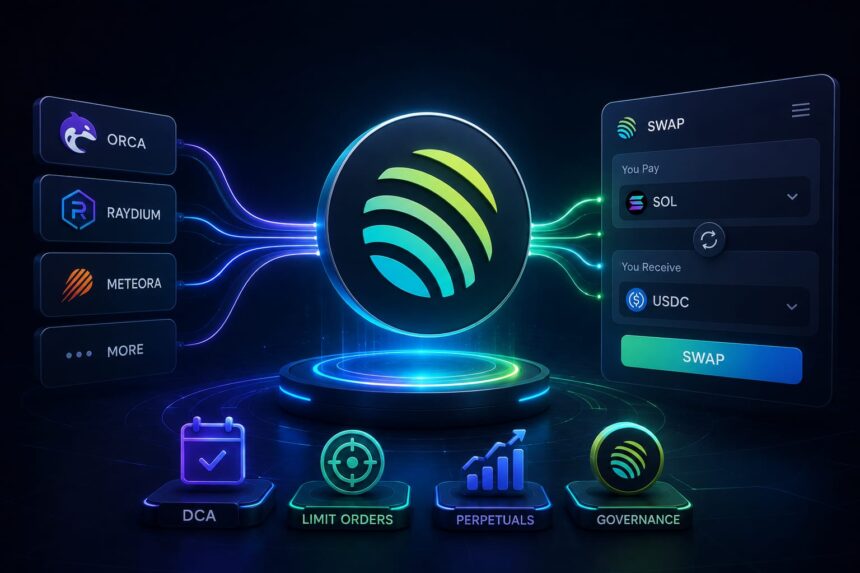
Jupiter is the default starting point for any token swap on Solana. It routes every trade across every major Solana DEX simultaneously: Orca, Raydium, Meteora, and others, then splits the order across the most efficient paths to get the best combined output. For traders who use a single DEX directly, Jupiter consistently delivers better prices for the same swap. The difference compounds over time.
Key Highlights
- Routes swaps across all major Solana liquidity sources for best price execution
- Dollar cost averaging: automate recurring buys at set intervals and amounts
- Limit orders: set a target price and Jupiter executes automatically when reached
- Perpetual trading: leveraged long and short positions on SOL, BTC, and ETH
- JUP governance token with active DAO, regular airdrop rounds, and token buybacks
- Integrated directly into Phantom Wallet swap function as the default router
The Verdict
Jupiter is the right aggregator for any Solana user who wants consistent best execution on swaps. The DCA and limit order tools add meaningful functionality for investors who want to automate their accumulation strategy. The perpetuals platform is competitive for Solana leverage traders. No Solana trader should be using a single DEX directly when Jupiter routes across all of them at no additional cost.
Swap Routing
Jupiter’s routing engine evaluates thousands of possible paths for each swap: direct routes, two-hop routes, three-hop routes, and split routes where part of the order goes through one path and the rest through another. For any given input token and output token, Jupiter finds the combination that maximizes the output amount. For small trades on liquid pairs like SOL to USDC, the routing difference versus a direct Raydium or Orca swap is minimal. For larger trades or less liquid tokens, Jupiter’s routing can deliver significantly better execution than any single venue.
The engine runs off-chain for speed but executes the swap on-chain. There is no centralized custody at any point. You approve the transaction in your wallet, which executes the route Jupiter calculated. If the price moves more than your configured slippage tolerance before execution, the transaction reverts and you pay only the failed transaction fee (under $0.01 on Solana).
Dollar Cost Averaging
Jupiter’s DCA tool lets you set automated recurring buys: for example, buy $100 of SOL every Monday using USDC from your wallet. The tool executes the swap from your connected wallet on the configured schedule. You keep custody of all funds between executions. The DCA feature is genuinely useful for investors who want to accumulate Solana ecosystem tokens systematically without managing timing. It is simpler and more reliable than equivalent tools on most centralized exchanges.
Limit Orders
Jupiter limit orders work by depositing your input token into a program account. A keeper network monitors prices across Solana DEXs and executes the swap automatically when the target price is reached. Execution is not guaranteed if liquidity is insufficient at the target price when the order triggers. Unfilled orders can be cancelled to retrieve your deposited tokens. For anyone actively trading Solana tokens, limit orders replace the need to monitor prices manually for entry points.
JUP Token and Governance
JUP is the Jupiter governance token. The DAO votes on protocol fees, product development priorities, and the allocation of the Jupiter DAO treasury. Token buybacks from protocol revenue occur regularly, creating consistent buy pressure on JUP from the protocol itself. Jupiter has distributed tokens through multiple airdrop rounds targeting active platform users, incentivizing continued usage. AAVE stakers and LPs who are already active in Solana DeFi consistently appear among the top JUP airdrop recipients due to their frequent swap activity.
Perpetuals Platform
Jupiter Perps offers leveraged long and short positions on SOL, BTC, and ETH using liquidity from the JLP pool. Maximum leverage is 100x. Funding rates adjust based on market imbalance between longs and shorts. The liquidation engine is on-chain. JLP pool providers earn funding fees and trading losses from leveraged traders. The perpetuals product competes with Bybit and GMX for Solana-based leverage trading. It is the most accessible on-chain perp platform for Solana users who prefer noncustodial trading.
The TCB View
Jupiter’s routing engine delivers real value for every swap it processes. The best execution mandate is not marketing: the algorithmic routing genuinely outperforms single-venue swaps at scale. The product suite, including DCA, limit orders, and perps, has expanded Jupiter from an aggregator into the most complete Solana DeFi interface available. The JUP token governance and buyback program align incentives between the protocol and its users. In 2026, no Solana user who cares about execution quality should swap through anything other than Jupiter.