
Last updated: 3 July 2026
The cryptocurrency market recently shed an estimated $21.49 billion from its total capitalization. This represented a 0.9 percent decline across digital assets within a single observation period. Such shifts highlight persistent volatility, a core feature of a community where derivative products like perpetual futures play a dominant role in price action and speculation. (via CoinGecko)
Key Highlights
- Crypto market valuation fell by an approximate $21.49 billion, according to recent market data.
- This decline translates to a 0.9 percent reduction in overall market capitalization.
- Perpetual futures contracts are a cornerstone of crypto trading, offering leveraged exposure without an expiry date.
- The funding rate mechanism is critical for balancing perpetual contract prices with underlying spot prices.
- Mark price and liquidation engines are fundamental risk management tools preventing market manipulation and enforcing margin requirements.
The Perpetual Futures industry
Perpetual futures contracts have become a defining feature of the cryptocurrency derivatives market. Unlike traditional futures that possess a fixed expiration, these instruments allow traders to maintain leveraged positions indefinitely. Their popularity stems from the flexibility they offer, enabling aggressive speculation or sophisticated hedging strategies against spot market holdings.
that said, this flexibility comes with natural risks. Rapid market movements, such as the recent $21.49 billion contraction, directly impact the profitability and solvency of these leveraged positions. Traders must maintain sufficient margin to cover potential losses; failure to do so can lead to swift and often brutal liquidations. It’s a high stakes environment.
Platforms like Binance, Bybit, and OKX enable trillions in perpetual futures trading volume annually. These contracts are instrumental in global price discovery for major assets like Bitcoin and Ethereum. They also offer a way for institutions and professional traders to express complex views on market direction, or to manage their existing exposure without directly moving large amounts of underlying assets.
Understanding the Funding Rate Mechanism
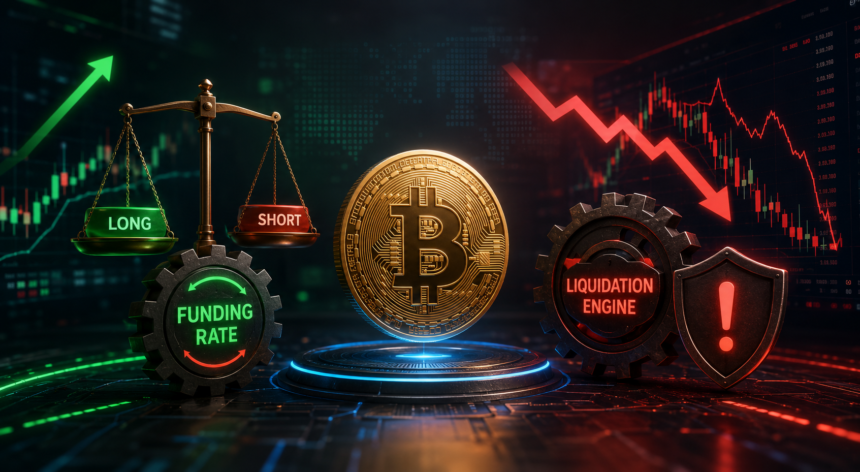
A unique aspect of perpetual futures is the funding rate. This is a small payment exchanged between holders of long and short positions at regular intervals, typically every eight hours. Its primary purpose is to tether the perpetual contract’s price to the underlying spot price of the asset, preventing large and sustained divergences.
When the perpetual contract trades above the spot price, indicating higher demand for long positions, the funding rate usually turns positive. In this scenario, long position holders pay short position holders. Conversely, if the contract trades below the spot price, suggesting more demand for shorts, the funding rate becomes negative, and short position holders pay long position holders. This continuous payment system acts as an arbitrage incentive, driving the contract price back toward equilibrium with the spot market.
Market conditions, like the recent 0.9 percent market drop, can heavily influence funding rates. A significant downturn might cause sustained negative funding rates as traders heavily short the market, betting on further declines. This mechanism is a vital real time indicator of market sentiment, offering insights into whether longs or shorts are dominating current positions and paying the price for it. It’s a powerful tool.
Mark Price and the Liquidation Engine
Central to risk management in perpetual futures trading are the mark price and the liquidation engine. The mark price is a calculated value, distinct from the last traded price. Exchanges derive it using a combination of the asset’s spot price across multiple exchanges (an index price) and a moving average of the contract’s actual trading price. This prevents manipulation by preventing a single large order from artificially affecting the price used to calculate margin and trigger liquidations.
The liquidation engine is an automated system designed to close a trader’s position when their margin balance falls below a predefined maintenance margin threshold. This typically occurs when losses on a leveraged position erode the initial capital. The mark price is the definitive trigger for these events. If the mark price moves against a trader’s position to a point where their margin is insufficient, the liquidation engine steps in immediately.
Liquidations are swift and automatic, preventing a trader’s losses from exceeding their initial margin and protecting the solvency of the exchange and other traders. These cascades of forced selling during periods of high volatility can contribute to market instability and accelerate price declines. Understanding margin levels and the potential for liquidation is central for any trader. Our analysis, often mirrored in metrics like the TCB MINER STRESS SCORE, suggests that these events become more prevalent during sustained periods of market uncertainty.
Market Reactions and Trader Risk
When the cryptocurrency market experiences a contraction like the recent $21.49 billion reduction, the mechanisms of perpetual futures are put to the ultimate test. Traders using high leverage can see their positions wiped out quickly as the mark price triggers their liquidation points. This amplifies downward pressure in the market, creating feedback loops where liquidations lead to further price drops, and subsequent liquidations.
The average trader needs to comprehend these built in risks. While perpetual futures offer opportunities for significant gains due to leverage, they also expose traders to substantial and rapid losses. Many don’t fully grasp the speed at which their capital can evaporate. Careful risk management, including proper position sizing and stop loss orders, is indispensable.
Market wide sentiment and fundamental shifts often show up first in derivatives markets. For instance, an improving TCB MINER STRESS SCORE might signal underlying strength, potentially influencing funding rates and trading volumes in perpetuals. Observing these interconnected dynamics provides a fuller picture of the crypto economy’s health.
Frequently Asked Questions (FAQs)
what are perpetual futures in crypto
Perpetual futures are a type of derivative contract in cryptocurrency that allows traders to hold leveraged positions without an expiration date. They are a defining feature of the crypto derivatives market, enabling both speculation and hedging strategies.
how much did the crypto market drop recently
The cryptocurrency market recently experienced a decline of approximately $21.49 billion from its total capitalization. This represented a 0.9 percent reduction in overall market capitalization within a single observation period.
what is a funding rate in perpetual futures
The funding rate mechanism is a crucial component of perpetual futures contracts. Its purpose is to help keep the price of the perpetual contract aligned with the price of the underlying asset in the spot market.
why are perpetual futures popular in crypto
Perpetual futures are popular in crypto because they offer traders significant flexibility, allowing them to maintain leveraged positions indefinitely. This makes them useful for aggressive speculation or for sophisticated strategies to hedge against holdings in the spot market.
The TCB View
Our read: Market dips consistently expose the strengths and weaknesses of derivatives platforms and their users. The recent $21.49 billion decline, while modest in percentage terms, stresses system components. A concrete risk is that retail traders, chasing high leverage without fully grasping funding rates and liquidation triggers, face devastating and swift capital loss. The opportunity lies with sophisticated participants who can hedge their portfolios or profit from accurately predicting shifts in funding rate sentiment. The signal to track: prolonged shifts in funding rates across major exchanges often precede or accompany significant price movements.