
Last updated: 3 July 2026
Decentralized finance (DeFi) liquidity pools, the foundational technology enabling widespread token swaps across Web3, held more than $70 billion in total value locked during the final quarter of 2023. These autonomous pools allow users to exchange digital assets without the need for traditional intermediaries or centralized order books.
This significant capital accumulation within self executing contracts signals a growing confidence and utility in the decentralized financial market. It reflects a maturing market where capital finds productive use directly on blockchain networks.
Key Highlights
- Total Value Locked (TVL) in DeFi liquidity pools exceeded $70 billion.
- This significant capital milestone was reached in the fourth quarter of 2023.
- Liquidity pools are essential for allowing decentralized exchange and price discovery for digital assets.
- Participants, known as liquidity providers, deposit token pairs into these pools and earn a share of trading fees.
- The operational backbone of these pools relies on sophisticated automated market maker algorithms.
Understanding What Are Liquidity Pools DeFi
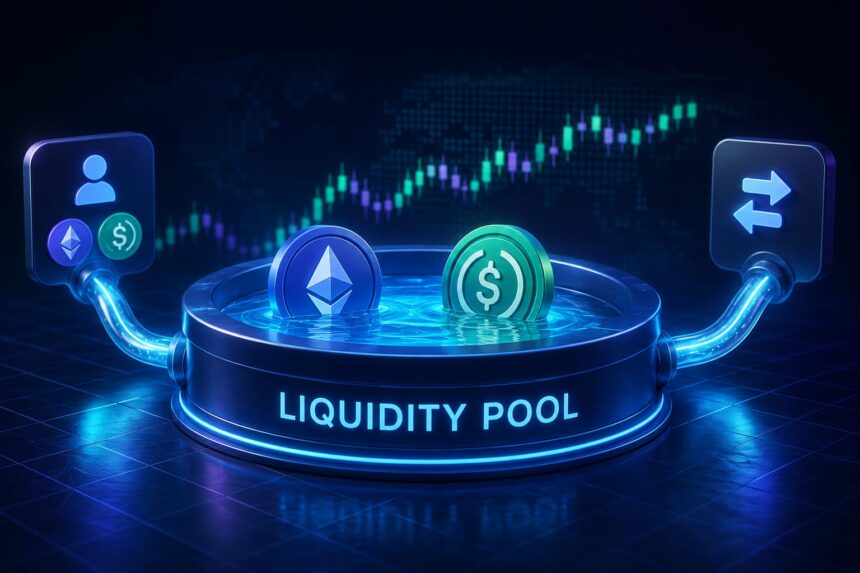
Liquidity pools represent collections of funds locked in smart contracts, designed specifically to enable decentralized trading. Think of them not as a company or an institution, but as a self governing reservoir of tokens.
These pools allow users to swap one cryptocurrency for another directly through a protocol, bypassing the traditional buy and sell orders found on centralized exchanges. This direct peer to contract interaction is a cornerstone of the DeFi movement.
Unlike conventional markets where buyers and sellers are matched by an order book, decentralized liquidity pools operate differently. There’s no person in the middle, no central server matching requests. Instead, these pools use mathematical formulas within smart contracts to determine asset prices based on the ratio of tokens held within them. This revolutionary approach enables constant, permissionless trading, often with minimal slippage on highly liquid pairs.
The primary purpose of a liquidity pool is to ensure sufficient capital exists for efficient asset swaps within the decentralized industry. Without these pools, trading tokens on a decentralized exchange would be slow, expensive, or even impossible. They effectively create an always available market, reducing the friction and capital requirements traditionally associated with market making. This infrastructure has become indispensable for countless DeFi applications, from lending protocols to yield aggregators.
The Mechanics Behind Decentralized Liquidity
The operational core of nearly every liquidity pool is an Automated Market Maker, or AMM. An AMM is simply an algorithm, a set of rules encoded into a smart contract, that manages the tokens within the pool and determines the price of assets.
The simplest and most widely used AMM model is the constant product formula, often expressed as X * Y = K, where X and Y represent the quantities of two different tokens in the pool, and K is a constant value that remains unchanged throughout transactions.
Individuals or entities who provide tokens to these pools are known as liquidity providers, or LPs. An LP typically deposits an equivalent value of two different tokens into a pool, for example, 50 percent Ether and 50 percent a stablecoin like USDC.
In return for supplying this capital, LPs receive a small share of the trading fees generated by the pool. This incentive structure encourages participants to lock up their assets, thereby contributing to the overall liquidity of the decentralized exchange.
When a trader wants to swap Token X for Token Y, they send Token X to the pool. The AMM algorithm then calculates how much of Token Y the trader will receive, ensuring the product X * Y = K remains constant.
If a trader buys Token Y, the supply of Y in the pool decreases, and the supply of X increases. This shift in the token ratio causes the price of Token Y to rise relative to Token X within that specific pool. The process is elegant and entirely automated.
that said, providing liquidity isn’t without its complexities. One significant risk for LPs is “impermanent loss.” This phenomenon occurs when the price of an asset deposited into a liquidity pool diverges from its price outside the pool.
If, for instance, Ether dramatically increases in value against USDC, a LP might have been better off simply holding their Ether outside the pool rather than providing it.
The loss is termed “impermanent” because it only becomes realized upon withdrawal from the pool, and the asset prices could theoretically converge again. Understanding this risk is crucial for any potential liquidity provider.
Beyond the basic constant product model, AMM technology has evolved sharply. Newer designs, such as concentrated liquidity pools pioneered by platforms like Uniswap V3, allow LPs to allocate their capital within specific price ranges.
This innovation drastically improves capital efficiency for providers and can reduce price slippage for traders by making liquidity deeper where it’s most needed. Other specialized AMMs, like those employed by Curve Finance, are optimized for stablecoin swaps, minimizing slippage on assets that are designed to maintain a pegged value.
These advancements illustrate the rapid pace of innovation within the DeFi sector, constantly seeking to improve upon initial designs.
Growth Drivers, Market Significance, and the $70 Billion Milestone
The surpassing of $70 billion in total value locked within DeFi liquidity pools during the fourth quarter of 2023 is far more than a simple numerical achievement. It’s a powerful indicator of the growing trust, utility, and capital efficiency of decentralized finance as a whole. This figure represents tangible capital that has flowed into the Web3 industry, committed to helping trading and supporting the broader network.
This growth isn’t accidental; it’s fueled by several key drivers. An increasing global user base engaging with DeFi applications contributes meaningfully. More individuals and institutions are exploring the benefits of transparent, permissionless financial services. And the development of increasingly sophisticated DeFi protocols, offering innovative lending, borrowing, and yield generation strategies, has created greater demand for strong underlying liquidity. The capital is finding productive homes.
From an economic standpoint, deeper liquidity pools are inherently beneficial for all market participants. High liquidity translates to less price slippage for traders, especially for larger transactions. This attracts even more trading volume to decentralized exchanges, creating a virtuous cycle where more liquidity brings more traders, and more traders bring more fees for LPs.
The efficiency gains delivered by these systems are profoundly impacting digital asset markets, making them more accessible and equitable.
The versatility of liquidity pools also drives innovation. They enable the creation of new financial primitives that were previously impossible or impractical in traditional finance. Stablecoin pools provide reliable exchange rates for assets pegged to fiat currencies, crucial for managing volatility. Wrapped asset pools allow native tokens from one blockchain to be used on another.
Synthetic asset pools offer exposure to real world assets without owning them directly. All these developments build upon the fundamental infrastructure that liquidity pools provide, building an explosion of financial engineering within the decentralized realm.
Risks, Rewards, and Participant Incentives
For individuals considering becoming liquidity providers, understanding both the rewards and natural risks is most important. The primary incentive for LPs is the opportunity to earn passive income through a share of the trading fees generated by the pool.
Every time someone swaps tokens using the pool, a small transaction fee is charged, and a portion of that fee is distributed proportionally to all liquidity providers. This can offer an attractive yield, particularly in high volume pools.
but the risks extend beyond impermanent loss. Smart contract risk is a major concern. Because liquidity pools are governed by self executing code, any vulnerabilities or bugs in that code can lead to significant financial losses for LPs. History has seen numerous instances of exploits and hacks targeting DeFi protocols, highlighting the importance of thorough security audits and vigilance from participants. Newer projects carry inherently higher smart contract risk.
Another significant risk category relates to the underlying assets themselves. If one of the tokens in a liquidity pool experiences a severe price crash or even becomes worthless, the LP’s position can be heavily impacted. This “rug pull” scenario is particularly relevant for liquidity providers in pools containing tokens from unproven or anonymous projects. Research into the outfit team, its tokenomics, and its community is essential before committing capital.
Despite these challenges, the allure of accessible yield continues to draw capital into liquidity pools. The entire system is built on these participant incentives. As the DeFi community matures, there’s increasing focus on mitigating these risks through advanced AMM designs, insurance protocols, and clearer regulatory frameworks. But the onus remains on individual participants to perform their due diligence and assess the risk return profile specific to their investments.
Frequently Asked Questions (FAQs)
what are liquidity pools in defi
Liquidity pools are collections of digital funds locked in smart contracts that enable decentralized trading of cryptocurrencies. They act as self governing reservoirs of tokens, allowing users to swap one digital asset for another without needing traditional intermediaries.
how much money is in defi liquidity pools
During the final quarter of 2023, decentralized finance liquidity pools held over $70 billion in total value locked. This significant capital accumulation shows growing confidence and utility in the decentralized financial market.
how do liquidity pools work
Liquidity pools allow users to exchange digital assets directly on blockchain networks, powered by sophisticated automated market maker algorithms. Participants, known as liquidity providers, deposit token pairs into these pools and earn a share of trading fees.
why are liquidity pools important for web3
Liquidity pools are foundational technology for Web3 because they enable widespread token swaps and decentralized exchange. They are essential for price discovery for digital assets and reflect a maturing market where capital finds productive use directly on blockchain networks.
The TCB View
Our read: The $70 billion in Total Value Locked within DeFi liquidity pools during Q4 2023 is a clear milestone in the maturation of decentralized finance. It’s no longer just an experimental niche; it’s a functioning, capital rich sector. The immediate risk for participants remains impermanent loss, which continues to challenge even experienced liquidity providers by eroding gains if not properly managed.
Conversely, the profound opportunity lies in the permissionless, transparent financial infrastructure these pools offer, creating global access to liquidity and price discovery without traditional gatekeepers. The signal to track: the continuing evolution of automated market maker designs, specifically their ability to offer higher capital efficiency and more strong impermanent loss mitigation.