
Last updated: 21 July 2026
Allora launched its full mainnet and ALLO token in November 2025. This step moved its decentralized artificial intelligence network from a long running testnet phase to live operations. The protocol now supports real time inference and model training through its distributed architecture, rewarding the models that deliver the most accurate predictions.
Key Highlights
- Allora’s mainnet officially went live in November 2025, enabling verifiable AI.
- The network lets participants offer compute resources for AI model training and inference tasks.
- It introduces a native token, which powers inacentives, staking, and protocol governance.
- The system aims to distribute artificial intelligence capabilities, moving away from centralized control.
- Users can now leverage a secure, open network for AI model development and execution.
What is Allora?
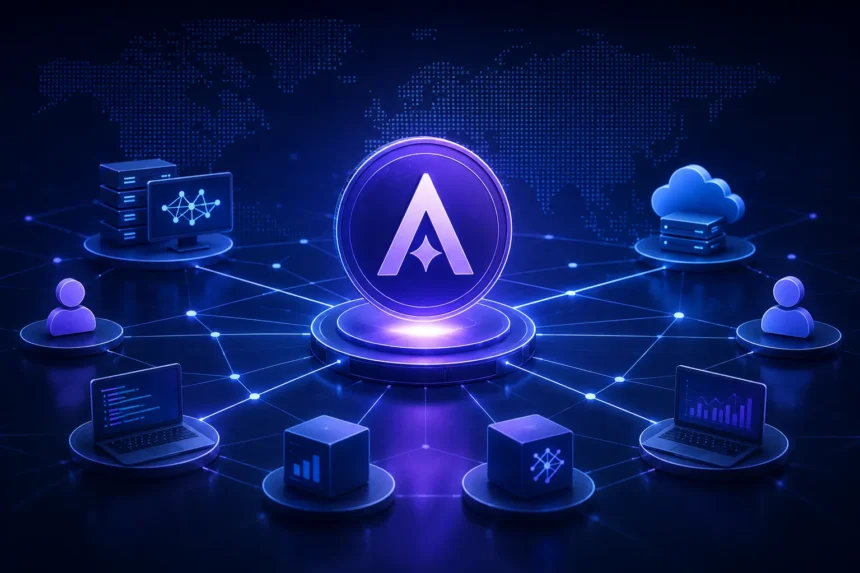
Allora functions as a peer to peer network designed for artificial intelligence. It connects those who need AI models with those who can provide the necessary compute power and expertise. Traditional AI development often relies on large, centralized cloud providers or proprietary data sets. Allora offers an alternative by spreading these functions across many independent participants.
This approach democratizes access to sophisticated AI, preventing any single entity from monopolizing its development or use. It allows smaller teams and individual researchers to contribute to and benefit from a collective intelligence. The core idea involves building a shared, verifiable AI layer.
Its architecture differentiates it from conventional AI operations. Instead of a single server farm training a model, hundreds or even thousands of independent nodes can contribute. This distributed approach provides greater resilience against outages and censorship. It’s a network built by many, for many.
Individual developers can deploy their models for training or inference, paying for resources as needed. Data scientists can access a diverse pool of computational power. This open model is a break from previous setups.
Participants, referred to as “Upsolvers” and “Inferers,” play specific roles within this new paradigm. Upsolvers are model trainers, providing expertise to improve AI models. Inferers, on the other hand, execute these trained models, providing answers to specific queries. Each role is crucial for network function.
How the Network Functions
Allora uses an unique design to coordinate AI tasks across its global network of participants. It blends blockchain technology with off chain compute. The blockchain layer handles coordination, incentives, and verification. Actual heavy lifting, like model training or complex inferences, happens off chain.
When an AI task is submitted to Allora, it’s broken down and assigned to available compute providers. These providers, also known as “Inferers,” run the AI models using their own hardware. The network then verifies the results. This system ensures both accuracy and fair compensation.
A native utility token drives the network’s economic activity. This token is used for payments for AI services, for staking to secure the network, and for participating in governance decisions. It’s how all transactions occur.
Staking mechanisms ensure good behavior. Participants offering compute or validating results must stake tokens. This bond can be slashed if they act maliciously or fail to deliver accurate work. It protects the network’s integrity.
The network supports various AI models, from predictive analytics to natural language processing. Its generalized design means it isn’t limited to a specific type of artificial intelligence. Any AI model can operate here.
Consensus on AI model outputs is vital. Allora employs a novel “peer prediction” mechanism. This system rewards participants who accurately predict the consensus outcome, without needing a ground truth answer every time. It’s a clever way to ensure quality.
Security measures protect both the data and the models. Cryptographic proofs and zero knowledge techniques ensure privacy and verifiability without revealing sensitive information. Users retain control of their data.
Developers submit requests, specifying their AI task requirements and desired outcome. The network automatically matches them with available resources and allocates the work. This automation simplifies AI deployment.
Incentives are carefully balanced to encourage participation and prevent centralization. The more compute power an Inferer provides, and the more accurate their results, the greater their reward. It’s a merit based system.
Mainnet Launch and Its Implications
The November 2025 mainnet launch marked a central moment for Allora. Before this, the network operated in testnet phases, where functionality was proven without real economic value at stake. Now, it processes live transactions and handles real world AI computations.
This transition means that tokens staked by participants carry real value, and payments for AI services are final. It introduces a genuine economic layer to the network. This move proves its readiness.
With the mainnet live, external developers can truly integrate their applications and services with Allora’s decentralized AI. This opens up a new frontier for innovation, enabling uses previously impossible. It’s now open for business.
The launch signifies that the core protocol is stable and secure enough for public use. Extensive testing preceded this moment. Developers tested for performance, stability, and security vulnerabilities. They worked hard on this.
Now, network activity and data generation begin in earnest. Metrics like transaction volume, number of active nodes, and AI model usage become verifiable public records. This transparency builds trust.
Users can expect improved performance and reliability as the network scales. More participants joining means more available compute, reducing latency and increasing processing capacity. Growth is key here.
The mainnet also brings decentralized governance into full effect. Token holders can now propose and vote on protocol upgrades, economic parameters, and future development directions. It’s community driven now.
This isn’t merely a technical release; it’s the establishment of a new economic layer for artificial intelligence. It offers a tangible alternative to the powerful centralized entities dominating AI. This is a big deal.
The launch represents years of development and planning coming to fruition. It wasn’t an overnight success. Dedicated teams worked tirelessly to bring this vision to life. They overcame many hurdles.
Building Decentralized AI Applications
For developers, the Allora mainnet provides a new canvas for creating artificial intelligence powered applications. They can tap into a global, distributed network of AI models and compute resources. It’s a versatile platform.
Consider a developer building a prediction market for real world events. Instead of relying on a single, potentially biased AI model, they can leverage Allora to query multiple independent models. This diversification improves accuracy.
Another application might involve privacy preserving AI for health data analysis. Data owners could allow their data to be used for training AI models without ever exposing the raw information. This protects sensitive details.
The system allows for competitive model training. Different Upsolvers can train versions of the same model. The network then identifies and rewards the best performing models based on verifiable metrics. It drives model quality.
Integration is designed to be straightforward. APIs and SDKs allow developers to connect their applications to Allora’s decentralized network with relative ease. They won’t need to rebuild everything.
Imagine a global AI powered content moderation system, free from a single company’s editorial biases. Allora could enable such a system, with community validated models enforcing agreed upon rules. This provides fairness.
The verifiable nature of AI on Allora is a major advantage. Users can have confidence that the AI outputs they receive haven’t been tampered with. Every step is traceable.
This turning point can lead to more equitable and transparent AI systems. It’s about distributing power, not concentrating it. This benefits everyone.
The potential for scientific research is enormous. Researchers can access vast compute resources for complex simulations or data analysis without institutional gatekeepers. It removes barriers.
The TCB View
Our read: Allora’s mainnet launch in November 2025 is more than a technical event; it’s a direct challenge to the current centralized control of artificial intelligence. The network aims to distribute AI’s power, allowing many more individuals and organizations to participate in its growth. This is an important step.
The question nobody’s asking: Can decentralized AI truly outcompete the billions of dollars and vast compute resources held by tech giants? While exciting, there’s a concrete risk that user adoption will be slower than anticipated, making it hard to attract a critical mass of participants. The network needs users.
that said, the opportunity is immense: a truly open, verifiable AI layer could disrupt existing monopolies and create entirely new markets for AI services. Its approach to verifiable, peer predicted outcomes offers an unique value proposition. This could change the game.
The signal to track: the number of unique Upsolvers and Inferers actively contributing to the network over the next two quarters. Their participation truly validates the team.