Last updated: 29 July 2026
Key Highlights
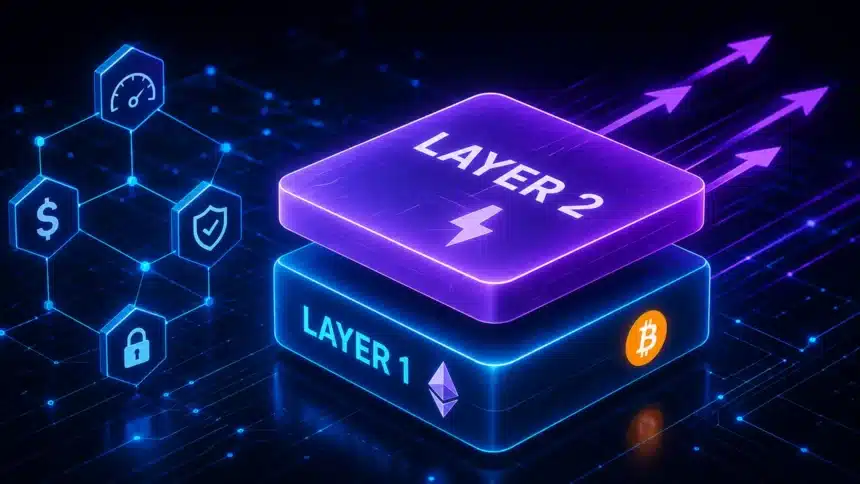
- Layer 2 networks are secondary protocols built on top of a base blockchain (Layer 1) that inherit its security while processing transactions faster and at lower cost.
- Ethereum’s Layer 2 ecosystem in 2026 includes Arbitrum, Optimism, Base, zkSync Era, Starknet, and Polygon zkEVM, collectively processing millions of transactions daily at fees measured in fractions of a cent.
- Two major rollup types dominate Ethereum scaling: optimistic rollups (assume transactions are valid, challenge period for fraud proofs) and zero knowledge rollups (mathematical proof of validity submitted with every batch).
- Bitcoin’s primary Layer 2 is the Lightning Network, a payment channel network for fast, cheap Bitcoin transfers, not general smart contracts.
- Ethereum Layer 2 TVL crossed $50 billion in 2026, with Arbitrum One consistently holding the largest share at approximately 40% of L2 TVL.
Layer 2 is one of the most important concepts in blockchain technology and one of the most misunderstood. It refers to a secondary protocol built on top of a base blockchain (called Layer 1) that inherits the security of the base layer while dramatically increasing transaction speed and reducing fees. Understanding why Layer 2 networks exist, how they work, and which ones matter in 2026 is essential for anyone interacting with the Ethereum or Bitcoin ecosystems.
Why Layer 1 Blockchains Need Scaling
Every transaction on a Layer 1 blockchain like Ethereum must be processed, validated, and stored by every node on the network. This global redundancy is what makes the network decentralized and secure: no single point of failure, no authority that can alter the record. The tradeoff is throughput. Ethereum processes approximately 15 to 30 transactions per second on its base layer. Gas fee spikes are the direct user facing symptom of this throughput limit. Bitcoin processes approximately 7. This is why miners earn fees on top of the block subsidy: congestion creates fee market pressure that rewards block production.
For comparison, Visa processes approximately 24,000 transactions per second at peak. A global financial system running entirely on Ethereum’s Layer 1 would be hopelessly congested. The 2021 NFT boom and DeFi summer proved this: Ethereum gas fees reached hundreds of dollars per transaction during peak congestion, pricing out ordinary users from the very network that was supposedly democratizing finance.
The blockchain trilemma frames this challenge: any blockchain must make tradeoffs between decentralization, security, and scalability. You can optimize for two but not all three simultaneously. Layer 2 solutions attack the scalability constraint without compromising Layer 1’s decentralization or security, by moving execution off chain while keeping settlement and finality on chain.
Rollups: How Ethereum Scales in 2026
The dominant Layer 2 architecture on Ethereum is the rollup. Most DeFi protocols now deploy on Layer 2 as their primary environment rather than Ethereum mainnet. A rollup executes transactions off chain, bundles hundreds or thousands of them into a single batch, and submits a compressed proof of that batch to the Ethereum mainnet. The Ethereum mainnet verifies the proof and records the final state. Individual transactions in the batch are never processed by every Ethereum node, but the net result is that anyone can verify the final state using Ethereum’s security guarantees.
The difference between the two major rollup types is how they prove the validity of off chain transactions.
Optimistic rollups (Arbitrum, Optimism, Base) assume all transactions are valid by default. They submit batches to Ethereum with no validity proof attached. There is a challenge window, typically seven days, during which any participant can submit a fraud proof if they detect an invalid transaction. If a fraud proof is verified, the invalid batch is rejected and the malicious sequencer is penalized. This approach is simpler to implement and compatible with the full Ethereum Virtual Machine, but the seven day withdrawal period for moving assets from Layer 2 back to Layer 1 is a significant user experience friction.
Zero knowledge rollups (zkSync Era, Starknet, Polygon zkEVM, Scroll) submit a cryptographic validity proof with every batch. A zero knowledge proof is a mathematical construct that proves the correctness of a computation without revealing the underlying data. The Ethereum smart contract on Layer 1 verifies the proof. If it is valid, the state transition is accepted immediately. This allows for near instant finality and withdrawals without a challenge period, but generating zero knowledge proofs is computationally intensive and achieving full EVM compatibility has taken years of engineering work.
The Major Ethereum Layer 2 Networks in 2026
Arbitrum One, developed by Offchain Labs, is the largest Ethereum Layer 2 by TVL and by on chain activity as of May 2026. It hosts a thriving DeFi ecosystem including GMX (perpetual DEX), Radiant (lending), and Camelot (DEX), along with deployments of major protocols like Aave, Uniswap, and Curve. Arbitrum’s governance is managed by the Arbitrum DAO, with ARB token holders voting on protocol decisions.
Optimism (now rebranded as OP Mainnet) is the second largest optimistic rollup. Its most significant contribution may not be its own network but the OP Stack: an open source framework for building rollups that Coinbase used to build Base, the most successful new Layer 2 launch of 2023. The Superchain vision envisions multiple OP Stack chains sharing security and sequencing infrastructure.
Base, launched by Coinbase in August 2023, grew faster than any previous Layer 2 in its first year. Coinbase’s existing 100+ million registered users provided an instant distribution advantage. By 2026, Base hosts significant consumer application activity, meme coin trading, and creator economy apps, differentiating itself from the DeFi heavy Arbitrum and Optimism ecosystems. Base’s centralized sequencer (Coinbase operated) is a decentralization concern that Coinbase has committed to progressively decentralizing.
zkSync Era, developed by Matter Labs, was the first general purpose EVM compatible zero knowledge rollup to reach mainnet. Its native account abstraction (allowing smart contracts to act as user wallets, enabling features like social recovery and gas less transactions) makes it technically distinctive. It hosts a growing ecosystem of DAO-governed DeFi and consumer apps.
Starknet, using StarkWare’s proprietary STARK proofs, takes a different approach: its native language (Cairo) is not directly EVM compatible, requiring developers to learn a new language but gaining the performance advantages of STARK’s proof system at scale. Starknet powers dYdX v4 and hosts a number of gaming and creator economy applications that benefit from its transaction cost profile at high volumes.
Bitcoin’s Layer 2: The Lightning Network
Bitcoin’s Layer 2 story is simpler and more focused. The dominant Layer 2 for Bitcoin is the Lightning Network, a payment channel network that allows unlimited instant Bitcoin payments between channel participants at fees of essentially zero, with only channel opening and closing transactions settling on the Bitcoin blockchain.
Lightning does not support smart contracts or DeFi applications. It does one thing: move Bitcoin fast and cheap for payments. This aligns with Bitcoin’s design philosophy of simplicity and focus. The Lightning Network has grown substantially since its 2018 mainnet launch and is now integrated into major payment apps including Strike and Cash App, with real world usage in El Salvador and growing merchant acceptance globally.
Other Bitcoin Layer 2 protocols have been developed to bring smart contract functionality to Bitcoin. Stacks uses a separate consensus mechanism anchored to Bitcoin for finality. RSK (Rootstock) is an EVM compatible sidechain pegged to Bitcoin. The Liquid Network is a federated sidechain for faster Bitcoin settlements among exchanges and businesses. None of these has achieved the adoption scale of Lightning, and all involve different security tradeoffs compared to the Bitcoin mainnet.
Gas Fees on Layer 2: The Numbers in 2026
The practical impact of Layer 2 adoption is visible in transaction costs. A simple ETH transfer on Ethereum mainnet costs approximately $2 to $8 in gas fees during normal network conditions in May 2026. The same transaction on Arbitrum costs approximately $0.01 to $0.05. On Base, costs are similarly in the fraction of a cent range.
The Ethereum Dencun upgrade in March 2024 introduced EIP-4844, which created a new data storage format (blobs) specifically for Layer 2 data. This reduced Layer 2 data costs by approximately 90% almost overnight. Post Dencun, Layer 2 fees became genuinely competitive with traditional payment processor fees for the first time, unlocking use cases like gaming micropayments, creator tipping, and high frequency DeFi strategies that were economically impractical before.
Each Bitcoin halving cycle has historically coincided with growing Layer 2 adoption as higher BTC prices draw new users to the broader ecosystem. The upcoming Ethereum Glamsterdam upgrade, scheduled for summer 2026, is expected to further increase Layer 1 throughput through parallel execution, which will reduce congestion and gas costs both on Layer 1 and for Layer 2 data submission.
Layer 2 Security: What Inheriting Ethereum Security Actually Means
The phrase “inherits Ethereum security” requires unpacking. For rollups, it means that the canonical state of the Layer 2 is settled on Ethereum. Even if the Layer 2 sequencer goes offline, users can withdraw their funds directly to Ethereum using the state proofs stored on mainnet. The security guarantee is that your funds cannot be stolen by a malicious sequencer, only delayed.
The actual security profile of a given Layer 2 depends on its implementation maturity. Most major rollups in 2026 still have training wheels: upgrade keys held by a multisig that can change the protocol without a governance vote, sequencer centralization in a single entity, and fraud or validity proof systems that are not fully permissionless. The industry term for the maturity level of a rollup’s decentralization is the “stage” framework developed by L2Beat, which rates rollups from Stage 0 (centralized training wheels) to Stage 2 (fully decentralized and permissionless).
As of May 2026, most major rollups are at Stage 1, meaning they have decentralized fraud or validity proofs but retain upgrade keys. Achieving Stage 2 requires removing or time locking upgrade keys and fully permissionless proving, steps that most teams are working toward but have not yet completed. Users who care about the full security model should check L2Beat’s current ratings for any Layer 2 they use.
The Multi Chain Future
The scaling narrative has shifted significantly since the early days of “one chain to rule them all.” The 2026 ecosystem is multi chain by necessity: different Layer 2 networks optimize for different use cases, attract different developer communities, and have different cost and speed profiles. Bridges between Layer 2 networks, cross chain messaging protocols like LayerZero and Chainlink. DeFi protocols that operate across multiple chains depend on this infrastructure for shared liquidity’s CCIP, and shared liquidity infrastructure are the connective tissue of this multi chain ecosystem.
The risk in a fragmented multi chain world is liquidity fragmentation: instead of deep liquidity pools on one network, the same total liquidity is spread thinner across many networks. The industry response has been to build cross chain aggregators, unified liquidity protocols, and intent based architectures where users specify outcomes rather than routes, with specialized solvers finding the optimal path across chains automatically.