
Last updated: 23 June 2026
Key Highlights
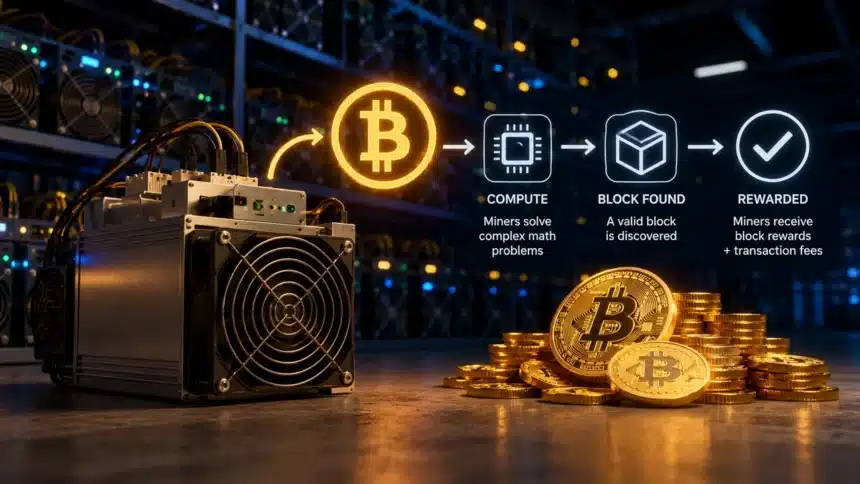
- Bitcoin mining is the process of validating transactions and adding new blocks to the blockchain using specialized hardware called ASICs.
- Miners earn revenue from two sources: newly minted Bitcoin (the block reward, currently 3.125 BTC) and transaction fees paid by users.
- As of May 2026, Bitcoin’s hash rate exceeds 820 exahashes per second, making the network more computationally powerful than ever.
- Mining profitability is directly tied to Bitcoin’s price, electricity cost, hardware efficiency, and the current network difficulty.
- The top three mining pools (Foundry USA, AntPool, and F2Pool) collectively control over 60% of hash rate, raising centralization concerns.
Bitcoin mining is the competitive process by which new transactions are verified and added to the Bitcoin blockchain, while simultaneously releasing new Bitcoin into circulation. Miners use purpose built hardware to solve a mathematical puzzle, and the first to solve it earns the right to add the next block and collect the reward. It is the engine that secures the network, processes payments, and issues new supply without any central authority.
Why Mining Exists: The Incentive Structure
Satoshi Nakamoto designed mining as the solution to a core coordination problem: how do thousands of independent computers that do not trust each other agree on one version of a financial ledger? The answer was to make the right behavior economically rewarding and the wrong behavior economically ruinous.
Miners invest in hardware and electricity. That cost is only recovered if they follow the rules and produce valid blocks. An invalid block is rejected by the network, earning the miner nothing. Trying to cheat the system is more expensive than cooperating. This is the core security model of Bitcoin: economic incentives replace institutional trust.
What ASIC Miners Are and How They Work
Application Specific Integrated Circuits, or ASICs, are chips engineered for one task only: computing the SHA-256 hash function as fast as possible. They are not general purpose computers. You cannot run software on them or browse the internet. They exist entirely to perform trillions of hash calculations per second.
The dominant hardware in 2026 includes the Bitmain Antminer S21 Pro (delivering 234 terahashes per second at 16.5 joules per terahash) and the MicroBT Whatsminer M60S (230 TH/s at 17.5 J/TH). Efficiency, measured in joules per terahash, is the critical metric. Lower is better. Machines above 25 J/TH are increasingly unprofitable unless electricity costs are very low.
GPU mining, which was viable in Bitcoin’s early years, became obsolete by 2013 as ASICs emerged. Today, CPU or GPU mining of Bitcoin is economically pointless. The hash rate gap between ASICs and consumer hardware is many orders of magnitude.
The Mining Puzzle Explained
Miners are not solving some useful mathematical problem. They are solving a purposely artificial one. The puzzle works like this: take the block header data (transactions, timestamp, previous block hash, and a variable called the nonce), run it through SHA-256 twice, and check whether the resulting string starts with enough leading zeros to meet the current target.
There is no shortcut. The only method is brute force: increment the nonce by one, rehash, check. A modern ASIC does this roughly 234 trillion times per second. The entire network combined is doing 820 quintillion hashes per second as of May 2026. When a miner finds the solution, they broadcast the new block. Other nodes verify it in milliseconds and begin building on top of it.
How Miners Earn: Block Rewards and Transaction Fees
Every valid block a miner adds to the blockchain earns them two things. First, the block subsidy: newly created Bitcoin that did not exist before. After the April 2024 halving, this is 3.125 BTC per block. At a Bitcoin price of $95,000 that is approximately $297,000 per block, with a new block every 10 minutes on average.
Second, all transaction fees in that block. During congested periods, fees can add another 0.5 to 2 BTC per block. As the block subsidy halves every four years and eventually approaches zero around 2140, transaction fees are expected to become miners’ primary revenue source.
Mining Pools: Why Solo Mining Rarely Makes Sense
With the network hash rate at 820 EH/s, a single Antminer S21 Pro contributing 234 TH/s has roughly a one in 3.5 billion chance of winning any given block. At that rate, the expected time to find a solo block is around 180 years. The variance is completely unworkable for a business.
Mining pools solve this by aggregating hash power from thousands of miners. When the pool wins a block, the reward is split proportionally based on each miner’s contributed shares. Revenue becomes regular and predictable. Pools charge a fee, typically 1 to 3 percent of earnings. The full breakdown of pool types and payout methods is worth understanding before committing to any pool.
The largest pool today is Foundry USA, operated by DCG, which holds around 30% of global hash rate. AntPool and F2Pool together hold another 30 to 35%. The concentration of hash rate in three pools raises legitimate decentralization concerns, though individual miners can switch pools at any time.
The Role of Electricity in Mining Economics
Electricity is the single largest operating cost for any mining operation, typically representing 60 to 80 percent of total costs. The most competitive operations run on power priced below $0.04 per kilowatt hour. These are almost exclusively industrial facilities built next to hydroelectric dams, geothermal plants, or curtailed wind and solar generation.
At $0.07 per kWh, which is a common industrial rate in the United States, running an Antminer S21 Pro costs approximately $39 per day in electricity. At a network difficulty that implies roughly $55 per day in revenue at $95,000 BTC, the margin is thin. At $0.05 per kWh, the same machine earns a healthy margin. At $0.10 per kWh, it loses money.
This is why mining has migrated relentlessly toward cheap power. Iceland (geothermal), Paraguay (hydro), parts of Texas and Alberta (curtailed renewables), and Ethiopia have become major mining hubs. Renewable energy now accounts for over 50% of Bitcoin’s energy mix, according to the Cambridge Centre for Alternative Finance’s 2026 report.
Hardware Cycles and Capital Investment
Mining hardware depreciates quickly. A machine that is cutting edge today loses its efficiency advantage within 18 to 24 months as newer generations arrive. Large mining companies like Marathon Digital Holdings, Riot Platforms, and CleanSpark manage fleets of tens of thousands of machines and must constantly reinvest in newer hardware to stay competitive.
Capital expenditure on hardware is the other major cost beyond electricity. An Antminer S21 Pro retails at approximately $3,500 to $4,500 in mid-2026. A facility deploying 50,000 machines is investing $175 million to $225 million in hardware alone, before facility construction, power infrastructure, and cooling systems.
What Happens After All Bitcoin Is Mined
The last Bitcoin will be mined approximately in the year 2140, when the block subsidy reaches zero. At that point, miners will earn only transaction fees. The viability of Bitcoin’s security model in a fee only regime depends on the transaction fee market being robust enough to compensate miners for their ongoing costs.
Some analysts argue that a Bitcoin economy at massive scale will generate sufficient fee revenue. Others point to the Lightning Network routing most payments off chain, reducing on chain fee volume. The next four halvings will test this assumption incrementally, making each halving cycle a real world data point on fee market development.
The Network Effect of Hash Rate Growth
Hash rate growing to 820 EH/s means the Bitcoin network is more secure against attack than at any prior point in history. A 51% attack would require an attacker to acquire and operate more computing power than the entire rest of the network. At current hash rates, that would cost tens of billions of dollars in hardware and ongoing electricity. The compounding security of increasing hash rate is one of the strongest arguments for Bitcoin’s long term viability.