Last updated: 30 May 2026
The Bitcoin halving event has had a profound impact on the cryptocurrency’s price history with each subsequent reduction in block reward resulting in a significant surge in value. Since the first halving in 2012, the price of Bitcoin has increased by thousands of dollars following each reduction in supply. The most recent halving in April 2024 has sparked renewed interest in the cryptocurrency’s price trajectory.
Key Highlights
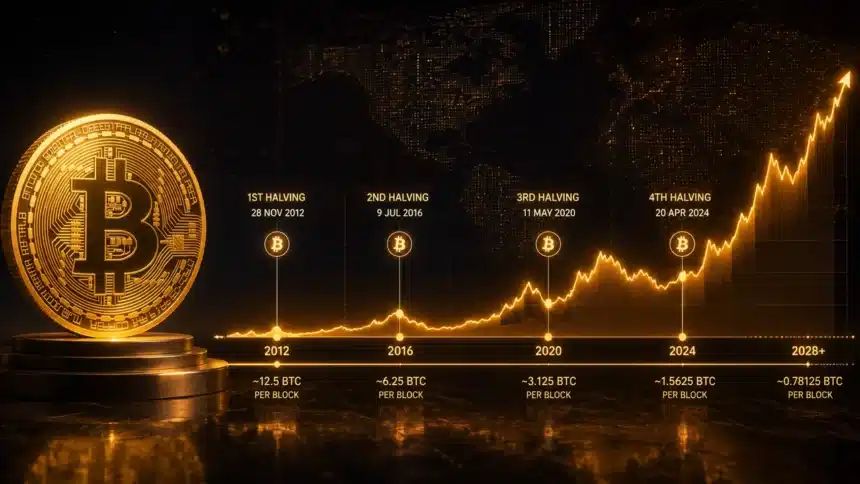
- First Halving: November 28, 2012, block reward cut from 50 BTC to 25 BTC
- Second Halving: July 9, 2016, block reward cut from 25 BTC to 12.5 BTC
- Third Halving: May 11, 2020, block reward cut from 12.5 BTC to 6.25 BTC
- Fourth Halving: April 19, 2024, block reward cut from 6.25 BTC to 3.125 BTC
- Fifth Halving: Approximately April 2028, block reward will cut from 3.125 BTC to 1.5625 BTC
Bitcoin’s halving events are the most predictable supply side events in the history of money. Every 210,000 blocks, approximately every four years, the reward paid to miners for validating transactions is cut in half. This mechanism is hardcoded into Bitcoin’s protocol and will continue until the last fraction of a Bitcoin is mined sometime around the year 2140. Since the first halving in November 2012, each halving has been followed by a significant increase in Bitcoin’s price over the subsequent 12 months. The 2024 halving broke from some historical patterns in interesting ways. Understanding all four halvings precisely gives you the analytical foundation for thinking about what the 2028 halving could mean.
Key Highlights
- First Halving: November 28, 2012. Block reward cut from 50 BTC to 25 BTC
- Second Halving: July 9, 2016. Block reward cut from 25 BTC to 12.5 BTC
- Third Halving: May 11, 2020. Block reward cut from 12.5 BTC to 6.25 BTC
- Fourth Halving: April 19, 2024. Block reward cut from 6.25 BTC to 3.125 BTC
- Fifth Halving: Approximately April 2028. Block reward will cut from 3.125 BTC to 1.5625 BTC
- Key mechanism: New BTC supply cut 50 percent overnight while demand remains unchanged or grows
The First Halving: November 28, 2012
The first Bitcoin halving occurred at block 210,000 on November 28, 2012. The block reward dropped from 50 BTC to 25 BTC. Bitcoin’s price at the time of the first halving was approximately $12. One year later, in November 2013, Bitcoin had reached approximately $1,000. That is an 83x price increase in the 12 months following the first halving.
Context matters for interpreting that number. Bitcoin in 2012 was a tiny, largely unknown asset. The user base was primarily cryptographers, libertarian technologists, and early adopters. Total market capitalization was around $130 million. The move from $12 to $1,000 was massive in percentage terms but small in absolute dollars. It reflected an expansion of the user base rather than large scale institutional capital flows. The halving reduced supply growth from 50 BTC per block to 25 BTC per block, and that supply reduction combined with growing awareness and adoption to produce the price surge.
The first halving established the basic template: supply growth halved, existing demand continued, new demand grew, price increased considerably over the following year. Whether that template would repeat would only be known with the second halving four years later.
The Second Halving: July 9, 2016
The second halving occurred at block 420,000 on July 9, 2016. The block reward dropped from 25 BTC to 12.5 BTC. Bitcoin’s price at the time of the second halving was approximately $650. One year later, in July 2017, Bitcoin had reached approximately $2,600. That is a 4x increase in 12 months following the halving, before the December 2017 peak of nearly $20,000, which came approximately 17 months after the halving.
The second halving confirmed that the pattern from 2012 was not a one off. Supply cut in half, demand growing, price followed substantially over the subsequent year. The mechanism was also better understood by 2016 than it had been in 2012. A meaningful community of analysts and investors anticipated the halving and positioned ahead of it, which means some of the price effect was captured in advance rather than entirely after the fact.
The second halving cycle also produced the first major institutional attention to Bitcoin. The 2017 bull run that peaked near $20,000 attracted media coverage and financial industry scrutiny that brought a new wave of retail and early institutional investors into the asset. That attention laid the groundwork for the infrastructure development that would enable the next halving cycle.
The Third Halving: May 11, 2020
The third halving occurred at block 630,000 on May 11, 2020. The block reward dropped from 12.5 BTC to 6.25 BTC. Bitcoin’s price at the time of the third halving was approximately $8,800. One year later, in May 2021, Bitcoin had reached approximately $58,000. That is a 6.6x increase in 12 months following the halving, with the cycle peak of $69,000 coming approximately 18 months after the halving in November 2021.
The third halving cycle coincided with unprecedented global monetary stimulus in response to the COVID-19 pandemic. Central banks around the world cut rates to zero and expanded their balance sheets dramatically. That monetary expansion amplified Bitcoin’s appeal as a hedge against currency debasement, attracting the first wave of genuine institutional investors including MicroStrategy, Square, and Tesla into Bitcoin’s holder base.
The third cycle also saw the launch of the first institutional grade Bitcoin custody and financial products outside of Grayscale’s trust structure. Fidelity Digital Assets expanded its custody offering. Multiple Bitcoin futures ETFs launched. The infrastructure for institutional participation was building rapidly, which meant that each subsequent halving would occur in an environment of greater institutional access than the previous one. As TCB covered in its explainer on Bitcoin cold storage and hardware wallet options in 2026, the custody infrastructure that was being built through 2020 and 2021 is what makes institutional Bitcoin allocation operationally practical today.
The Fourth Halving: April 19, 2024. Why It Broke the Pattern
The fourth halving occurred at block 840,000 on April 19, 2024. The block reward dropped from 6.25 BTC to 3.125 BTC. Bitcoin’s price at the time of the fourth halving was approximately $63,500. In the 12 months following the fourth halving, Bitcoin reached approximately $100,000 at its peak before consolidating in the $75,000 to $85,000 range through early 2026. That is a peak gain of approximately 57 percent in the first 12 months, far below the multiples seen in the first three halving cycles.
Several factors explain why the fourth halving produced a smaller percentage gain than previous cycles. The most important is scale. A 4x move from $650 requires $650 more per BTC. A 4x move from $63,500 requires $190,500 more per BTC. The dollar capital required to move the market by the same percentage multiple grows with each cycle, and the pool of new capital available to drive that movement does not grow proportionally. As an asset matures and attracts more of the world’s investable capital, percentage returns naturally compress toward the returns of other large liquid assets.
The second factor is timing. The fourth halving was preceded by the January 2024 approval of spot Bitcoin ETFs, which pulled forward some of the institutional demand that would otherwise have materialized in the 12 months after the halving. Institutional capital that entered Bitcoin in February and March 2024 was buying ahead of the halving supply reduction rather than responding to it after the fact. That demand front running partially offset the supply reduction’s price impact in the months following the halving itself.
The third factor is the broader macro environment. The Federal Reserve’s rate environment through most of 2024 and early 2025 was more restrictive than in the 2020 halving cycle, limiting the availability of cheap leverage that has historically amplified Bitcoin price moves. The US China trade tensions and geopolitical volatility in 2025 and early 2026 also weighed on risk asset sentiment during critical phases of the cycle. As TCB reported when analyzing Bitcoin mining economics and profitability in 2026, the fourth halving also sharply pressured miners with production costs running above $88,000 per BTC at times, which created forced selling pressure from stressed mining operations that previous cycles had not seen at the same scale.
What the Halving Mechanism Actually Does to Supply
The mathematical core of every halving event is straightforward. Bitcoin produces a fixed number of blocks per day, approximately 144. Each block before the April 2024 halving paid 6.25 BTC to the miner who found it. At 144 blocks per day, that is 900 new BTC per day entering circulation. After the halving, each block pays 3.125 BTC. At 144 blocks per day, that is 450 new BTC per day.
450 fewer Bitcoin per day is not a trivial supply reduction at current prices. At $80,000 per BTC, 450 fewer BTC per day is $36 million less in new daily supply. Over a year, that is approximately $13 billion less in new supply. The demand side must absorb less new supply for the same price to hold, which means the price will tend to rise if demand is constant or growing. That is the mechanism. It is not complicated. What is complicated is forecasting how much demand growth accompanies the supply reduction in each cycle.
As TCB covered when explaining Bitcoin’s difficulty adjustment mechanism, the halving also affects miner economics in a way that feeds back into supply dynamics through miner selling behavior. Miners who are marginally profitable before a halving may become unprofitable after the reward cut, forcing them to sell more BTC to cover operating costs or exit mining entirely. That selling pressure partially offsets the supply reduction’s price impact, particularly in the months immediately following the halving when price has not yet fully adjusted.
The Fifth Halving: What 2028 Could Mean
The fifth Bitcoin halving is expected approximately in April 2028, when the block reward will drop from 3.125 BTC to 1.5625 BTC. The new daily supply will drop from approximately 450 BTC to approximately 225 BTC.
Forecasting the price impact of the 2028 halving requires holding several variables steady while acknowledging that all of them could change considerably over two years. The current institutional adoption trajectory suggests that Bitcoin ETFs will continue accumulating, with BlackRock and others building larger positions. If the CLARITY Act or equivalent legislation establishes a clear regulatory framework for Bitcoin, the pool of institutional capital that can access it will continue expanding. The macro environment in 2028 will be shaped by whatever the Federal Reserve’s rate path produces over the next two years and by the November 2026 renewal of the US China trade deal framework.
On the supply side, the 2028 halving will be more impactful than 2024 in absolute dollar terms if BTC is trading above its current level, because each BTC of reduced daily supply represents more dollar value removed from new supply. On the demand side, Bitcoin’s market cap is now large enough that the absolute dollar inflows required to move the market meaningfully are larger than what retail cycles alone can provide. The 2028 halving’s price impact will depend on whether institutional inflow rates continue, moderate, or accelerate as regulatory clarity improves globally.
The TCB View
The halving cycle framework is the most predictable feature of Bitcoin’s supply economics and one of the most useful analytical lenses for thinking about multi year price trends. But it is not a mechanical price prediction engine. Each cycle has occurred in a different macro environment, with different institutional infrastructure, and at different scales. The lessons from the first three halvings, which all produced enormous percentage gains, should not be mechanically applied to the fourth and fifth because the base effect, institutional adoption stage, and macro context differ considerably.
What the halving history consistently shows is that supply reduction combined with growing demand produces price appreciation over 12 to 24-month windows following the event. That structural dynamic has not changed across four cycles and is unlikely to change for the fifth. The 2028 halving, with institutional ETF infrastructure fully established, regulatory clarity potentially locked in through the CLARITY Act, and Bitcoin holding above $80,000 at the start of the cycle, will produce a different type of bull market than 2016 or 2020. Whether it produces a smaller percentage gain at a much higher price, or whether the maturation of institutional adoption creates a different dynamic, is the most interesting open question in Bitcoin’s price history. The next two years will be the evidence.