
Last updated: 30 May 2026
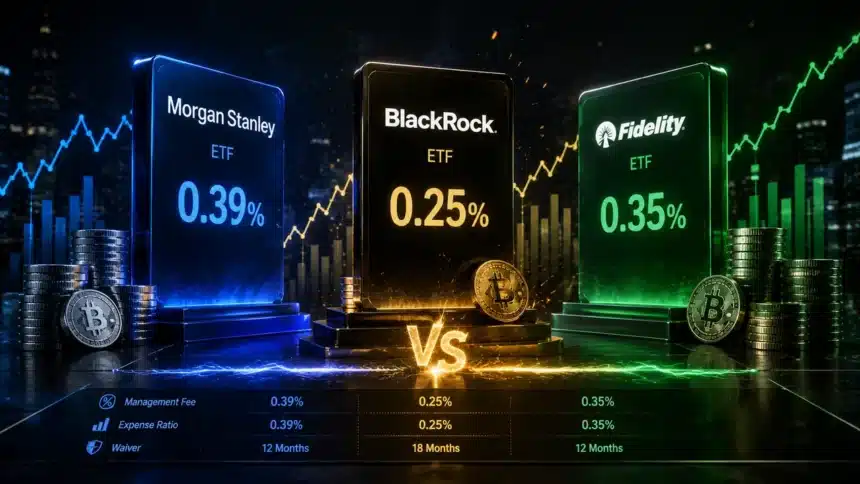
In the ongoing Bitcoin ETF fee war, Morgan Stanley’s MSBT stands out with its low 0.14% annual fee, significantly undercutting rivals BlackRock’s IBIT and Fidelity’s FBTC which charge a 0.25% annual fee, while VanEck HODL and Invesco Galaxy BTCO hover in between, offering competitive pricing options for investors.
Key Highlights
- Morgan Stanley’s MSBT has a 0.14% annual fee
- BlackRock’s IBIT and Fidelity’s FBTC charge a 0.25% annual fee
- Total US spot Bitcoin ETF AUM is approximately $110 billion as of May 2026
- VanEck HODL has a 0.20% annual fee, with 5% donated to Bitcoin Core developers
- Invesco Galaxy BTCO has a 0.25% annual fee, waived for first 6 months and first $5 billion
Morgan Stanley launched a spot Bitcoin ETF, ticker MSBT, at a fee of 0.14 percent per year, the lowest fee of any major Bitcoin ETF product and a direct challenge to BlackRock’s IBIT and Fidelity’s FBTC, both charging 0.25 percent. The entry of Morgan Stanley at a lower fee point has restarted the conversation about which Bitcoin ETF will win the long term institutional market share competition and what fee compression means for the sustainable economics of running a Bitcoin ETF. The short answer is that fee compression benefits retail investors enormously while squeezing issuers who do not have BlackRock’s scale advantages.
Key Highlights
- Morgan Stanley MSBT: 0.14% annual fee
- BlackRock IBIT: 0.25% annual fee. $50 billion+ in AUM, 70% of monthly ETF inflows
- Fidelity FBTC: 0.25% annual fee. Second largest US Bitcoin ETF by AUM
- WisdomTree BTCW: 0.25% annual fee
- VanEck HODL: 0.20% annual fee, with 5% donated to Bitcoin Core developers
- ARK 21Shares ARKB: 0.21% annual fee
- Invesco Galaxy BTCO: 0.25% annual fee, waived for first 6 months and first $5 billion
- Total US spot Bitcoin ETF AUM: Approximately $110 billion as of May 2026
What the Fee Numbers Actually Mean in Dollars
The difference between 0.14 percent and 0.25 percent may sound small in percentage terms. The dollar impact on a large institutional allocation is not small. A pension fund with a $100 million Bitcoin ETF allocation pays $140,000 per year in fees at MSBT’s 0.14 percent versus $250,000 per year at IBIT or FBTC’s 0.25 percent. The annual saving is $110,000 on a $100 million position. For a fund with $1 billion in Bitcoin ETF exposure, the annual saving is $1.1 million.
For retail investors with smaller allocations, the fee difference is less material in dollar terms but still matters over a long holding period. An investor holding $10,000 in a Bitcoin ETF for 10 years pays approximately $140 at 0.14 percent annually versus $250 at 0.25 percent annually, a difference of approximately $110 compounded over a decade. In a product that is fundamentally a passive tracking vehicle for an asset that either appreciates or declines based on Bitcoin’s price, minimizing the fee drag makes sense.
The fee structure has also become a marketing variable that ETF issuers use to attract assets in a competitive market. Morgan Stanley’s 0.14 percent is explicitly positioned as an alternative to IBIT for institutional allocators who are fee sensitive and do not have a specific reason to prefer BlackRock’s product. The message is direct: same underlying asset, same regulatory framework, 44 percent lower fee. For any institutional buyer operating under strict fee optimization mandates, that message is difficult to ignore.
Why BlackRock Wins at 0.25 Percent Despite Cheaper Alternatives
BlackRock’s IBIT holds approximately $50 billion in AUM and captures 70 percent of monthly Bitcoin ETF inflows despite being priced at 0.25 percent, above Morgan Stanley’s 0.14 percent and above several smaller competitors. The explanation is distribution, not price.
BlackRock has more registered investment advisor relationships, more wire house distribution agreements, and more institutional sales coverage than any competitor in the ETF market. When a wealth management platform adds a Bitcoin ETF to its approved product list, the BlackRock product is typically the first to be approved because it comes with the full BlackRock relationship, support infrastructure, and liquidity backing. An RIA managing $500 million in client assets who wants to offer Bitcoin exposure will default to IBIT unless they have a specific reason to go to Morgan Stanley or Fidelity, because IBIT is the option that is already in their platform’s product catalog.
That distribution advantage compounds over time. IBIT’s massive AUM creates a liquidity advantage: the bid ask spread on IBIT trades is narrower than on smaller ETFs because more shares trade every day, which means institutional investors can enter and exit large positions with less market impact. A 0.11 percentage point fee disadvantage relative to MSBT can be more than offset by the reduced implicit trading cost from tighter spreads for an institution executing large block trades regularly. As TCB covered in its analysis of BlackRock’s 810,000 BTC position and dominant ETF market share, the concentration of institutional inflows at BlackRock reflects structural distribution advantages that fee cutting alone cannot overcome.
The Fidelity Positioning: Fee Parity, Different Distribution Base
Fidelity’s FBTC charges 0.25 percent, the same as IBIT, and is the second largest US Bitcoin ETF by AUM. Fidelity’s competitive differentiation is not fee based. It is infrastructure based. Fidelity Digital Assets provides the custody for FBTC, meaning that Fidelity controls the entire stack from the ETF wrapper through the custodial infrastructure holding the underlying Bitcoin. That vertical integration is a different value proposition than BlackRock’s partnership with Coinbase Custody: some institutions prefer a single counterparty relationship rather than an ETF issuer dependent on a separate custodian.
Fidelity also has deep relationships with the institutional retirement market, including 401(k) plan administrators and pension trustees. As more institutional retirement plans consider Bitcoin allocations, Fidelity’s ability to offer FBTC through existing retirement plan infrastructure gives it a distribution channel that BlackRock does not match. The competition between IBIT and FBTC is therefore partly a competition between BlackRock’s wealth management distribution strength and Fidelity’s retirement market depth, rather than a pure price comparison.
VanEck’s 5 Percent Donation: Values Based Differentiation
VanEck’s HODL ETF takes a different approach to differentiation. At 0.20 percent, it is priced lower than IBIT and FBTC but higher than MSBT. The unique feature is a pledge to donate 5 percent of HODL’s profits to Bitcoin Core developers through Brink and OpenSats, organizations that fund Bitcoin protocol development. This is an appeal to investors who view Bitcoin’s long term value as tied to the health of its developer ecosystem and want their ETF fee to support that ecosystem rather than going entirely to the issuer’s profit margin.
The VanEck donation model is a creative differentiation strategy that is unlikely to drive large institutional inflows from fee optimizing pension funds, but may resonate with values driven retail investors and crypto native institutional buyers who prioritize Bitcoin‘s development health alongside investment returns. As TCB covered when explaining Bitcoin’s network effects and the importance of its developer ecosystem, the long term security and development of the Bitcoin protocol is a genuine factor in the asset’s value, not just a philosophical consideration.
What Fee Compression Means for Issuer Economics
The fee war is good for investors and painful for issuers who do not have BlackRock’s scale. A Bitcoin ETF is an expensive product to operate. Compliance, custody, auditing, exchange listing fees, authorized participant relationships, and marketing require ongoing expenditure. The revenue to cover those costs comes entirely from the annual fee on AUM.
At $110 billion in total US spot Bitcoin ETF AUM and an average fee of approximately 0.22 percent, the total annual fee revenue pool is approximately $242 million. That is spread across 11 ETF products competing for the same underlying asset. The economics heavily favor the largest products. BlackRock’s IBIT at $50 billion in AUM generates approximately $125 million in annual fee revenue. A smaller competitor with $1 billion in AUM at 0.14 percent generates $1.4 million, which is barely enough to cover operating costs before profit.
The likely outcome of continued fee compression is consolidation. Small Bitcoin ETF products with insufficient AUM to generate sustainable fee revenue at competitive fee rates will either be acquired by larger players, merged into broader crypto ETF products, or closed. The survivors will be the products with large enough AUM to be profitable at the fee rates the market ultimately settles on, plus the large established players who can subsidize their Bitcoin ETF from broader business revenue while using it as a distribution relationship investment.
The TCB View
The Bitcoin ETF fee war is playing out as a compressed version of what happened in equity ETF markets over 20 years. BlackRock’s iShares S&P 500 ETF and Vanguard’s equivalent product drove fees from 0.50 percent to 0.03 percent over two decades, generating massive investor value while squeezing smaller issuers out of the market. Bitcoin ETF fees will follow a similar trajectory over a much shorter period because the market started with multiple competitive products from the first day and because institutional investors applying fee optimization frameworks will push fees lower faster than the retail dominated equity ETF market did.
For investors, the practical advice is straightforward: track the fee levels of whichever Bitcoin ETF you hold and be willing to switch if a materially cheaper product gains sufficient scale to match on liquidity. The fee difference between 0.14 percent and 0.25 percent compounded over a decade of Bitcoin ETF ownership is real money. For issuers without BlackRock’s distribution advantages, the fee compression is an existential pressure that will drive consolidation well before 2028. The Bitcoin ETF market of 2026 has too many products at too many different fee levels for all of them to survive as independent entities through the next market cycle.