
Last updated: 30 May 2026
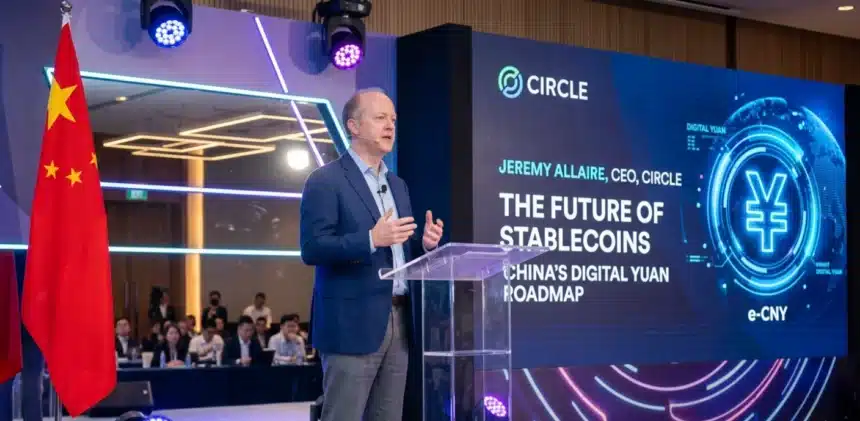
China is reportedly on track to launch a yuan-backed stablecoin within the next 3 to 5 years, according to Circle CEO Jeremy Allaire, with the goal of making it easier for people worldwide to use the currency for trade and payments, potentially giving China a significant edge in the global currency war.
Key Highlights
- Circle CEO Jeremy Allaire predicts China could launch a yuan-backed stablecoin within the next 3 to 5 years.
- A stablecoin would allow China to “export” its currency, making it easier for people worldwide to use for trade and payments.
- China currently restricts offshore yuan-pegged coins, but officials are reportedly exploring them to boost international adoption.
Key Highlights
Key Highlights
- Timeline: Circle CEO Jeremy Allaire predicts China could means launch a yuan backed stablecoin within the next 3 to 5 years.
- Global Competition: This move is seen as a strategic step for China to challenge the dominance of the US Dollar in the digital economy.
- Exporting the Yuan: A stable coin would allow China to “export” its currency by making it easier for people worldwide to use for trade and payments.
- Technological Race: Allaire describes this shift as a “technological competition” where the currency with the best digital features will win.
- Regulatory Shift: While China currently restricts offshore yuan pegged coins, officials are reportedly exploring them to boost international adoption.
- Modernizing Trade: The goal is to create a faster, cheaper, and fully digital way to move money across borders without using Western banking systems.
In the rapidly evolving world of global finance, a new race is quietly unfolding. It isn’t a race for gold, oil, or even territory. It is a race for the future of money itself. Recently, Jeremy Allaire, the CEO of Circle (the company behind one of the world’s most popular digital dollars), made a bold prediction: China could launch a yuan backed “stablecoin” within the next three to five years.
While that might sound like a technical update for bankers, it actually represents a massive shift in how every person on the planet might eventually buy groceries, send money to family, or run a business. To understand why this matters, we need to pull back the curtain on what is happening in the world of digital currencies and why China is positioning itself to lead the pack.
What exactly is Stablecoin?
Before we dive into China’s specific plans, we have to understand the tool they are considering using. Most people have heard of Bitcoin, the digital currency that goes up and down in value like a roller coaster. Because Bitcoin is so unpredictable, you can’t really use it to buy a loaf of bread it might be worth $5 today and $2 tomorrow.
A stablecoin is designed to fix that problem. It is a digital currency that is “hitched” or “pegged” to a real world asset, usually a traditional currency like the US Dollar or the Chinese Yuan. For every digital coin issued, there is a real dollar or yuan sitting in a bank account to back it up.
This means the digital coin stays “stable.” It gives you the speed and ease of the internet but the reliability of the cash in your wallet. It’s like having a digital version of a physical bill that can be sent across the world in seconds for almost no cost.
The Current Landscape: A Dollar Dominated World
Right now, the internet runs on the US Dollar. If someone in Brazil wants to buy something from someone in South Korea, they usually use US Dollars as the middleman. The vast majority of stablecoins used today including Circle’s USDC are tied to the dollar.
This gives the United States a lot of power. It means the world relies on American banks and American technology to move money. China, as the world’s second largest economy, has watched this for years and decided it wants a piece of the action. They want the Yuan to be just as easy to use globally as the Dollar is today.
Why China is Moving Toward a Yuan Stablecoin
Jeremy Allaire’s prediction isn’t just a guess; it’s based on the clear direction China has been taking for over a decade. Here are the primary reasons why China is heating up this “currency race.”
Modernizing the Way We Pay
China is already the world leader in mobile payments. If you visit a major Chinese city, you’ll rarely see anyone using paper cash or even plastic credit cards. Everyone uses apps like Alipay or WeChat Pay to scan QR codes. Moving toward a government backed digital stablecoin is simply the next logical step in making their economy 100% digital.
Going Global Without the Middleman
Currently, if a Chinese company wants to do business in Africa or Europe, the transaction often has to pass through the Western banking system (known as SWIFT). This system can be slow, expensive, and subject to political rules. By creating a digital Yuan stablecoin, China can allow other countries to trade with them directly, bypassing the traditional pipes controlled by Western banks of global finance.
Financial Inclusion
There are billions of people around the world who don’t have a traditional bank account but do have a smartphone. A stablecoin allows these people to participate in the global economy. If China provides the easiest, safest digital currency for these people to use, the Yuan could become the “people’s currency” in emerging markets.
The 3 to 5 Year Timeline: Why Now?
According to the Circle CEO, the window for this change is between three and five years. Why that specific timeframe?
Technology takes time to perfect, but more importantly, regulations take time to write. Governments around the world are currently arguing over the rules for digital money. China has been testing its own “Central Bank Digital Currency” (the e CNY) for several years in various cities.
However, a “stable coin” is slightly different from a standard government digital currency. A stablecoin can often be used more easily on private platforms and across different types of internet technology. Allaire believes that as the technology matures and the global “currency war” intensifies, China will see the strategic necessity of releasing a stablecoin version of their currency to compete with the digital dollar.
How This Changes the “Currency Race”
The term “currency race” sounds like something out of a spy movie, but it’s actually a competition for influence.
If everyone starts using a digital Yuan to buy goods online, China gains more insight into global trade and more power over how money moves. For the average person, this competition is actually a good thing in some ways. When countries compete to make their money “better,” it usually leads to:
- Lower Fees: No more paying 5% or 10% just to send money to a relative in another country.
- Faster Transactions: Money moves instantly, 24/7, even on weekends and holidays.
- Better Security: Digital ledgers make it harder for money to simply “disappear” or be stolen through traditional physical means.
The Challenges Ahead for China
Even though China is ahead in many ways, launching a global stablecoin isn’t easy. They face several hurdles:
Trust and Transparency
For people in other countries to use a digital Yuan, they have to trust the system. They need to know that their digital coins are actually backed by real money and that the government won’t suddenly “turn off” their access to their funds. Building this international trust is much harder than building the technology itself.
The Power of the US Dollar
The dollar has been the king of money for nearly 80 years. Most of the world’s debt is in dollars, and most oil is bought in dollars. Breaking that habit is a monumental task. Even a very efficient digital Yuan will have to work twice as hard to convince people to switch away from the dollar.
What Does This Mean for You?
You might be wondering, “I don’t live in China, so why should I care?”
The reason is that the way you interact with money is about to change forever. In the next five years, the “digital wallet” on your phone will likely become more important than the physical wallet in your pocket. You may soon have the choice to hold different types of digital “cash” some tied to the dollar, some to the yuan, and some to gold or other assets.
If China successfully launches a yuan stablecoin, it will force the US and Europe to speed up their own digital money projects. This competition will lead to an explosion of new financial tools. Imagine being able to stream your salary by the second instead of waiting two weeks for a paycheck, or being able to buy a tiny fraction of a house or a piece of art with the click of a button. This is the world a future powered by stablecoins creates.
The Human Element: Will People Actually Use It?
At the end of the day, money is based on a social contract. It only works because we all agree it has value. Whether it’s a piece of paper, a gold coin, or a string of digital code, its value comes from our collective belief.
The Circle CEO’s prediction highlights a shift in that belief. We are moving away from the idea that money must be a physical thing controlled by a local bank. We are moving toward a world where money is “software.”
If China makes the best “money software” in the next few years, people will use it. If the US makes the best software, people will stay with the dollar. The “race” Allaire describes is a race to see who can provide the most useful, stable, and accessible tool for the 8 billion people on Earth.
Understanding the Depth of the Shift
To truly appreciate the magnitude of a Chinese stablecoin, we have to look at the history of money. For centuries, money was “hard” gold and silver. Then it became “paper,” backed by those metals. In 1971, the world moved to “fiat” money paper backed only by the promise of a government.
We are now entering the fourth era: Programmable Money.
A Chinese Yuan stablecoin wouldn’t just be a digital version of a bill. It would be a bill that has “instructions” attached to it. For example, a business could program the money so that it is only released to a supplier once a shipping container is scanned at a port. This removes the need for lawyers, escrow accounts, and mountains of paperwork.
When Jeremy Allaire speaks about a 3 to 5 year timeline, he is talking about the time it takes for this “programmable” reality to become the standard. China wants to be the one who writes the code for that standard.
The Role of Companies Like Circle
It’s interesting that this news comes from the CEO of Circle. Circle is an American company that created USDC (USD Coin). They are currently the leaders in the digital dollar space. By pointing out China’s progress, Allaire is also sending a message to Western regulators: “If we don’t move fast and create clear rules for digital money, China will set the rules for us.”
It is a wakeup call. The technology is out of the bottle, and it can’t be put back in. The only question left is which country’s currency will be the most popular on the digital frontier.
Summary of the “Currency Race”
The “race” can be broken down into three main tracks:
- The Technology Track: Who can build the fastest, most secure network? (China is currently leading here).
- The Adoption Track: Who can get the most shops, banks, and people to actually use the coin? (The US Dollar still leads here due to its history).
- The Trust Track: Who can prove that their digital money is safe from hackers and safe from government interference? (This is the biggest hurdle for everyone).
TCB View
The prediction that China could launch a yuan stablecoin within 3 to 5 years is more than just a financial headline. It is a sign that the very nature of how we exchange value is shifting.
In the near future, the “race” between the Dollar and the Yuan won’t just be fought in factories or on stock exchanges, it will be fought on the screens of our smartphones. As these two giants compete to digitize their currencies, the world will get smaller, transactions will get faster, and the old way of doing things, waiting days for a bank transfer or paying high fees to move your own money will become a memory of the past.
Whether China wins the race or simply forces everyone else to run faster, the result is the same: the era of digital, stable, and global money is almost here. And as Jeremy Allaire suggests, it’s coming a lot sooner than most people think.