
Last updated: 30 May 2026
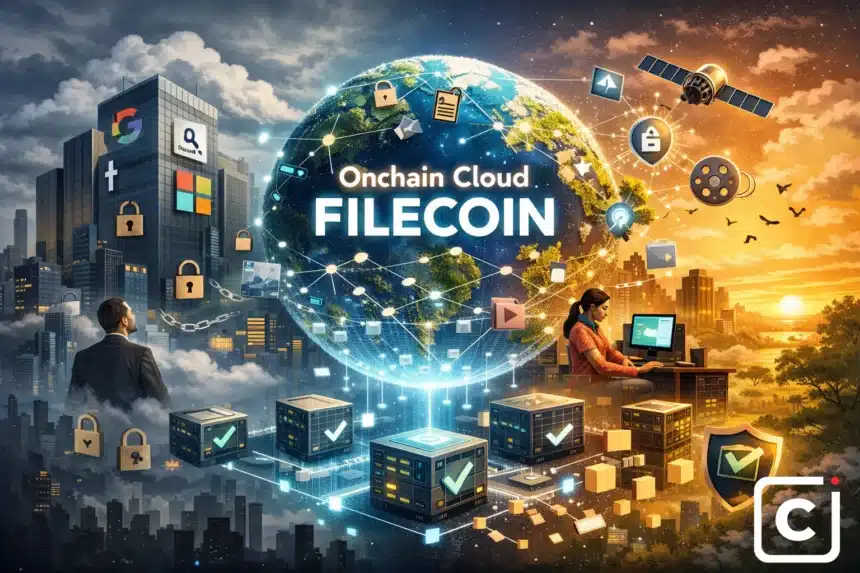
Filecoin has officially bitcoin its “chain Cloud” on the main fights coin price crash”>network, moving beyond simple data storage to offer a fully automated, transparent, and programmable cloud ecosystem.
Key Takeaways
Key Highlights
- Total Control: Users own their data keys; no central corporation can peek at or delete your files.
- Lower Costs: Open competition between storage providers naturally drives prices down compared to fixed monthly subscriptions.
- Automated Reliability: Smart “contracts” ensure your data is backed up and verified every minute without human intervention.
- Global Reach: A massive network of independent computers worldwide makes the system nearly impossible to shut down.
What is Filecoin’s Onchain Cloud?
For years, we have kept our photos, documents, and business files in “the cloud.” In reality, that cloud is just a giant building full of computers owned by one of three or four massive companies. If their servers go down, or if they decide to change their terms of service, you lose access.
Filecoin’s Onchain Cloud changes the “where” and the “how” of storage. Instead of one company owning the building, thousands of individuals and small businesses around the world offer their extra computer space for rent. The “Onchain” part means that every agreement how much you pay, how long the file stays there, and proof that the file is still safe, is recorded on a public digital ledger that anyone can verify but no one can fake.
Why Moving to the Cloud Matters for the Internet’s Future
In the current digital age, data is more valuable than oil. However, the way we store it is currently very fragile. If a major provider has an outage, half the internet stops working. Filecoin’s launch on the main network is a major milestone because it introduces “Programmable Storage.”
This means developers can now write simple instructions (software) that tell the data how to behave. For example, a photographer could set a rule: “Automatically make five copies of my wedding gallery across three different continents and renew the storage every year using my digital balance.” This happens without a single person at a desk approving the transaction.
Breaking Down the Benefits: Specific Improvements
The launch isn’t just a technical update; it provides real world evidence of a better way to handle digital life.
Proof of Storage (The End of “Trust Me”)
With traditional providers, you assume they are keeping your data safe because you pay them. With Filecoin’s Onchain Cloud, the system requires providers to submit a “proof” every few hours. If a provider’s computer goes offline or loses a piece of your file, the system automatically detects it and can move your data to a healthy provider or issue a refund.
Massive Scalability
According to recent network data, Filecoin already has several Exabytes of storage capacity. To put that in perspective, one Exabyte can hold about 100,000 times the amount of information stored in the entire Library of Congress. This launch makes that massive capacity easier for regular apps to use.
Open Market Pricing
Because anyone can become a storage provider, there is a constant “auction” happening. Providers compete to offer the best prices to win your business. This is why decentralized storage is often a fraction of the cost of traditional high end cloud services.
How It Works: A Simple Comparison
| Feature | Traditional Cloud (Big Tech) | Filecoin Onchain Cloud |
| Ownership | Company owns the server | You own the “keys” to your data |
| Privacy | Company can access files | Encrypted; only you can see files |
| Security | Single point of failure | Distributed across thousands of nodes |
| Cost | Fixed, often high | Market driven, usually much lower |
| Verification | Trust the company’s word | Proofs are recorded on the ledger |
The “Human” Side of Decentralized Storage
You might wonder, “Why should I care if my files are on a blockchain?” Think of it like a community garden versus a grocery store. In a grocery store, you buy what they have, at their price, and if they close, you get nothing. A community garden is maintained by the people; everyone contributes, and the resources belong to the community.
Filecoin is creating a Community Cloud. It allows a small business owner in India to provide storage for a student in Brazil. It keeps the money within the community of users and providers rather than siphoning it all to a single headquarters in Silicon Valley.
Real World Use Cases for the New Mainnet Launch
Now that the Onchain Cloud is live, we are seeing immediate adoption in several areas:
- Preserving History: Organizations are using Filecoin to store massive archives of human history, such as the Internet Archive and environmental data, ensuring it can never be deleted by a government or a failing company.
- Video Streaming: New video platforms are using this cloud to host content, preventing “buffering” by pulling the video from the computer closest to the viewer.
- AI Training: Large AI models require huge amounts of data. Using a decentralized cloud allows researchers to store this data safely and share it with other scientists without huge transfer fees.
Security and Privacy: Your Digital Vault
In the old system, if a hacker breaks into a central server, they get everyone’s files. In the Filecoin Onchain Cloud, your files are “shredded” (split into tiny pieces) and encrypted before they are sent out. A hacker would have to break into hundreds of different computers all over the world simultaneously to even see a single photo of your cat.
Furthermore, because you hold the digital “key,” even the person whose computer is physically holding your file cannot open it. To them, it just looks like random gibberish.
What’s Next for the Onchain Cloud?
The launch on the main network is just the beginning. In the coming months, we expect to see:
- Easier Interfaces: Apps that look just like Google Drive or Dropbox but run on Filecoin in the background.
- Faster Speeds: As more people join the network as “Retrieval Providers,” downloading your files will become faster than traditional methods.
- Wider Integration: Your favorite websites will slowly start moving their “heavy” data (videos and images) to the Onchain Cloud to save money and increase security.
FAQ: Understanding the New Cloud
1. Is Filecoin just for Bitcoin experts?
Not at all. While the technology uses a ledger similar to Bitcoin, the goal is for everyday people to use it without ever knowing there is a “blockchain” under the hood. It’s just a better way to save files.
2. Can my files be deleted if I stop paying?
The agreement (the “Deal”) has a set timeframe. You can set your files to stay for six months, a year, or a century. As long as the digital contract is funded, the files remain.
3. Is it legal to store data this way?
Yes. It is simply a different type of computer network. Users are still responsible for following the laws of their own country regarding what they store, just like with a physical hard drive.
4. What happens if a storage provider’s house burns down?
The system is designed to make multiple copies of your file on different computers in different locations. If one goes away, the “Onchain” instructions automatically trigger a new copy to be made from the remaining ones.
5. How do I get started?
Many new “gateways” are launching that allow you to drag and drop files directly into the Filecoin network using a standard web browser.
Final Thoughts: A New Chapter for the Internet
The launch of Filecoin’s Onchain Cloud marks a turning point where the internet moves away from being a collection of “walled gardens” owned by billionaires. It is an invitation to a more open, honest, and resilient digital world. By removing the middleman and automating trust, we are finally building a cloud that belongs to everyone.