
Last updated: 9 April 2026
Key Highlights
- A Bad Trade: An investor tried to swap $50 million for a very rare, tiny digital coin that almost nobody uses.
- The “Small Pool” Problem: Because the market for that tiny coin was so small, it couldn’t handle such a large order. It’s like trying to fit a whole gallon of water into a tiny thimble; it just doesn’t work.
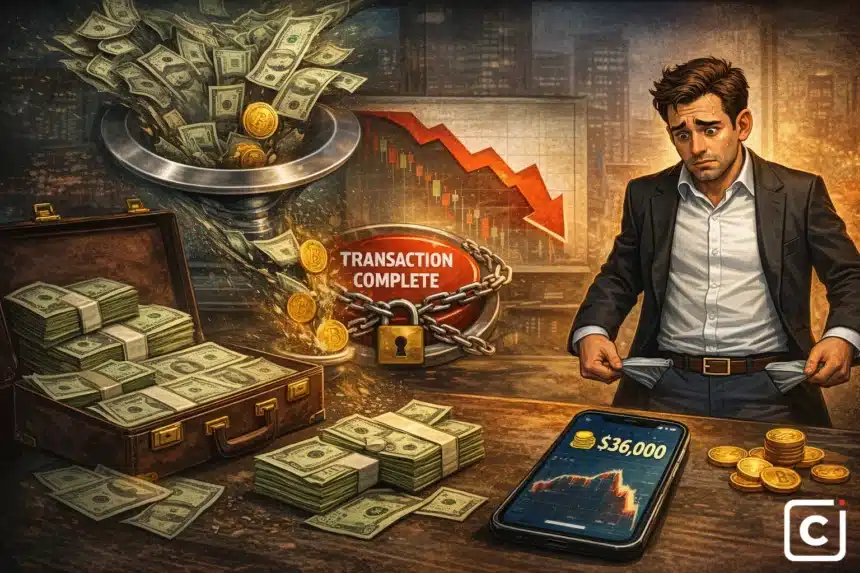
- The Price Crash: To finish the trading process, the system kept raising the price of the tiny coin higher and higher. By the time the trade was done, the investor had spent $50 million to get coins only worth $36,000.
- No “Undo” Button: In the world of digital currency, transactions are permanent. There is no bank to call and no way to get the money back once the button is clicked.
A wealthy investor recently lost nearly all their money dropping from $50 million to just $36,000 because of one single mistake while swapping digital coins.
- Why it matters: It shows that in the world of digital money, there is no “undo” button.
- Who it affects: Anyone who trades digital coins on their own without using a big, traditional bank.
- What to watch: New apps are adding “safety breaks” to stop people from making these huge mistakes.
In this article, we’ll explain exactly how this happened.
What Actually Happened?
Imagine you have a giant diamond worth $1 million. You walk into a tiny corner store and tell the clerk, “I want do the trading of this diamond for a pack of gum.”
The clerk says, “I don’t have $1 million in change to give you.”
If you say, “That’s okay, just give me the gum and keep the diamond,” you just made a very bad trade. You have a $2 pack of gum, and the clerk has a $1 million diamond.
That is exactly what this investor did. They had $50 million in “Stablecoins” (digital coins that are always worth $1). They tried to trade them for a very rare, tiny coin that almost nobody uses. Because there weren’t enough of those tiny coins available, the system “charged” them $50 million just to get a few of them.
When the trade finished, the investor looked at their wallet and saw they only had $36,000 worth of coins left.
Why Did the Price Drop So Fast?
In the world of digital trading, we use something called “Liquidity.” Think of it like a swimming pool of money.
- A Big Pool (Safe): If you throw a bucket of water into the ocean, the ocean level doesn’t change. Big coins like Bitcoin are like the ocean.
- A Tiny Cup (Risky): If you try to pour a whole bucket of water into a tiny tea cup, it overflows and makes a mess.
The investor tried to pour $50 million into a “tea cup.” The system couldn’t handle it, so the price “broke.” This is often called a “Price Impact” error.
Where Did the $50 Million Go?
The money didn’t just disappear into thin air. It went to the people who “own” the tiny corner store (the trading pool). In this world, regular people can put their own coins into these pools to help others trade. When this investor made their giant mistake, the people who provided the coins for that pool basically “won the lottery” instantly.
| If you are trading… | In a Big Market | In a Tiny Market |
| $100 | You get $100 back | You get $99 back |
| $50 Million | You get $50 Million back | You get $36,000 back |
Simple Ways to Stay Safe
You don’t need to be a math expert to avoid this. Just follow these three simple rules
1. Read the Red Text
Before you click “Swap” or “Buy,” look at the screen. If you see a percentage in Red (like “Price Impact: 99%”), DO NOT CLICK. It means you are about to lose almost all your money.
2. Don’t Trade Everything at Once
If you want to move a lot of money, do it in small steps. Trade $100 first to see if it works. Then trade another $100. This keeps the “swimming pool” level steady.
3. Use Famous Apps
If you are new, stick to the big, well known apps. They usually have “Safety Rails” that will block a trade if it looks like a mistake.
Can They Get the Money Back?
Usually, the answer is No. Digital currency is built on “Blockchain,” which is like writing in permanent marker. Once a trading is done, it cannot be erased. The only way to get the money back is if the people who “won” the money decide to give it back. While some people are nice and do this, most of the time, that money is gone forever.
FAQ:
Q: Was this a scam?
A: No. It was just a very bad deal. The investor agreed to the price, and the computer followed the orders.
Q: Can this happen to me?
A: Only if you use “Decentralized” apps where you are in total control. If you use a basic app like Coinbase, they usually won’t let you make a mistake this big.
Q: Why is it called a “Fat Finger” move?
A: It’s a joke in the trading world. It means someone’s finger was too “fat” and they accidentally hit the wrong button or typed too many zeros.
Free Daily Briefing
Get the Daily Briefing
Crypto, AI, and Web3 intelligence. Free, every day.
The Daily Brief by TCB
Crypto, AI & finance intelligence in 5 minutes. Every weekday morning. Free.