
Last updated: 9 June 2026
Key Highlights
- Bitcoin is a decentralized digital currency created in 2009 by the pseudonymous Satoshi Nakamoto, designed to operate without banks or governments.
- It runs on a public blockchain, a distributed ledger that records every transaction across thousands of computers worldwide.
- Bitcoin’s supply is hard capped at 21 million coins, making it the scarcest monetary asset ever engineered.
- Proof of work consensus ensures no single party can alter the transaction history without controlling more than half the network’s computing power.
- As of May 2026, over 491 million Bitcoin wallets exist globally and institutional adoption via ETFs has passed $60 billion in assets under management.
Bitcoin is a peer to peer electronic cash system that lets people send value anywhere in the world without a bank, payment processor, or government in the middle. It was introduced in October 2008 through a nine page whitepaper authored by someone using the name Satoshi Nakamoto. The first Bitcoin block, known as the Genesis Block, was mined on January 3, 2009. Since then it has grown from an experiment among cryptographers into a multi trillion dollar global asset held by pension funds, sovereign wealth funds, and hundreds of millions of individuals.
The Problem Bitcoin Was Built to Solve
Before Bitcoin, every attempt at digital cash failed because of one fundamental problem: double spending. If you send a digital file to someone, you can copy it first. There was no way to prove you had not already spent the same digital coin somewhere else, so every digital payment system required a trusted middleman, a bank or payment network, to keep the official ledger.
Satoshi’s breakthrough was replacing the trusted middleman with cryptographic proof and distributed consensus. Instead of one company’s database, the ledger is replicated across tens of thousands of computers. To rewrite a transaction you would need to redo the computational work for that block and every block after it, faster than the rest of the network combined. That is economically and practically impossible at Bitcoin’s current scale.
What the Bitcoin Blockchain Actually Is
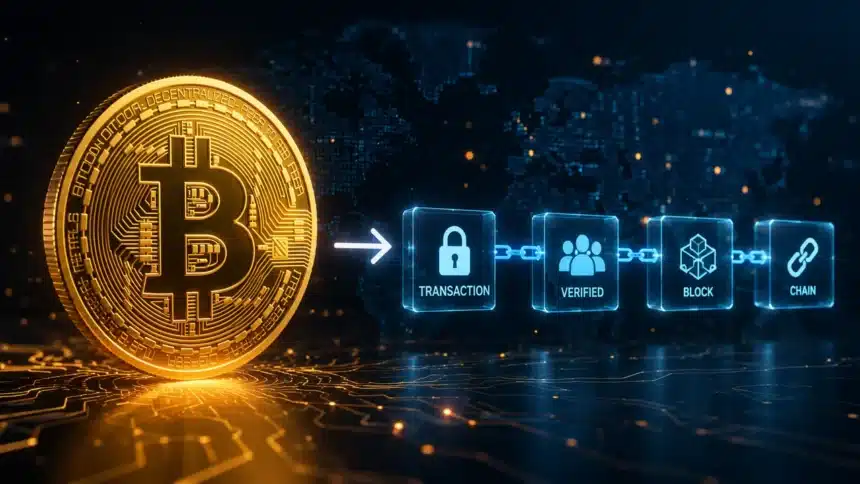
The blockchain is a chain of data blocks, each containing a batch of verified transactions, a timestamp, and a cryptographic fingerprint (hash) of the previous block. That chain structure means altering any historical block would invalidate every block that came after it, making the record tamper evident.
New blocks are added roughly every 10 minutes. Each block can hold around 2,500 to 3,000 transactions. Every full node on the network stores a complete copy of this chain, currently around 600 gigabytes. No single server owns it. Anyone can download it.
When you send Bitcoin, your transaction is broadcast to the network, picked up by nodes, validated against the rules, and included in the next block by a miner. Once it has six confirmations (six blocks built on top of it), it is considered final.
Proof of Work: How the Network Reaches Agreement
Bitcoin uses a consensus mechanism called proof of work. Miners compete to solve a computationally intensive puzzle: find a number that, when combined with the block data and passed through SHA-256 hashing, produces an output below a target threshold. This is pure trial and error, requiring trillions of guesses per second.
The first miner to find the solution broadcasts the new block and receives the block reward: currently 3.125 BTC after the April 2024 halving. This reward is the only way new Bitcoin enters circulation. It will drop to 1.5625 BTC at the next halving in 2028.
Proof of work does two things simultaneously. It makes adding blocks expensive (requiring real world electricity and hardware), and it makes the network’s history expensive to rewrite. The cost is the security.
The 21 Million Supply Cap
Bitcoin’s most important property is its fixed supply. No matter what, only 21 million BTC will ever exist. This is enforced by the protocol itself, not by any company or government. As of May 2026, approximately 19.7 million BTC have been mined. The remaining 1.3 million will be released gradually over the next century through progressively smaller block rewards.
For comparison, the US Federal Reserve has expanded its balance sheet from $900 billion in 2008 to over $7 trillion by 2026. Bitcoin cannot be inflated by a central authority. That property is why commentators from Larry Fink of BlackRock to Cathie Wood of Ark Invest have compared it to digital gold. The Bitcoin versus gold debate is one of the most active conversations in institutional finance today.
Bitcoin Wallets and Private Keys
You do not store Bitcoin in a wallet the way cash sits in a purse. What you store is a private key: a 256-bit secret number that proves you own a particular address on the blockchain. If you know the private key, you can spend the Bitcoin. If you lose it, no one can recover your funds. There is no password reset, no customer service number, no court order that can reverse it.
Wallets come in several forms. Software wallets on your phone or computer are convenient but exposed to malware. Hardware wallets like the Ledger Flex or Trezor Safe 5 keep the private key on an offline chip, dramatically reducing attack surface. For very large holdings, multisig setups require multiple keys to authorize a transaction, eliminating any single point of failure.
How Bitcoin Transactions Work Step by Step
When you initiate a Bitcoin transaction, your wallet software constructs a message that includes the recipient’s address, the amount, a transaction fee (paid to the miner), and a cryptographic signature proving you authorized the spend. That message is broadcast to the peer to peer network.
Nodes validate it: does the address have enough balance? Is the signature valid? Is the fee sufficient? Valid transactions enter the mempool, a waiting area. Miners pull transactions from the mempool, prioritizing by fee rate (satoshis per byte). Your transaction gets packaged into a block, which is then mined and confirmed.
Transaction fees are set by supply and demand. During periods of high network activity, such as major market moves or NFT mints on Ordinals, fees spike. During quiet periods they fall to a few hundred satoshis. The Lightning Network addresses this by routing micropayments off chain for near zero fees.
Bitcoin’s Real Use Cases in 2026
Bitcoin is used in several distinct ways today. As a store of value, it functions like digital gold: scarce, portable, and not controlled by any government. Institutions access it through spot Bitcoin ETFs from BlackRock (IBIT), Fidelity (FBTC), and others that together passed $60 billion in AUM by early 2026.
As a payment network, Bitcoin processes around 300,000 to 400,000 on chain transactions daily, with the Lightning Network handling millions of instant micropayments. El Salvador made Bitcoin legal tender in 2021. The Chivo wallet saw mixed adoption, but the Strike app and direct merchant payments have continued growing independently of the government program.
In countries with hyperinflation or capital controls, such as Argentina, Nigeria, and Venezuela, Bitcoin serves as a savings tool when the local currency loses purchasing power rapidly. The ability to hold value outside the banking system has real world utility that goes beyond speculation.
Who Controls Bitcoin
Nobody controls Bitcoin, and that is the point. The protocol is open source. Changes require consensus among node operators, miners, and developers. Attempts to change the rules without consensus, such as the SegWit2x hard fork attempt in 2017, have failed because miners cannot force nodes to adopt a different protocol. Nodes simply reject invalid blocks.
Bitcoin Core is the dominant implementation, maintained by hundreds of volunteer contributors. No company owns it. No government can shut it down. To kill Bitcoin you would need to take down every node in every country simultaneously, which is not practically possible.
Where Bitcoin Stands in 2026
Bitcoin’s market capitalization in May 2026 sits above $1.4 trillion, making it the seventh largest asset in the world by value, ahead of Meta and behind Saudi Aramco. Its hash rate has reached a record 820 exahashes per second, meaning the network is more secure today than at any prior point in its history.
The 2024 halving reduced the block reward to 3.125 BTC and tightened supply issuance further. Institutional infrastructure including regulated custodians, ETFs, and options markets has matured significantly. What began as a cypherpunk experiment is now a recognized asset class embedded in global financial infrastructure.