
Last updated: 29 May 2026
Storing
Key Highlights
- Custodial exchanges like Coinbase hold approximately 1.5 million BTC, representing over 7% of Bitcoin’s circulating supply as of early 2024.
- Hardware wallets such as Ledger and Trezor offer superior security for balances exceeding $1,000, isolating private keys from internet connected devices.
- Multisignature wallets, used by institutions like Fidelity Digital Assets, require multiple keys to authorize transactions, mitigating single points of failure.
- Software hot wallets like Electrum and Wasabi Wallet provide a balance of convenience and user control, suitable for smaller amounts typically under $500.
- The Bitcoin network processed over 500,000 transactions daily in Q4 2023, emphasizing the constant need for secure transaction signing methods.
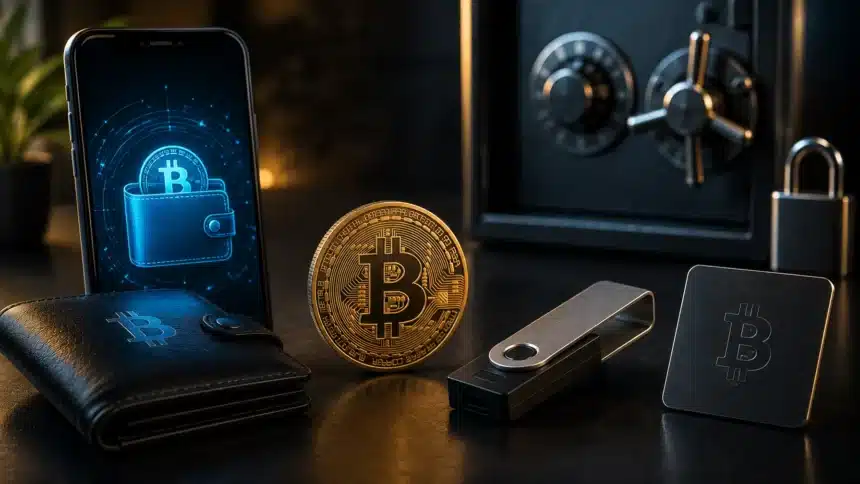
To truly understand how to store Bitcoin safely, one must navigate a spectrum of custody options, each offering distinct trade offs between convenience, control, and security. From entrusting your digital assets to a third party exchange to taking full sovereign control with a hardware device, the choice impacts your exposure to risk. This guide breaks down the primary methods for Bitcoin storage, helping you make an informed decision based on your specific needs and risk tolerance.
Custodial Exchanges: Convenience at a Cost
Custodial exchanges like Coinbase, Kraken, and Binance offer the simplest entry point for many new Bitcoin users. When you purchase Bitcoin on these platforms, the exchange holds your private keys on your behalf. This approach mirrors traditional banking, where you trust an institution to safeguard your funds.
The primary advantage of custodial storage is its ease of use. Exchanges handle the technical complexities of key management, backups, and transaction signing. Many also offer FDIC insurance for fiat balances, although this typically does not extend to crypto assets themselves, only the fiat held on the platform.
However, this convenience comes with significant drawbacks. The adage “not your keys, not your coin” highlights the core issue: you do not possess the direct control over your Bitcoin. This exposes you to counterparty risk, meaning the exchange could be hacked, become insolvent, or face regulatory seizure. The collapse of FTX in late 2022, which saw billions in customer funds frozen and lost, serves as a stark reminder of these dangers. Similarly, the Celsius Network bankruptcy in 2022 trapped user assets, demonstrating that even seemingly established platforms carry substantial risk.
For active traders who frequently move in and out of positions, or for those dealing with very small amounts of Bitcoin, custodial exchanges can be a pragmatic choice. However, for any significant holding, or for individuals prioritizing long term security and sovereignty, alternative methods are strongly recommended.
Software Hot Wallets: Balancing Access and Security
Software hot wallets represent a step up in terms of user control, allowing you to manage your own private keys. These wallets are applications installed on your computer or smartphone, such as Electrum, Wasabi Wallet, or Exodus. They are called “hot” because they remain connected to the internet, facilitating quick transactions.
The main benefit of a software wallet is that you, and only you, hold the private keys. This eliminates counterparty risk from exchanges. You are responsible for backing up your seed phrase, typically a 12 or 24 word list, which is the master key to your Bitcoin. Losing this phrase means losing access to your funds forever.
Despite offering more control, software wallets are still vulnerable to internet based threats. Malware on your device, phishing attacks that trick you into revealing your seed phrase, or even a compromised operating system can lead to the theft of your Bitcoin. For instance, sophisticated malware can monitor clipboard contents and swap recipient addresses during transactions.
Software wallets are suitable for holding smaller amounts of Bitcoin, perhaps under $500, that you intend to use for regular transactions or interact with decentralized applications. They offer a good balance for users who want more control than an exchange but do not require the absolute highest level of security for larger holdings. Wasabi Wallet, for example, offers enhanced privacy features like CoinJoin, which can obscure transaction origins.
Hardware Wallets: How to Store Bitcoin Safely in Cold Storage
Hardware wallets are widely considered the most secure option for how to store Bitcoin safely, particularly for substantial amounts. Devices like Ledger, Trezor, and Coldcard are purpose built to store your private keys offline, completely isolated from internet connected computers. This is often referred to as “cold storage.”
When you want to make a transaction, you connect the hardware wallet to your computer. The transaction details are sent to the device, which then signs the transaction using your private keys internally. The signed transaction is sent back to the computer for broadcasting to the Bitcoin network, but your private keys never leave the secure element within the hardware wallet. This physical isolation protects against malware, viruses, and online hacks.
These devices typically feature a secure chip, similar to those found in credit cards, making them highly resistant to tampering. They also require physical confirmation of transactions on the device itself, adding an extra layer of security against remote attacks. For example, a Ledger Nano S Plus or Trezor Model T requires you to physically press buttons to confirm a transaction, preventing unauthorized transfers even if your computer is compromised.
While hardware wallets offer unparalleled security, they do introduce a learning curve. Users must understand how to properly set up the device, backup their seed phrase securely (often etched into metal or stored in a fireproof safe), and update firmware safely. Purchasing directly from the manufacturer is crucial to avoid supply chain attacks where a malicious party could tamper with the device before it reaches you. For anyone holding Bitcoin valued at over $1,000, a hardware wallet is an essential investment for peace of mind and true ownership.
Advanced Custody: Multisignature and Beyond
For those with very large Bitcoin holdings or institutional requirements, multisignature wallets represent the pinnacle of security and resilience. A multisignature, or multisig, wallet requires multiple private keys to authorize a transaction, rather than just one. For example, a 2 of 3 multisig setup means that out of three designated keys, any two must sign a transaction for it to be valid.
This distributed key management significantly mitigates risk. If one key is lost or stolen, your funds remain secure because the attacker still needs a second key. This setup protects against a single point of failure, whether it is a lost device, a forgotten password, or a compromised individual. Companies like Unchained Capital and Casa offer managed multisig solutions, while advanced users can configure their own using tools like Specter Desktop with multiple hardware wallets.
Multisig wallets are particularly attractive for family inheritance planning, corporate treasuries, or high net worth individuals. For instance, Fidelity Digital Assets offers institutional grade custody solutions that often incorporate multisignature technology, demonstrating its adoption at the highest levels of finance. The complexity of setting up and managing a multisig wallet is higher, requiring careful coordination among key holders and a deeper understanding of Bitcoin’s technical aspects.
Beyond multisig, other advanced custody methods include geographically distributed cold storage, where hardware wallets are stored in different secure locations, and even specialized vaults with biometric access controls. These methods are typically reserved for extremely large sums, often in the millions of dollars, where the cost and complexity are justified by the value of the assets protected.
Choosing Your Bitcoin Storage Strategy
Selecting the right Bitcoin storage method depends on your individual circumstances. For beginners with small amounts, a reputable custodial exchange might be adequate for initial exploration. As your holdings grow, or as you become more comfortable with the technology, transitioning to a software hot wallet for daily spending and a hardware wallet for long term savings becomes prudent.
A common strategy involves diversification: keeping a small amount on an exchange