
Last updated: 9 June 2026
Key Highlights
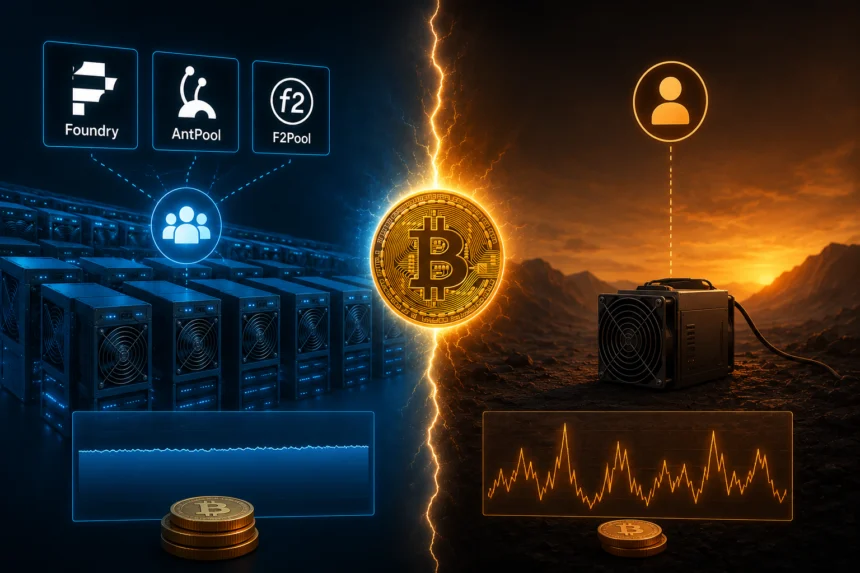
- Foundry, AntPool, and F2Pool control over 60% of the total bitcoin mining hash rate as of Q2 2024, sparking centralization concerns.
- The average pool fee for top mining pools like Foundry and AntPool ranges from 1-3%, with payout methods including PPS, PPLNS, and FPPS.
- Bitcoin’s total mining revenue reached $15 billion in 2023, with mining pools generating significantly more revenue than solo miners due to reduced variance.
The debate between bitcoin mining pool vs solo mining has been ongoing, with many miners weighing the pros and cons of each approach. At its core, the choice between joining a mining pool or going solo depends on the miner’s priorities, with revenue, variance, and decentralization being key considerations. In this article, we will explore how mining pools work, their fees, payout methods, and why solo mining is statistically impractical for most miners, with a focus on the bitcoin mining pool vs solo mining trade off.
Introduction to Mining Pools
Bitcoin mining pools like Foundry, AntPool, and F2Pool allow miners to combine their computational resources, increasing their chances of solving complex mathematical equations and earning block rewards. By pooling their resources, miners can reduce the variance of their revenue, making it more predictable and stable.
For instance, a miner joining a large pool like Foundry can expect to receive a steady stream of revenue, albeit with a 1-3% pool fee deducted from their earnings. This fee is a small price to pay for the increased stability and reduced variance that comes with mining pool membership.
How Mining Pools Work
Mining pools operate by dividing the work among participating miners, with each miner contributing their computational power to the pool. The pool’s administrator then assigns work to each miner, who solves a portion of the complex mathematical equation required to validate a block of transactions.
Once a miner in the pool solves the equation, the pool is rewarded with the block reward, which is then distributed among the participating miners according to their contributed hash power. This distribution is typically done using payout methods like PPS (Pay Per Share), PPLNS (Pay Per Last N Shares), or FPPS (Full Pay Per Share).
Payout Methods and Pool Fees
The payout method used by a mining pool can significantly impact a miner’s revenue. For example, PPS payout methods reward miners based on the number of shares they submit, regardless of whether the pool solves a block. In contrast, PPLNS payout methods reward miners based on the number of shares they submit, but only if the pool solves a block.
Pool fees also play a crucial role in determining a miner’s revenue. With fees ranging from 1-3%, miners must carefully consider the cost of joining a pool versus the benefits of reduced variance and increased revenue. In the context of bitcoin mining pool vs solo mining, the fee can be a decisive factor in choosing between the two options.
The Case Against Solo Mining
Solo mining, on the other hand, involves a miner working alone to solve complex mathematical equations and earn block rewards. While solo mining can be appealing to those who value decentralization and autonomy, it is statistically impractical for most miners due to the high variance and low revenue.
For instance, a solo miner with a modest 1 TH/s hash rate would need to wait an average of 100 days to solve a block, earning a block reward of 6.25 BTC. In contrast, a miner joining a large pool like AntPool can expect to earn a steady stream of revenue, with the pool’s combined hash power increasing the chances of solving a block.
Centralization Concerns
The concentration of hash power among the top 3 mining pools, including Foundry, AntPool, and F2Pool, has raised concerns about centralization in the bitcoin network. With over 60% of the total hash rate controlled by these pools, some worry that the network is becoming increasingly vulnerable to 51% attacks and other forms of manipulation.
However, notably that the bitcoin protocol is designed to be resilient to centralization, with mechanisms like ASIC resistance and the upcoming taproot upgrade aimed at promoting decentralization and security.
The TCB View
TCB believes that the bitcoin mining pool vs solo mining debate is ultimately a trade off between revenue, variance, and decentralization. While solo mining offers autonomy and decentralization, it is statistically impractical for most miners due to the high variance and low revenue. In contrast, mining pools offer reduced variance and increased revenue, but at the cost of centralization and pool fees.
We see the concentration of hash power among the top 3 mining pools as a significant risk, with the potential for 51% attacks and other forms of manipulation. However, we also recognize that the bitcoin protocol is designed to be resilient to centralization, with mechanisms aimed at promoting decentralization and security. Watch for the upcoming taproot upgrade, which could potentially reduce the dominance of large mining pools and promote greater decentralization in the network.