Last updated: 30 May 2026
Key Highlights
Key Highlights
- A DAO, or Decentralized Autonomous Organization, is a member owned community governed by smart contracts and token based voting rather than a board of directors or executive team.
- Major DAOs in 2026 include Uniswap (governs the largest DEX), MakerDAO (governs the DAI stablecoin), Arbitrum DAO (governs the largest Ethereum Layer 2), and Nouns DAO (daily NFT auction with treasury control).
- DAO governance works through proposals: any token holder above a minimum threshold can submit a proposal, the community votes, and if it passes, the smart contract executes it automatically.
- Voter apathy is one of the most persistent problems in DAO governance. Most major DAOs see participation rates of 5 to 15% of eligible voters on any given proposal.
- Legal recognition of DAOs remains inconsistent globally. Wyoming, Marshall Islands, and a handful of other jurisdictions recognize DAOs as legal entities. Most do not.
A Decentralized Autonomous Organization, universally known as a DAO, is an internet native organization governed by its members through token based voting and executed by smart contracts, without any centralized leadership or board of directors. DAOs represent one of the most genuinely novel organizational structures to emerge from the blockchain era: a way for distributed groups of people who may never meet each other to collectively own and manage billions of dollars in assets, make protocol decisions, and fund projects, all through code rather than corporate hierarchy.
How a DAO Actually Works
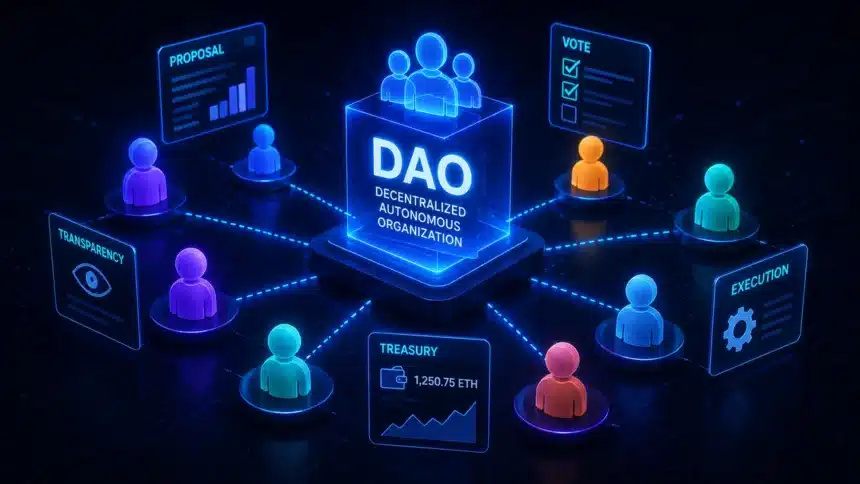
At its simplest, a DAO is a combination of three things: a treasury (funds held in a smart contract), governance tokens (which represent voting power), and a governance process (how proposals are made, debated, and executed).
The typical governance lifecycle looks like this. A member with enough tokens to meet the proposal threshold (which varies by DAO but is typically a small percentage of total supply) submits a formal proposal on chain or through an off chain signaling tool like Snapshot. The proposal is posted for community discussion, usually in a forum like Discourse or Discord, for a period of days or weeks. Then a formal vote opens on chain. Token holders vote yes, no, or abstain. If the proposal passes the required quorum and approval threshold, a time lock period begins (typically 48 to 72 hours), after which the smart contract automatically executes the approved action.
The critical property of a well designed DAO is that the smart contract executes without requiring any human to approve the final step. A successful governance vote authorizing a $50 million grant will release those funds automatically when the time lock expires, regardless of whether any executive agrees or disagrees with the decision.
Major DAOs in 2026 and What They Control
The scale of DAO governance in 2026 is substantial. Uniswap DAO controls the Uniswap protocol, which processes tens of billions in monthly trading volume, and manages a treasury holding several billion dollars in UNI tokens. Governance decisions at Uniswap include fee switches (whether to redirect some trading fees to the DAO treasury rather than liquidity providers), cross chain deployments, and protocol upgrades.
MakerDAO, now rebranded as Sky Protocol, governs the DAI stablecoin and its successor USDS. It manages collateral types, stability fees (the interest rate for minting DAI), and the allocation of the protocol’s revenue. Given that DAI is used as the base stablecoin across much of the DeFi ecosystem, Maker governance decisions have systemic effects across DeFi.
Arbitrum DAO, formed in 2023 when Offchain Labs airdropped ARB tokens to users of the Arbitrum network, controls a treasury that peaked at over $3 billion in ARB. It governs the Arbitrum One and Arbitrum Nova networks, approves grants to ecosystem developers, and makes decisions about the network’s sequencer and fraud proof system. Arbitrum DAO’s governance is one of the most active in the space, with regular proposals on everything from DeFi grants to gaming partnerships to protocol parameter changes.
Nouns DAO takes a different approach. Every 24 hours, one Noun NFT is auctioned and the proceeds go into the DAO treasury. Each Noun represents one vote. The DAO funds projects that spread the Nouns brand and advance public goods in the Ethereum ecosystem. By 2026, Nouns has accumulated and deployed tens of millions in ETH through hundreds of proposals, funding everything from murals and films to open source developer tooling.
The Balancer DAO Case Study: When Things Go Wrong
The Balancer Labs collapse in 2025 offers an instructive case study in DAO governance failure under stress. Balancer Protocol, a decentralized exchange and automated market maker, suffered a significant exploit that drained protocol funds. The corporate entity behind the protocol dissolved, leaving the DAO to restructure operations.
The challenge was immediate: a DAO designed for steady state governance of a functioning protocol suddenly needed to make rapid decisions about restructuring, legal obligations, and treasury management under crisis conditions. The slow, deliberative governance process that protects DAOs from hasty decisions became a liability when speed was essential. Fee adjustments and token buybacks that should have taken days to implement took weeks because governance could not move faster.
This tension between the deliberative pace of DAO governance and the speed requirements of crisis response is one of the fundamental unsolved problems in DAO design. Most major DAOs now maintain a security committee or emergency multisig with the authority to pause contracts without a full governance vote, accepting a centralization tradeoff in exchange for the ability to respond to attacks within hours rather than weeks.
Voter Apathy: The Most Persistent DAO Problem
In theory, token based governance is the purest form of democratic ownership. Understanding the difference between centralized and decentralized control helps frame why this matters. In practice, most governance votes are decided by a tiny fraction of eligible participants. Uniswap governance proposals regularly see less than 10% of eligible UNI tokens voted. Compound governance has struggled to reach quorum on important proposals. The Arbitrum DAO’s early votes on major treasury allocations showed participation from fewer than 5% of ARB holders.
Several factors drive low participation. Many token holders are passive investors with no interest in governance. The cost of staying informed about complex technical proposals is high. For small token holders, the impact of a single vote on the outcome is negligible. Gas costs for on chain voting add friction (though off chain voting via Snapshot has reduced this). And many token holders are exchanges and custodians that hold tokens on behalf of users who have never been given a voice in governance.
Solutions being tested include vote delegation (token holders can assign their votes to active delegates who specialize in governance), optimistic approval (proposals pass unless vetoed rather than requiring active approval), and veToken models (longer token lock up periods grant more voting power, attracting more committed participants). None of these fully solves the apathy problem, but they redistribute the active participation more efficiently among those who care.
Legal Status: The Unresolved Question
One of the most significant unresolved issues in DAO development is legal recognition. In most jurisdictions, a DAO is not a recognized legal entity. This creates serious practical problems. A DAO cannot sign contracts, cannot employ staff directly, cannot own property in its own name, and in some cases cannot be held liable for its actions, which paradoxically exposes individual token holders to unlimited personal liability as if they were general partners in an unincorporated partnership.
Wyoming became the first US state to recognize DAOs as LLCs in 2021. The Marshall Islands recognized DAOs as legal entities in 2022. Several other jurisdictions have followed or are in the process of creating DAO specific legal frameworks. The European Union’s MiCA framework touches on DAO issued tokens but does not create a comprehensive DAO legal structure. In most of the world, DAOs operate in legal ambiguity, using legal wrappers (a traditional LLC or foundation) to interact with the off chain world while the on chain governance remains decentralized.
This legal ambiguity has real consequences. The CFTC sued Ooki DAO (formerly bZx) in 2022 and served the lawsuit through its governance forum, establishing precedent that US regulators can treat DAO token holders as liable for the DAO’s actions. This case sent a significant warning signal to the entire DAO ecosystem about the risks of operating without appropriate legal structure.
Treasury Management: Running a Billion Dollar Community
The largest DAO treasuries are measured in billions. Managing those funds responsibly is a genuine challenge. Most early DAO treasuries were almost entirely concentrated in the protocol’s own governance token, meaning a 70% price decline (which has happened multiple times across the crypto cycle) could wipe out most of the treasury’s dollar value even while the token count remained unchanged.
DeFi native treasury management has evolved significantly. Major DAOs now maintain diversified treasuries with portions in stablecoins (USDC, USDT, DAI), ETH, and governance tokens. They deploy treasury assets in DeFi protocols to earn yield. They use grants programs, ecosystem funds, and working groups to deploy capital systematically rather than through ad hoc proposals. Karpatkey, Llama, and Gauntlet are professional treasury management DAOs that manage on chain assets for other DAOs on a fee basis, bringing institutional portfolio management practices to decentralized governance.
The Future of DAOs
DAOs are not going to replace corporations universally. The organizational structure is too slow for most commercial operations, too dependent on token holder engagement, and too legally ambiguous for most jurisdictions. What DAOs are genuinely well suited for is governing shared infrastructure that no single entity should control: protocol parameters, fee structures, treasury allocation for public goods, and upgrade decisions for community owned networks.
The trajectory in 2026 is toward more professional, more legally structured, and more efficiently governed DAOs. SubDAOs (smaller specialist committees with delegated authority from the main DAO) are increasingly common. Professional delegate programs are attracting governance specialists who actively participate in multiple DAOs. Legal wrappers are becoming standard for any DAO that needs to interact with the traditional legal system.
The core innovation of the DAO, that a group of strangers connected only by token ownership can collectively control significant assets through transparent, on chain rules, remains genuinely novel and genuinely useful. The DeFi protocols that most users interact with daily are governed by DAOs. The continued functioning of billions in on chain assets depends on DAO governance working well. Understanding how crypto cycles work helps predict when DAO treasuries will face the most pressure. The fear and greed cycle in crypto markets often reflects how well or poorly major DAOs are perceived to be functioning. Understanding what DAOs are and how they work is therefore not optional for anyone serious about the decentralized economy.