

Last updated: 9 June 2026
Key Highlights
- Total Value Locked (TVL) in DeFi liquidity pools surpassed $50 billion across various chains by Q4 2023, reflecting significant growth.
- Uniswap V3, launched in May 2021, introduced concentrated liquidity, allowing providers to earn fees within specific price ranges.
- Impermanent loss, a key risk, can result in up to 50% less value than simply holding assets if one token drops to 25% of its initial price.
- Stablecoin pools on platforms like Curve Finance typically offer Annual Percentage Yields (APYs) ranging from 3% to 8% for lower risk.
- Leading decentralized exchanges such as PancakeSwap on BNB Chain frequently process daily trading volumes exceeding $200 million.
Participating in DeFi liquidity pools allows individuals to earn passive income by providing assets to decentralized exchanges, acting as the backbone of the decentralized finance ecosystem. This guide explains how to participate in DeFi liquidity pools, covering everything from choosing the right platform to managing risks and maximizing returns for beginners.
Understanding DeFi Liquidity Pools
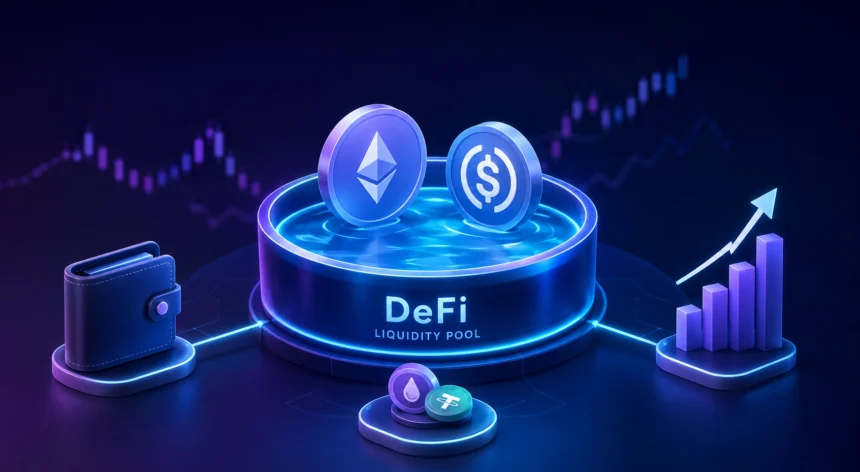
DeFi liquidity pools are collections of cryptocurrencies or tokens locked in a smart contract. These pools facilitate trading on decentralized exchanges (DEXs) using an automated market maker (AMM) model, eliminating the need for traditional order books and intermediaries.
When you contribute your assets to a liquidity pool, you become a liquidity provider (LP). LPs receive a portion of the trading fees generated by transactions within that pool, proportional to their contribution. This mechanism incentivizes users to supply the capital needed for efficient token swaps.
For example, a common pool might consist of ETH and USDC. When a user wants to swap ETH for USDC, they interact with this pool. The AMM algorithm determines the exchange rate based on the ratio of assets in the pool, and the LP earns a small fee from that transaction.
Choosing the Right Pool and Platform
Selecting the appropriate liquidity pool is crucial for managing risk and optimizing returns. Beginners should consider several factors, including the platform’s reputation, the token pair involved, the Total Value Locked (TVL), and the Annual Percentage Yield (APY).
Major platforms like Uniswap, Curve Finance, Balancer, and SushiSwap are generally more established and have undergone extensive security audits. Uniswap is known for its wide range of token pairs and concentrated liquidity, while Curve Finance specializes in stablecoin and wrapped asset swaps, often offering lower impermanent loss risk.
When evaluating a pool, examine its TVL, which indicates the total value of assets locked within it. Higher TVL often suggests greater stability and liquidity. Also, look at the trading volume for the specific pool. High volume means more fees are generated, leading to potentially higher APYs for LPs.
Consider the volatility of the token pair. Providing liquidity for a stablecoin pair, such as USDC/DAI on Curve, typically carries less impermanent loss risk than a volatile pair like ETH/SOL on Uniswap. While volatile pairs can offer higher APYs, they also expose LPs to greater potential losses if asset prices diverge significantly.
Connecting Your Wallet and Acquiring Assets
Before you can provide liquidity, you need a compatible cryptocurrency wallet and the necessary tokens. MetaMask is a popular choice, supporting Ethereum and many EVM compatible networks like Polygon, Arbitrum, and BNB Chain. Hardware wallets like Ledger or Trezor offer enhanced security for larger holdings.
First, ensure your chosen wallet is set up and funded with the tokens required for your desired liquidity pool. If you do not already own the tokens, you will need to acquire them through a centralized exchange like Coinbase or Binance, or a decentralized exchange if you prefer.
Once acquired, transfer these tokens from the exchange to your self custody wallet. Always double check the recipient address and network to prevent loss of funds. For instance, if you are providing liquidity on an Ethereum based DEX, ensure your tokens are on the Ethereum mainnet.
After your wallet is funded, navigate to the decentralized exchange where your chosen pool is located. Most DEXs will have a clear “Connect Wallet” button, usually in the top right corner. Click this, select your wallet provider, and approve the connection request that appears in your wallet interface.
Providing Liquidity and Managing Your Position
With your wallet connected and assets ready, you can now provide liquidity. On the DEX interface, find the “Pool” or “Liquidity” section. Search for the specific token pair you selected earlier. For example, if you chose the ETH/USDC pool on Uniswap, navigate to that specific pool page.
You will be prompted to deposit an equal value of both tokens into the pool. For instance, if you deposit $100 worth of ETH, you must also deposit $100 worth of USDC. Enter the amount for one token, and the interface will automatically calculate the equivalent amount for the other.
Before depositing, you will need to approve the DEX’s smart contract to spend your tokens. This is a one time transaction per token. After approval, confirm the deposit transaction. You will pay a network gas fee for both the approval and the deposit. Once confirmed, you will receive LP tokens, which represent your share of the liquidity pool.
These LP tokens are crucial; they are your receipt and entitle you to your share of the pool, including accumulated fees. You can monitor your position on the DEX’s liquidity page, which often displays your current earnings and the value of your deposited assets. When you wish to withdraw, you will “burn” these LP tokens to reclaim your original assets plus any earned fees.
Mitigating Risks and Maximizing Returns
While DeFi liquidity pools offer attractive returns, they come with inherent risks. The most significant is impermanent loss, which occurs when the price ratio of your deposited tokens changes after you provide liquidity. If one asset significantly outperforms or underperforms the other, the value of your withdrawn assets may be less than if you had simply held them outside the pool. For example, if ETH doubles in value while USDC stays pegged, an ETH/USDC LP might end up with more USDC and less ETH than initially deposited.
To mitigate impermanent loss, consider stablecoin pools or pools with highly correlated assets. Diversifying your liquidity across multiple pools and platforms can also spread risk. Additionally, be aware of smart contract risks; even audited protocols can have vulnerabilities. Always use reputable, well established platforms with a proven track record.
Gas fees, especially on Ethereum, can eat into profits, particularly for smaller liquidity positions or frequent transactions. Utilizing Layer 2 solutions like Arbitrum, Polygon, or Optimism can significantly reduce transaction costs. These networks offer faster and cheaper transactions while still benefiting from Ethereum’s security.
To maximize returns, actively monitor pool APYs and trading volumes. Some LPs engage in “yield farming,” moving liquidity between different protocols to chase the highest returns. However, this strategy requires constant attention and involves higher gas fees and potential impermanent loss if not managed carefully. Always calculate potential returns against all associated costs and risks.
The TCB View
TCB believes that participating in DeFi liquidity pools represents a compelling opportunity for passive income, though it requires a cautious and informed approach. We see the continued growth of TVL across major protocols, exceeding $50 billion, as a clear indicator of sustained interest and utility in the DeFi space.
The primary risk for new liquidity providers remains impermanent loss, particularly in volatile asset pairs, which can erode capital for the uninformed. Savvy LPs who understand this risk, perhaps by favoring stablecoin pools on platforms like Curve Finance or utilizing concentrated liquidity on Uniswap V3, stand to gain the most from trading fee generation.
Conversely, those who chase unsustainable high APYs on unaudited or new protocols without understanding the underlying mechanics or smart contract risks are likely to incur significant losses. Our read is that the democratization of finance through these pools will continue, but the landscape will favor those who prioritize security and long term strategy.
Watch for continued innovation in impermanent loss mitigation strategies and the broader adoption of Layer 2 networks to significantly reduce gas fees, making these opportunities accessible to a wider range of participants. TCB will be tracking the TVL growth on these Layer 2 solutions, particularly if they consistently capture more than 20% of new liquidity inflows.