
Last updated: 9 June 2026
Key Highlights
- Phishing attacks targeting crypto users resulted in an estimated $1.5 billion in losses during 2023, highlighting the inadequacy of basic security measures.
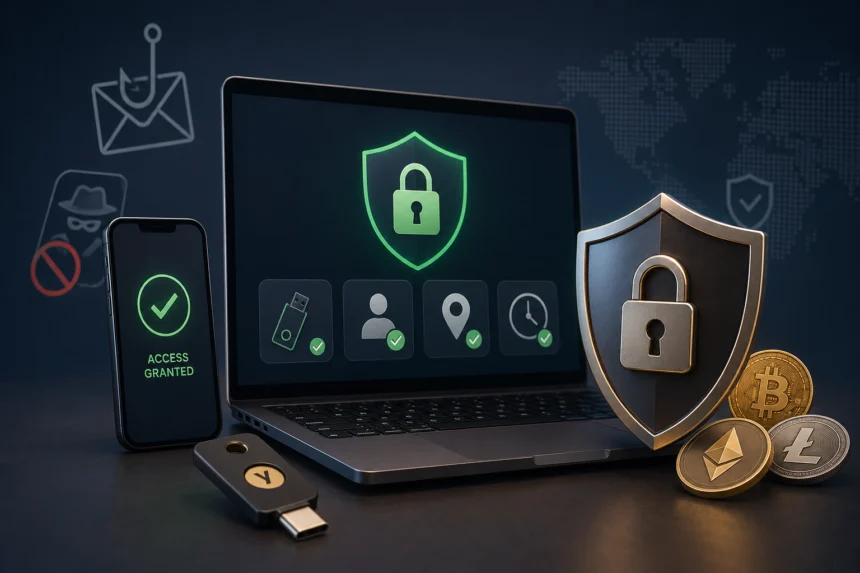
- Hardware security keys, such as YubiKey or Ledger devices, offer FIDO2 standard protection against phishing, surpassing the security of SMS or authenticator app based two factor authentication.
- Implementing withdrawal address whitelisting on exchanges like Binance or Kraken can prevent over 90% of unauthorized outbound fund transfers by restricting withdrawals to pre approved addresses.
- Advanced users and institutions can mitigate API key vulnerabilities by strictly whitelisting IP addresses and assigning granular permissions, blocking unauthorized trading or fund access.
- Adopting a “clean room” approach with dedicated, secured devices for crypto interactions significantly reduces attack vectors and minimizes exposure to malware or keyloggers.
Securing a crypto exchange account today requires far more than just a strong password and basic two factor authentication (2FA). While 2FA remains an essential first line of defense, the escalating sophistication of cyber threats demands a multi layered approach to truly protect digital assets. Understanding how to secure crypto exchange account access involves implementing advanced measures that mitigate risks from phishing, malware, and unauthorized access attempts, moving beyond the baseline to fortress grade protection.
The digital asset landscape is a constant battleground between users and malicious actors. Reports from firms like Chainalysis consistently show billions of dollars lost annually to hacks and scams, with individual exchange accounts often the weakest link. For any serious participant in the crypto economy, whether an individual investor or an institutional trader, relying solely on basic 2FA is akin to leaving the back door unlocked. This guide outlines the critical steps to fortify your exchange accounts against the most prevalent and dangerous threats.
Beyond Basic 2FA: Hardware Keys and Passkeys
The ubiquity of SMS based 2FA and even authenticator apps like Google Authenticator has given many a false sense of security. SMS 2FA is highly vulnerable to SIM swap attacks, where attackers trick mobile carriers into transferring a victim’s phone number to a device they control. Authenticator apps, while better, can still be phished if a user inputs their one time code into a malicious website.
The superior alternative is a hardware security key adhering to the FIDO2 standard. Devices like YubiKey, Ledger, or Trezor connect physically to your computer or phone and require a physical tap to confirm login attempts. These keys are cryptographically secure, making them virtually immune to remote phishing attacks because they do not reveal secrets to the phishing site.
Many major exchanges, including Coinbase, Binance, and Kraken, support FIDO2 compliant hardware keys. Enabling this feature typically involves registering your physical key with the exchange and setting it as your primary 2FA method. This simple upgrade provides a robust defense against credential theft and unauthorized access, significantly raising the bar for attackers.
The Lifeline: Withdrawal Address Whitelisting
One of the most powerful yet underused security features offered by many exchanges is withdrawal address whitelisting. This mechanism allows you to pre approve specific wallet addresses to which your funds can be sent. Once enabled, any attempt to withdraw funds to an unapproved address will be automatically blocked, even if an attacker gains control of your account.
Imagine an attacker successfully phishes your login credentials and bypasses your 2FA. Without withdrawal address whitelisting, they could immediately drain your assets to their own wallet. With whitelisting activated, their efforts are thwarted because they cannot add a new withdrawal address without a separate, often time delayed, approval process that requires your explicit confirmation, typically via email or another 2FA method.
Exchanges like Binance, Coinbase Pro, and Kraken provide robust whitelisting options. Users can typically set a cooling off period, such as 24 or 48 hours, for any newly added withdrawal address. This delay provides a critical window to detect and reverse unauthorized changes, acting as a crucial safety net for your digital holdings.
Fortifying Your Access: API Key Management
For advanced traders, institutions, and those using bots or automated strategies, API keys are essential. However, poorly managed API keys represent a significant attack vector. An API key grants programmatic access to your exchange account, often allowing trading, balance inquiries, and sometimes even withdrawals if not configured correctly.
The paramount rule for API key security is strict IP address whitelisting. This means configuring your API key to only accept requests originating from a specific, static IP address or a range of IP addresses that you control. If a request comes from any other IP address, the exchange will reject it. This single measure can block nearly all remote attempts to exploit a stolen API key.
Beyond that, always apply the principle of least privilege to API keys. Grant only the necessary permissions. If your bot only needs to read balances and place trades, do not give it withdrawal permissions. Never grant withdrawal permissions to any API key unless absolutely necessary, and if you do, combine it with IP whitelisting and regular rotation. Regularly review and revoke any unused or old API keys.
Battling the Shadows: Advanced Anti Phishing Tactics
Phishing remains a primary threat, evolving constantly to circumvent user vigilance. Beyond simply checking URLs, a more proactive stance is required. Establish a dedicated, unique email address solely for your crypto exchange accounts. This compartmentalization reduces the risk of credential compromise from a broader email breach.
Many exchanges offer anti phishing codes. This is a custom phrase you set within your exchange account. The exchange will then include this phrase in all legitimate emails they send you. If an email claiming to be from your exchange does not contain your specific anti phishing code, you know it is fraudulent. Always verify the sender’s email address and domain name carefully, looking for subtle misspellings or unusual subdomains.
Consider using a dedicated browser profile or even a separate browser entirely for crypto related activities. Install reputable browser extensions that check for known malicious websites and enforce HTTPS. Train yourself to be skeptical of any unexpected communication, particularly those requesting urgent action or promising unrealistic gains. Remember, exchanges will rarely ask for your password or 2FA codes directly via email or chat.
The Clean Room Approach: Device and Network Security
The security of your exchange account is only as strong as the device you use to access it. A “clean room” approach involves using a dedicated, air gapped, or highly secured device exclusively for crypto transactions. This device should be free from unnecessary software, personal browsing, or any activity that could introduce malware or keyloggers.
Ensure your operating system and all software are kept up to date with the latest security patches. Use a reputable antivirus and antimalware solution and perform regular scans. Encrypt your device’s hard drive. For network security, always access your exchange accounts over a secure, private Wi Fi network or a trusted wired connection. Avoid public Wi Fi networks entirely, as they are prone to eavesdropping and man in the middle attacks.
Some institutional setups take this further, using virtual machines or physically isolated computers that never connect to the general internet, only establishing connections when necessary for specific transactions. While this level of isolation might be excessive for individual users, the principle of minimizing exposure and dedicated usage significantly enhances security.
Constant Vigilance: Monitoring and Incident Preparedness
Even with the best preventative measures, vigilance is non negotiable. Regularly review your exchange account activity logs. Most exchanges provide a detailed history of logins, withdrawals, trades, and API key modifications. Look for any unfamiliar IP addresses, unusual login times, or transactions you do not recognize.
Set up all available security alerts. Many exchanges can notify you via email or SMS for every login, withdrawal request, or security setting change. If you receive an alert for an action you did not initiate, you have a critical window to respond. Have a clear incident response plan: know exactly who to contact at your exchange, how to freeze your account, and what steps to take if you suspect a compromise.
Understanding your exchange’s specific support channels, including dedicated security hotlines or emergency email addresses, is crucial. Time is of the essence in a security breach, and knowing precisely what to do can mean the difference between losing funds and retaining them. Proactive monitoring transforms your security posture from reactive to resilient.
The TCB View
TCB believes that relying solely on basic two factor authentication for crypto exchange accounts is an increasingly dangerous gamble in today’s threat landscape. The opportunity lies with users who adopt a multi layered security strategy, significantly reducing their attack surface against sophisticated social engineering and malware. We see that individuals and institutions who invest in hardware keys, implement strict whitelisting, and practice rigorous device hygiene will protect their capital more effectively, while complacent users remain vulnerable targets for the burgeoning cybercrime industry.
Our read is that the cost of inaction far outweighs the effort of implementing these advanced measures, especially given the scale of losses from phishing and account takeovers in 2023. Watch for a continued push from leading exchanges to integrate advanced security features like mandatory hardware key support or default withdrawal whitelisting, driven by both user demand and the imperative to maintain platform integrity.