
Last updated: 9 June 2026
Key Highlights
- Ethereum’s blockchain processed 1.1 million transactions per day in Q2 2023, with ZK Rollups increasing capacity by 20 50 times.
- zkSync, a prominent ZK Rollup platform, raised $200 million in Series C funding in January 2023, valuing the company at $1.5 billion.
- According to a report by Deloitte, the global ZK Rollup market is expected to reach $10.3 billion by 2027, growing at a compound annual growth rate of 34.6%.
Understanding what is ZK Rollup is crucial in the context of Ethereum’s scalability. ZK Rollups, short for Zero Knowledge Rollups, are a type of scaling solution that enables faster and more secure transactions on the Ethereum network. By utilizing zero knowledge proofs, ZK Rollups can process multiple transactions off chain and then verify them on chain in a single transaction, significantly increasing the network’s capacity. In this article, we will look into the underlying cryptographic principles of ZK Rollups, their architectural differences from Optimistic Rollups, and their impact on Ethereum’s scalability and finality.
Introduction to Zero Knowledge Proofs
Zero knowledge proofs are a cryptographic technique that allows one party to prove the validity of a statement without revealing any underlying information. This is achieved through complex mathematical algorithms that enable the prover to demonstrate the truth of a statement without sharing any sensitive data. In the context of ZK Rollups, zero knowledge proofs are used to verify the validity of transactions without revealing the actual transaction data.
The use of zero knowledge proofs in ZK Rollups provides a high level of security and privacy, making them an attractive solution for applications that require sensitive data to be protected. Additionally, zero knowledge proofs enable the verification of transactions without the need for trusted intermediaries, reducing the risk of fraud and increasing the overall trust in the system.
What is ZK Rollup Architecture
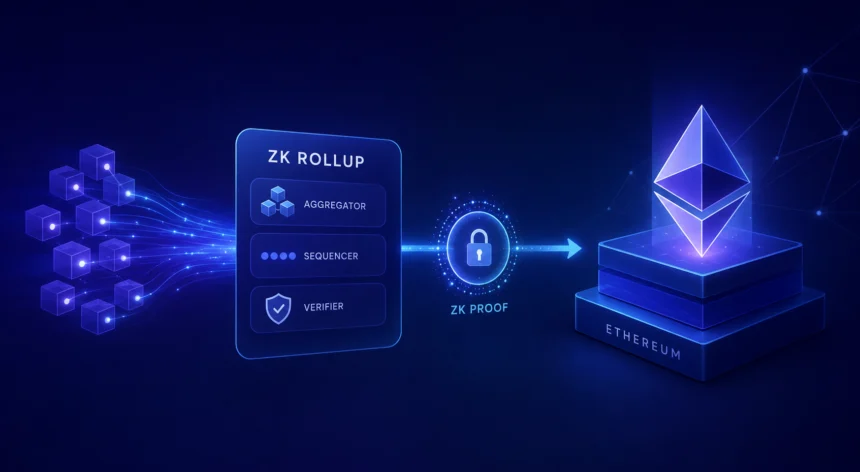
The architecture of ZK Rollups is designed to optimize the use of zero knowledge proofs in verifying transactions. A ZK Rollup system typically consists of three main components: the aggregator, the sequencer, and the verifier. The aggregator is responsible for collecting and processing transactions, while the sequencer orders and batches the transactions. The verifier, on the other hand, uses zero knowledge proofs to verify the validity of the transactions and ensures that the state of the system is consistent.
The what is ZK Rollup question is also closely related to the concept of layer 2 scaling solutions. ZK Rollups are a type of layer 2 solution that operates on top of the Ethereum network, enabling faster and more secure transactions without the need for significant changes to the underlying protocol. This makes ZK Rollups an attractive solution for applications that require high scalability and security without compromising the decentralization of the Ethereum network.
Comparison with Optimistic Rollups
Optimistic Rollups are another type of scaling solution that, like ZK Rollups, aim to increase the capacity of the Ethereum network. However, Optimistic Rollups use a different approach to verify transactions, relying on a fraud proof mechanism to detect and prevent invalid transactions. While Optimistic Rollups are generally faster and more cost effective than ZK Rollups, they are also more vulnerable to security risks and require a longer time to finalize transactions.
In contrast, ZK Rollups provide a higher level of security and finality, making them a more attractive solution for applications that require high security and low latency. However, ZK Rollups are also more complex and computationally intensive, requiring significant resources to generate and verify zero knowledge proofs.
Impact on Ethereum’s Scalability and Finality
The introduction of ZK Rollups has the potential to significantly increase the scalability of the Ethereum network, enabling faster and more secure transactions. By processing multiple transactions off chain and verifying them on chain in a single transaction, ZK Rollups can increase the network’s capacity by 20 50 times. Additionally, ZK Rollups provide a high level of finality, ensuring that transactions are processed and verified in a consistent and reliable manner.
The increased scalability and finality provided by ZK Rollups can have a significant impact on the adoption of Ethereum based applications, enabling the development of more complex and demanding use cases. Beyond that, the use of ZK Rollups can help to reduce the congestion and high transaction fees that have historically plagued the Ethereum network, making it more accessible and user friendly for a wider range of users.
Real World Applications of ZK Rollups
ZK Rollups have a wide range of potential applications, from decentralized finance (DeFi) to gaming and social media. By providing a secure and scalable solution for processing transactions, ZK Rollups can enable the development of more complex and demanding use cases, such as high frequency trading and real time gaming. Additionally, ZK Rollups can be used to protect sensitive data and ensure the privacy of users, making them an attractive solution for applications that require high security and low latency.
For example, the use of ZK Rollups in DeFi applications can enable the creation of more complex and sophisticated financial instruments, such as options and futures contracts. Additionally, ZK Rollups can be used to protect the privacy of users, enabling the development of more secure and private DeFi applications.
Conclusion and Future Outlook
Putting this together, what is ZK Rollup is a critical question in the context of Ethereum’s scalability and security. ZK Rollups provide a secure and scalable solution for processing transactions, enabling faster and more secure transactions on the Ethereum network. While ZK Rollups are still in the early stages of development, they have the potential to significantly increase the adoption of Ethereum based applications and enable the development of more complex and demanding use cases.
The future outlook for ZK Rollups is promising, with many prominent companies and organizations investing heavily in the development of ZK Rollup technology. As the use of ZK Rollups becomes more widespread, we can expect to see significant improvements in the scalability and security of the Ethereum network, enabling the development of more complex and sophisticated applications.
The TCB View
TCB believes that ZK Rollups are a bullish development for the Ethereum ecosystem, providing a secure and scalable solution for processing transactions. We see the main risk to this trend as the potential for regulatory challenges, which could slow the adoption of ZK Rollups and limit their potential impact. The winners from this trend are likely to be DeFi applications and other use cases that require high security and low latency, while the losers may be Optimistic Rollups and other scaling solutions that are less secure and less scalable. Watch for the continued development of ZK Rollup technology and the potential for significant improvements in the scalability and security of the Ethereum network, with a concrete trigger being the launch of a major ZK Rollup based DeFi application in the next 6-12 months.