
Last updated: 23 June 2026
Key highlights
Key Highlights
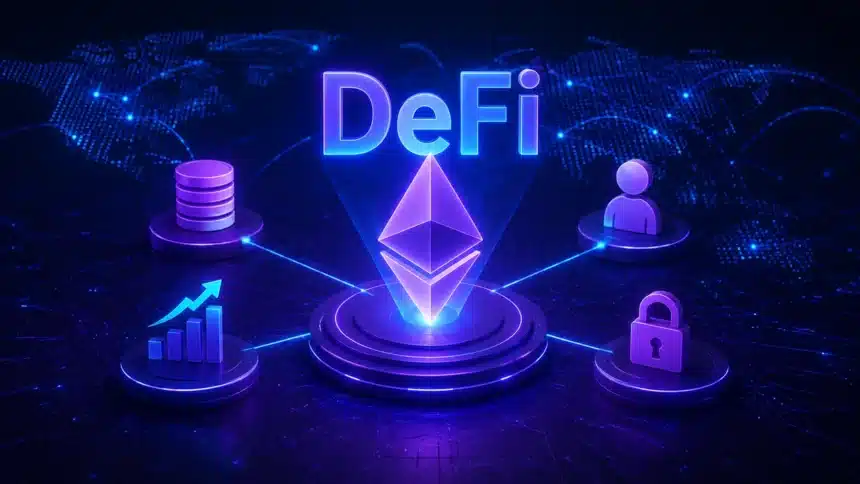
- DeFi, or decentralized finance, refers to financial services built on public blockchains that operate through smart contracts. Much of this activity now runs on Layer 2 networks rather than Ethereum mainnet, thanks to dramatically lower fees instead of banks, brokerages, or payment processors.
- The total value locked (TVL) in DeFi protocols across all chains exceeded $100 billion in 2026, led by Ethereum and its Layer 2 networks.
- Core DeFi services include decentralized exchanges (Uniswap), lending and borrowing (Aave, Compound), liquid staking (Lido), and yield aggregation (Yearn Finance).
- DeFi is permissionless: anyone with a crypto wallet and internet connection can access it, with no credit checks, identity verification, or geographic restrictions.
- Smart contract risk, liquidity risk, and regulatory uncertainty remain the primary reasons most retail users approach DeFi cautiously rather than replacing their bank accounts with it.
Decentralized finance, almost universally abbreviated to DeFi, is the collective term for financial services and products built on public blockchains that operate through self executing code called smart contracts rather than through banks, brokerages, or any centralized institution. It is one of the most significant experiments in financial infrastructure in decades, and understanding what it is, how it works, and what its real risks are is essential for anyone navigating the crypto space in 2026.
The Problem DeFi Is Trying to Solve
Traditional finance operates through a layered system of intermediaries. When you deposit money in a bank, the bank holds your funds and lends them to others. When you trade stocks, a broker executes the order and a clearinghouse settles it. When you send money internationally, your bank routes it through a correspondent banking network that can take days and charge significant fees. Each intermediary adds cost, takes a margin, and introduces counterparty risk.
DeFi replaces these intermediaries with smart contracts: programs that run on a blockchain and execute automatically when predefined conditions are met. This is also why Layer 2 networks have become the primary home for DeFi activity in 2026, reducing gas costs to fractions of a cent. A lending protocol does not need a loan officer. A decentralized exchange does not need a market maker desk or a compliance team. A stablecoin does not need a central issuer holding dollars in a bank account. The logic is in the code, the code runs on a decentralized network, and the result is financial services that operate 24 hours a day, seven days a week, without human intervention.
How Smart Contracts Power DeFi
A smart contract is a program deployed to a blockchain. Once deployed, its code cannot be changed (unless the contract includes an upgrade mechanism, which introduces its own risks). Anyone can read the code. Anyone can call its functions. The outcomes are deterministic: given the same inputs, the same outputs always result.
When you deposit ETH into Aave, a smart contract holds your collateral, tracks the borrow limit, calculates interest in real time, and liquidates your position automatically if the collateral value falls below a threshold. No human decision is involved. No office hours apply. The contract executes the same logic at 3 AM on a Sunday as it does at 9 AM on a Monday. This automation is what makes DeFi permissionless and continuous.
DAOs govern most major DeFi protocols, giving token holders control over protocol decisions. Ethereum hosts the majority of DeFi activity because its smart contract platform, the Ethereum Virtual Machine, was the first general purpose smart contract environment to achieve significant adoption. Bitcoin’s scripting language is intentionally limited and does not support complex DeFi applications natively, which is why virtually all major DeFi protocols run on Ethereum or its Layer 2 networks.
Decentralized Exchanges: Trading Without a Broker
Decentralized exchanges (DEXs) are the most widely used DeFi application. The dominant model is the automated market maker (AMM), pioneered by Uniswap in 2018. Instead of a traditional order book where buyers and sellers are matched, AMMs use liquidity pools: smart contracts holding two or more tokens, with prices determined algorithmically by the ratio of tokens in the pool.
When you swap ETH for USDC on Uniswap, you send ETH to the pool and receive USDC from it. The pool’s smart contract adjusts the price based on the new ratio. Liquidity providers (LPs) deposit token pairs into pools and earn a share of trading fees. There is no company approving your account, no KYC process, and no minimum trade size. You connect a wallet and trade.
Uniswap v4, deployed in 2024, introduced hooks that allow developers to customize pool behavior. In 2026, Uniswap remains the largest DEX by volume, processing tens of billions in monthly trading volume. Curve Finance specializes in stablecoin and pegged asset swaps with lower slippage. dYdX and GMX offer perpetual futures trading without a central exchange. The DEX ecosystem handles a significant and growing fraction of crypto trading volume that previously occurred entirely on centralized exchanges.
Lending and Borrowing: DeFi’s Bank Replacement
Lending protocols like Aave and Compound allow users to deposit crypto assets and earn interest, or to borrow against their existing crypto holdings. The core mechanism is overcollateralization: to borrow $1,000 in USDC, you might need to deposit $1,500 in ETH as collateral. This ensures the protocol is solvent even if the borrower defaults, because the smart contract can automatically sell the collateral to repay the loan.
Interest rates on lending protocols are set algorithmically based on supply and demand. When utilization of a pool is high (most deposits are lent out), interest rates rise to attract more deposits and discourage borrowing. When utilization is low, rates fall. This creates a continuous, real time interest rate market with no central rate setting authority. Market sentiment drives utilization rates in DeFi lending the same way it drives crypto prices broadly.
Aave has introduced credit delegation, which allows trusted parties to borrow against someone else’s collateral, and GHO, its own stablecoin backed by DeFi collateral. Compound v3 simplified the protocol architecture to reduce attack surface and improve capital efficiency. Together, these two protocols hold the majority of DeFi lending TVL, typically in the range of $15 to $25 billion combined.
Liquid Staking: Earning Yield on Staked ETH
After Ethereum’s transition to proof of stake in September 2022, ETH holders could earn staking rewards by locking their ETH with validators. The problem: staked ETH was illiquid and inaccessible while staked. Liquid staking protocols solved this by issuing a receipt token (stETH from Lido, rETH from Rocket Pool) that represents staked ETH plus accrued rewards and can be freely traded, lent, or used in other DeFi protocols.
Lido Finance became the dominant liquid staking provider and, by 2026, controls approximately 30% of all staked ETH, making it the single largest entity in Ethereum’s staking ecosystem. This concentration has triggered significant community debate about validator centralization risk. Rocket Pool, with its distributed node operator model and requirement for node operators to stake RPL as insurance, represents a more decentralized alternative with a smaller but loyal user base.
Stablecoins: The Foundation of DeFi Liquidity
DeFi could not function at scale without stablecoins. Traders need a stable unit of account. Lenders need a stable borrowing asset. Yield farmers need stable assets to move between protocols without constant exchange rate exposure. The stablecoin ecosystem in DeFi spans several distinct models.
Fiat backed stablecoins (USDC, USDT) are issued by centralized entities holding dollar reserves. They are the most liquid and widely accepted but reintroduce counterparty risk: Circle and Tether hold the underlying assets and could freeze or blacklist addresses. During the March 2023 Silicon Valley Bank collapse, USDC briefly depegged to $0.87 when concerns arose about Circle’s cash held at SVB before reassurance from Circle and the FDIC stabilized the peg.
Crypto collateralized stablecoins (DAI, LUSD) are issued by smart contracts against on chain crypto collateral. MakerDAO’s DAI is the most established, backed by a mix of USDC, ETH, and tokenized real world assets. Its peg has been remarkably stable. Liquity’s LUSD is backed purely by ETH, making it the most decentralized major stablecoin but limiting its scalability.
DeFi Risks Every User Must Understand
The permissionless nature of DeFi that makes it powerful also makes it dangerous for the unprepared. Smart contract risk is the most significant: a bug in the code can be exploited to drain funds, and there is no FDIC insurance, no recourse mechanism, and no customer service number to call. The Balancer Labs exploit that drained over $110 million in 2025 is one of dozens of significant DeFi hacks that have occurred since the ecosystem launched.
Liquidity risk occurs when a protocol’s liquidity dries up faster than positions can be closed, leading to severe slippage or inability to exit. Oracle manipulation attacks exploit the price feeds that DeFi protocols depend on to know the value of their collateral. Governance attacks occur when an attacker accumulates enough governance tokens to push through a malicious protocol change.
DAOs govern most major DeFi protocols, meaning token holders vote on changes. This democratizes control but also means that a sufficiently wealthy attacker can buy votes. For this reason, the most battle tested DeFi protocols are those with time locks on governance changes, multisig emergency pauses, and conservative upgrade procedures.
DeFi vs CeFi: Where Each Makes Sense
Centralized finance (CeFi) in crypto means exchanges like Coinbase, Kraken, and Binance. They are regulated, have customer support, offer fiat on and off ramps, and provide FDIC insurance on cash balances in some cases. They are the right entry point for most new users and for anyone who values simplicity and recourse over self custody.
DeFi makes sense for users who want full control over their assets, access to financial services not available in their country, or participation in new financial primitives like liquid staking and on chain lending. It requires technical competence to avoid common mistakes like approving unlimited token spending to malicious contracts, interacting with phishing clones of legitimate protocols, or losing assets to impermanent loss in liquidity pools.
The distinction between DeFi and CeFi is also blurring. Coinbase’s Base is a Layer 2 that hosts significant DeFi activity while Coinbase retains influence over the sequencer. Aave has introduced institutional lending desks. The regulatory environment under frameworks like MiCA in Europe and the CLARITY Act in the United States is pushing DeFi protocols toward some degree of compliance infrastructure, reducing the pure permissionlessness of the earliest protocols in exchange for regulatory acceptance.
Where DeFi Stands in 2026
Bitcoin’s halving cycles have historically marked the beginning of new DeFi growth phases, as rising BTC prices generate capital that flows into the broader ecosystem. DeFi in May 2026 is more mature, more regulated, and more institutionally engaged than at any point in its history. TVL has recovered from the 2022 lows and stabilized above $100 billion across chains. The major protocols (Uniswap, Aave, Lido, MakerDAO) have years of security track records and billions in ongoing user activity. Layer 2 networks have reduced gas costs to the point where small retail transactions are economically viable for the first time.
What DeFi has not done is replace traditional finance at scale. The users are still primarily crypto native. The interfaces are still complex for non technical users. Regulatory clarity in most jurisdictions is still incomplete. The next phase of DeFi growth will likely come from integration into institutional workflows, from tokenized real world assets bringing trillions in off chain value on chain, and from simpler interfaces that abstract away the complexity without compromising the underlying permissionlessness that makes DeFi valuable.