Last updated: 9 June 2026
Key Highlights
- Optimism is an Ethereum Layer 2 scaling solution launched in December 2021, processing transactions up to 20x cheaper than the Ethereum mainnet.
- The OP Stack, introduced in October 2022, is a modular, open source development framework enabling anyone to build custom Layer 2 blockchains compatible with Optimism.
- The Superchain vision aims to unify multiple OP Stack chains into a single interoperable network, sharing security and communication via a shared sequencer.
- The Bedrock upgrade, implemented in June 2023, significantly reduced transaction fees by up to 40% and improved transaction finality on Optimism.
- The Optimism Collective, governing the protocol and OP token, has allocated over $100 million in grants for public goods funding since its inception.
What is Optimism crypto? Optimism is a leading Layer 2 scaling solution for Ethereum, designed to drastically reduce transaction costs and increase throughput while maintaining the security guarantees of the mainnet. It achieves this through optimistic rollups, bundling thousands of transactions off chain and submitting a single, compressed proof to Ethereum. Beyond merely scaling, Optimism has evolved its ambition with the OP Stack and the Superchain vision, aiming to create a network of interconnected blockchains that collectively enhance Ethereum’s utility for developers and users alike.
Optimism’s Core Mission: Scaling Ethereum
Ethereum, the backbone of decentralized finance and web3, faces inherent limitations in scalability. High transaction fees, often called gas fees, and slow transaction processing times have long been barriers to widespread adoption, particularly during periods of high network congestion. Optimism emerged as a direct response to these challenges, offering a practical solution to expand Ethereum’s capacity.
Optimism operates as an optimistic rollup. This technology aggregates hundreds or thousands of transactions off the main Ethereum chain. These bundled transactions are then submitted to Ethereum as a single data blob, drastically cutting down the computational load on the mainnet. The term “optimistic” refers to the assumption that all transactions within a rollup batch are valid by default, allowing for faster processing.
A crucial component of optimistic rollups is the fraud proof system. If a malicious or incorrect transaction is submitted, a challenger has a specific window, typically seven days, to submit a fraud proof to the Ethereum mainnet. If the fraud proof is successful, the incorrect transaction is reverted, and the sequencer responsible for the invalid batch is penalized. This mechanism ensures the integrity of the rollup while leveraging Ethereum’s robust security.
Since its launch, Optimism has demonstrated significant improvements in user experience. Average transaction fees on Optimism can be dozens of times lower than on Ethereum, often costing less than $0.10 for a simple transfer, compared to several dollars or even tens of dollars on the mainnet. This cost reduction, coupled with faster transaction finality, makes decentralized applications more accessible and affordable for a broader user base.
The OP Stack: A Modular Blueprint for Decentralization
The OP Stack represents a significant evolution in Optimism’s strategy, moving beyond a single Layer 2 to a modular, open source development framework. Unveiled in October 2022, the OP Stack provides a standardized set of code components that developers can use to build their own custom Layer 2 blockchains, known as “OP Chains.” This modularity allows for unprecedented flexibility and customization.
Think of the OP Stack as a set of Lego blocks for blockchain development. It comprises various components, including the execution layer, settlement layer, data availability layer, and governance layer. Developers can swap out or modify these modules to suit specific application needs. For instance, a project might choose a different data availability solution or a custom transaction fee mechanism, all while inheriting the security and battle tested foundation of Optimism.
A key milestone for the OP Stack was the Bedrock upgrade, implemented in June 2023. Bedrock was not just an update for Optimism itself but a significant refinement of the underlying OP Stack architecture. It brought several critical improvements, including further reducing transaction fees by up to 40% by optimizing data compression, speeding up transaction finality, and enhancing compatibility with Ethereum’s execution client software. This upgrade made the OP Stack more efficient and attractive for new chain deployments.
The philosophical underpinning of the OP Stack is to foster a diverse ecosystem of interoperable chains. By providing a common framework, it aims to reduce the complexity and cost associated with launching new Layer 2s. This approach encourages innovation and allows niche applications or communities to create their own sovereign chains, tailored to their specific requirements, without having to build a blockchain from scratch.
The Superchain Vision: A Unified Ecosystem
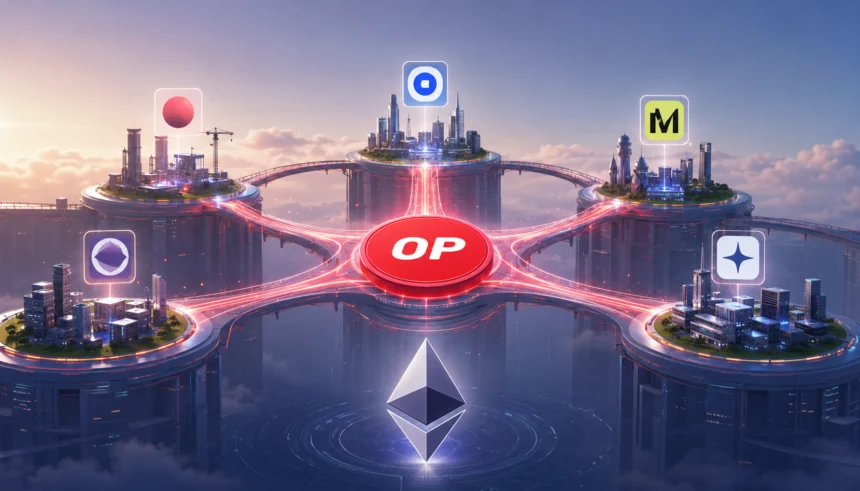
Optimism’s Superchain vision is an ambitious plan to connect all chains built using the OP Stack into a cohesive, interoperable network. Instead of a fragmented landscape of isolated Layer 2s, the Superchain envisions a future where multiple OP Chains can seamlessly communicate, share liquidity, and operate under a unified security umbrella. This network effect promises to unlock new possibilities for decentralized applications and user experiences.
At the heart of the Superchain is the concept of a shared sequencer set. While individual OP Chains might initially have their own sequencers, the long term goal is for a common set of decentralized sequencers to order transactions across the entire Superchain. This shared infrastructure would enable instant, trust minimized communication between chains, allowing users to move assets and data between different OP Chains as if they were all part of a single, larger network.
Several prominent projects have already embraced the OP Stack and are contributing to the Superchain vision. Coinbase’s Base Layer 2, for example, is built on the OP Stack and aims to onboard millions of users into the crypto economy. Other projects like Zora Network, a chain for creators, and Mode, a modular DeFi Layer 2, are also part of this expanding ecosystem. Each of these chains benefits from the OP Stack’s modularity and contributes to the overall network effect of the Superchain.
The Superchain aims to solve the liquidity fragmentation problem that often plagues multi chain ecosystems. By enabling seamless asset transfers and shared security, it can create a more capital efficient environment where users and developers do not have to worry about bridging assets across disparate networks. This unified experience is critical for scaling decentralized applications to a global audience.
The OP Token and the Optimism Collective
The OP token is the native cryptocurrency of the Optimism ecosystem, serving multiple crucial functions beyond a simple utility token. It plays a central role in the governance of the Optimism protocol through the Optimism Collective, a unique bicameral governance model designed to balance short term efficiency with long term public goods funding.
The Optimism Collective consists of two houses: the Token House and the Citizens’ House. The Token House, comprising OP token holders, is responsible for protocol upgrades, treasury management, and electing members to the Citizens’ House. This structure ensures that those with a vested interest in the protocol’s success have a direct say in its evolution.
The Citizens’ House, on the other hand, is focused on funding public goods. Members of the Citizens’ House are granted “Citizenship” non transferable NFTs, which allow them to allocate retroactive public goods funding. This innovative mechanism rewards projects and individuals who have already delivered value to the ecosystem, fostering a sustainable model for building shared infrastructure and tools that benefit everyone.
Since its inception, the Optimism Collective has made significant strides in public goods funding, allocating over $100 million in grants to various projects that support the broader Ethereum and Optimism ecosystem. This commitment to funding non profit infrastructure, research, and open source development sets Optimism apart, reinforcing its dedication to the broader crypto community rather than solely focusing on profit maximization.
The OP token also plays a role in the security and economic incentives of the network. While not directly used for gas fees on the Optimism Layer 2 (which are paid in ETH), the token’s value is intrinsically linked to the health and growth of the Superchain. As more projects adopt the OP Stack and the Superchain expands, the utility and demand for the OP token are expected to grow, further decentralizing and securing the network through its governance mechanisms.
The TCB View
TCB believes Optimism is a strong contender in the Layer 2 space, positioning itself not just as a scaling solution but as a foundational infrastructure provider for a multi chain future. The OP Stack is a significant innovation, democratizing Layer 2 creation and enabling a powerful network effect through the Superchain vision. We see the main opportunity in the rapid adoption of the OP Stack by major players like Coinbase’s Base, which validates the modular design and shared security model. However, the risk lies in execution complexity and competition from other Layer 2s and modular blockchain frameworks, which could fragment developer attention and liquidity. TCB believes the early adopters of the OP Stack, particularly those with existing user bases, stand to win significantly by leveraging a shared, secure environment, while isolated chains may struggle for relevance. Watch for the continued expansion of the Superchain, specifically the number of actively transacting chains built on the OP Stack and improvements in cross chain communication efficiency, as key metrics for its long term success.