
Last updated: 21 June 2026
Key Highlights
- The Artificial Superintelligence Alliance, formed by Fetch.ai, SingularityNET, and Ocean Protocol, was initially announced in April 2024.
- The combined market capitalization of the three constituent tokens was approximately $7.5 billion at the time of the merger proposal.
- The new Artificial Superintelligence (ASI) token will have a total supply of 2.631 billion tokens.
- Fetch.ai (FET) holders will convert their tokens to ASI at a 1:1 ratio, while SingularityNET (AGIX) converts at 1:0.43335 and Ocean Protocol (OCEAN) at 1:0.433226.
- The alliance aims to build a decentralized AI infrastructure to counter the growing dominance of centralized technology firms in the AI sector.
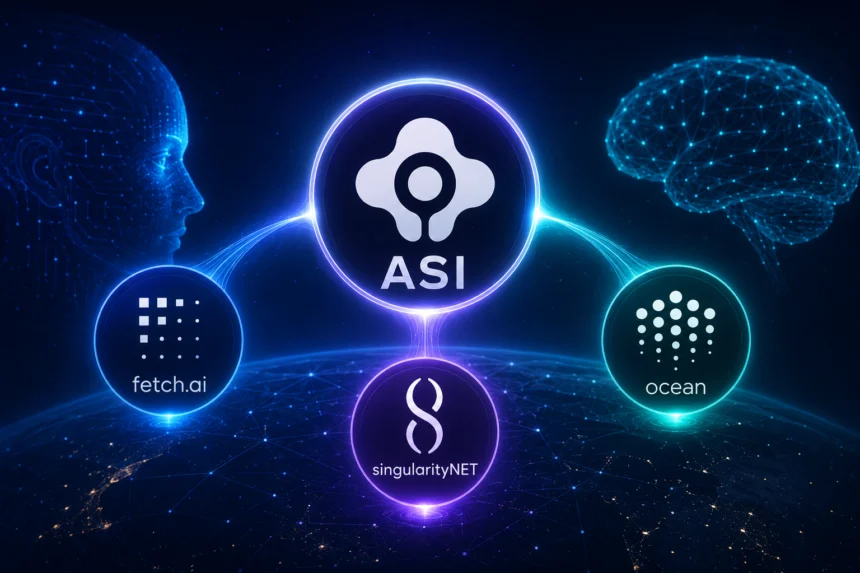
The Artificial Superintelligence Alliance is a landmark merger combining the strengths of three prominent decentralized AI projects: Fetch.ai, SingularityNET, and Ocean Protocol, creating a unified platform and a single new token, ASI, to power the future of decentralized artificial intelligence. This strategic consolidation aims to accelerate the development of open source, ethical AI, offering a formidable alternative to the increasingly centralized control of AI by major technology corporations.
What is the Artificial Superintelligence Alliance?
The Artificial Superintelligence Alliance represents a bold initiative to merge three distinct yet complementary decentralized AI protocols into a single, cohesive ecosystem. Fetch.ai, known for its autonomous AI agents and multi agent systems; SingularityNET, a marketplace for AI services and algorithms; and Ocean Protocol, a platform for secure data sharing and monetization, are pooling their resources, technology, and communities.
The primary goal of this alliance is to create a decentralized infrastructure capable of supporting the next generation of AI development and deployment. By unifying their efforts, the alliance seeks to foster an open, democratic, and ethical approach to AI, contrasting sharply with the closed, proprietary systems often developed by large tech companies. The new ASI token will serve as the native currency across this expanded ecosystem, facilitating transactions, governance, and network security.
The Genesis of the Alliance: A Strategic Consolidation
The decision to form the Artificial Superintelligence Alliance stems from a shared vision among the project founders to accelerate the development of benevolent decentralized AI. Dr. Ben Goertzel, CEO of SingularityNET, alongside Humayun Sheikh, CEO of Fetch.ai, and Trent McConaghy, founder of Ocean Protocol, recognized the need for a unified front to compete effectively against the concentrated power of centralized AI. Each protocol brings unique capabilities to the table.
Fetch.ai contributes its agent based AI framework, enabling autonomous software programs to perform tasks and interact across networks. SingularityNET offers a robust marketplace where AI developers can publish and monetize their algorithms, and users can access a wide range of AI services. Ocean Protocol provides the critical infrastructure for data sharing, ensuring privacy, control, and fair compensation for data providers, which is essential for training and running advanced AI models.
By integrating these components, the alliance aims to create a complete stack for decentralized AI, from data sourcing and model training to deployment and agent interaction. This consolidation is not merely a token swap; it represents a deeper technological integration designed to create network effects and accelerate innovation that would be difficult for any single project to achieve alone.
The ASI Token: Utility and Conversion Mechanics
The Artificial Superintelligence (ASI) token is the new unified cryptocurrency that will power the entire alliance ecosystem. It replaces Fetch.ai’s FET, SingularityNET’s AGIX, and Ocean Protocol’s OCEAN tokens, serving as the primary medium for transactions, staking, and governance across the combined platforms. This consolidation is designed to enhance liquidity, simplify user experience, and create a stronger, more recognizable brand in the crypto and AI markets.
The conversion process for existing token holders is structured to ensure fairness and transparency. Fetch.ai (FET) holders will convert their tokens to ASI at a straightforward 1:1 ratio. SingularityNET (AGIX) holders will convert at a ratio of approximately 1:0.43335 ASI, meaning for every AGIX token, they will receive 0.43335 ASI. Ocean Protocol (OCEAN) holders will convert at a similar ratio of approximately 1:0.433226 ASI.
The total supply of the new ASI token is set at 2.631 billion. This supply is derived from the conversion of existing tokens and an additional issuance to account for the new combined entity. The migration process is expected to be managed through secure, audited smart contracts, with a phased rollout. Holders will typically be able to swap their legacy tokens for ASI via official migration portals or supported exchanges once the process is fully live, which is anticipated to occur in stages throughout Q3 2024.
Vision for a Decentralized AI Future
The Artificial Superintelligence Alliance articulates a grand vision for a decentralized AI future, one that stands in stark contrast to the current trajectory of AI development. The founders believe that AI, particularly advanced general intelligence, should not be controlled by a few powerful corporations or nation states. Instead, it should be open, transparent, and accessible to all, fostering innovation and preventing potential misuse.
The alliance aims to build a global, decentralized network of AI services, agents, and data marketplaces that operate without single points of control. This framework would allow developers worldwide to contribute to and benefit from AI advancements, democratizing access to powerful AI tools and algorithms. Imagine a future where autonomous AI agents, powered by the ASI token, can seamlessly interact with data providers and AI services across a truly open network.
This decentralized approach is also deeply rooted in ethical considerations. By promoting open source development and community governance, the alliance seeks to ensure that AI systems are developed responsibly, with safeguards against bias, lack of transparency, and concentration of power. Their collective work envisions a future where AI serves humanity in a beneficial way, driven by collective intelligence rather than corporate mandates.
Market Impact and Challenges Ahead
The formation of the Artificial Superintelligence Alliance carries significant implications for both the crypto and AI markets. With a combined market capitalization approaching $7.5 billion at its announcement, the alliance immediately positions itself as a major player in the decentralized AI sector, potentially attracting increased investor interest and developer talent. The unified ASI token could see greater liquidity and trading volume than its individual predecessors, benefiting from network effects and a clearer value proposition.
For the broader AI industry, the alliance presents a credible, scaled alternative to the centralized models dominating today. It could inspire more projects to pursue decentralized architectures and encourage a shift towards open source, community governed AI development. The alliance’s success could demonstrate the viability of a truly open and interoperable AI ecosystem, challenging the closed garden approaches of companies like OpenAI and Google.
However, the path forward is not without considerable challenges. The technical integration of three complex protocols is a monumental task, requiring careful coordination and execution to ensure interoperability and stability. Bridging distinct communities with varying governance models and stakeholder interests will demand sophisticated consensus mechanisms and clear communication. Regulatory scrutiny around AI and decentralized autonomous organizations (DAOs) also presents an evolving landscape that the alliance must navigate. Beyond that, competition from well funded centralized AI entities remains intense, requiring the alliance to consistently innovate and deliver tangible value to its users and developers.
The TCB View
TCB believes the Artificial Superintelligence Alliance represents a highly ambitious and potentially transformative play in the decentralized AI landscape. This consolidation is a necessary strategic move to counter the rapid centralization of AI power, creating a formidable challenger with a combined market capitalization that demands attention. The opportunity lies in establishing a truly open, ethical, and interoperable AI ecosystem that can unlock a multi trillion dollar market for decentralized AI agents and services.
The primary risk, however, resides in the immense complexity of integrating three distinct protocols and their communities, along with the sheer scale of the vision. If executed well, the alliance’s developers, early adopters, and data providers stand to win significantly, benefiting from enhanced network effects and a robust infrastructure. Conversely, smaller, isolated decentralized AI projects may struggle to compete, and centralized AI giants could face a credible, open source alternative.
Our read is that while the vision is compelling, success hinges on meticulous execution. Watch for the smooth completion of the token migration and the subsequent growth in active AI agent deployments and data transactions on the combined network in Q4 2024, specifically looking for a 25% quarter over quarter increase in unique active agents as a key indicator of momentum.