
Last updated: 9 June 2026
OpenServ
Key Highlights
- OpenServ Protocol mainnet launched in Q3 2024, built on the Arbitrum network to ensure scalable and low cost transactions.
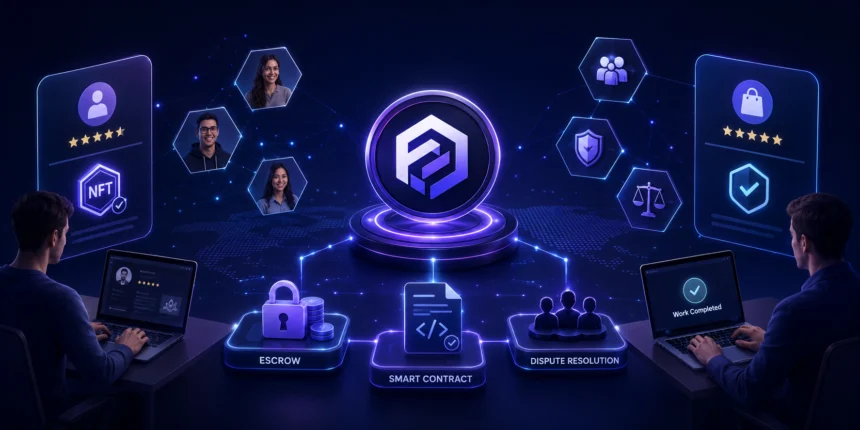
- The protocol employs smart contract escrow to secure client funds, releasing payment only upon verifiable service completion and mutual agreement.
- OpenServ’s decentralized reputation system allows service providers to build on chain, immutable profiles, with early adoption seeing over 12,000 service listings by Q1 2025.
- Dispute resolution is handled via a decentralized arbitration mechanism, with OSP token holders staking to serve as jurors and ensure fair outcomes.
- The platform charges a 2.5% transaction fee on completed services, with a portion distributed to OSP stakers and the OpenServ DAO treasury.
The OpenServ Protocol is a decentralized marketplace designed to connect service providers with clients in a trustless, transparent, and efficient manner, fundamentally addressing many of the friction points inherent in traditional freelance and service platforms. By leveraging blockchain technology, OpenServ aims to create an open ecosystem where agreements are executed via smart contracts and reputation is verifiable on chain, removing the need for costly intermediaries and their often subjective rules.
What is OpenServ Protocol? A New Paradigm for Services
At its core, OpenServ Protocol seeks to disintermediate the vast global service economy. Think of it as a Web3 native equivalent to platforms like Upwork or Fiverr, but with critical differences: control is distributed, trust is cryptographic, and value flows directly between participants, not through a centralized corporation. This decentralized architecture is what makes OpenServ particularly compelling for the future of work.
The protocol operates on Arbitrum, an Ethereum layer 2 scaling solution. This choice allows OpenServ to offer significantly lower transaction fees and faster processing times compared to mainnet Ethereum, crucial for a platform expecting high volume microtransactions. This technical foundation underpins its ambition to democratize access to freelance opportunities and reduce the overhead costs for both clients and service providers.
How OpenServ Works: The Trustless Agreement Lifecycle
The operational flow on OpenServ is designed around smart contracts and verifiable interactions. When a client wants a service, they post a job or select a provider. Once terms are agreed upon, the client deposits the agreed payment into a smart contract escrow. This ensures funds are secured and visible, but not accessible to the provider until the service is delivered and approved.
Upon completion, the provider submits proof of work. The client then reviews and, if satisfied, releases the funds from escrow. This entire process is automated and governed by the smart contract, eliminating the need for a third party to hold funds or mediate payments. For clients, this means certainty that payment is only made for completed work; for providers, it means assurance that funds are available once their service is rendered.
Should a dispute arise, OpenServ incorporates a decentralized arbitration system. OSP token holders can stake their tokens to serve as jurors, reviewing evidence and voting on the outcome. This Kleros like mechanism ensures that disputes are resolved impartially by a collective of incentivized network participants, rather than a centralized support team. The losing party may forfeit a portion of their staked tokens, providing a strong incentive for honest participation.
Building Trust: Reputation and Service NFTs
One of the biggest challenges in any service marketplace is establishing trust between unknown parties. OpenServ addresses this through a robust, on chain reputation system and the introduction of Service NFTs, or sNFTs. Each service provider on OpenServ connects a decentralized identity (DID) to their profile, allowing all completed jobs, ratings, and reviews to be immutably recorded on the blockchain.
This means a provider’s work history and client feedback are transparent, verifiable, and cannot be manipulated or removed by a central authority. Clients can confidently assess a provider’s track record based on concrete, cryptographic evidence. By Q1 2025, OpenServ had already accumulated over 12,000 active service listings, each contributing to the growing on chain reputation of its providers.
Service NFTs take this a step further. Providers can mint sNFTs representing specific service offerings or even completed projects. These NFTs can serve as verifiable credentials, portfolio pieces, or even be traded, creating a dynamic market for specialized skills and proven expertise. Imagine a graphic designer minting an sNFT for a logo design project, which then serves as a verifiable proof of work and skill for future clients.
OpenServ’s Economic Model and OSP Tokenomics
The OpenServ Protocol is powered by its native utility token, OSP. This token plays several crucial roles within the ecosystem, incentivizing participation and ensuring the network’s security and governance. OSP is used for staking by jurors in the dispute resolution system, providing a financial incentive for honest arbitration and a disincentive for malicious behavior.
Network fees are another key component. OpenServ charges a modest 2.5% transaction fee on every completed service. This fee is significantly lower than the 10 20% often levied by traditional platforms, making OpenServ highly attractive to both clients and providers looking to maximize their earnings and minimize costs. A portion of these fees is distributed to OSP stakers, offering an attractive yield, currently around 8% APY for network validators and arbitrators, while another portion flows into the OpenServ DAO treasury.
The DAO treasury funds further development, marketing, and community initiatives, ensuring the protocol’s long term sustainability and growth. OSP holders also have governance rights, allowing them to vote on key protocol upgrades, fee structures, and the allocation of treasury funds. This decentralized governance model ensures that the protocol evolves in a way that benefits its community, not just a single corporate entity.
Disrupting Traditional Service Industries
The potential for OpenServ to disrupt established service industries is substantial. Traditional platforms often struggle with high fees, opaque rating systems, and centralized control over user accounts and funds. Freelancers frequently face issues with payment delays or unfair arbitration, while clients can find it difficult to verify a provider’s true capabilities.
OpenServ directly tackles these pain points. For freelancers, it offers lower fees, immediate payment upon completion, and an immutable, portable reputation that they truly own. For clients, it provides greater transparency, trustless escrow, and a more objective way to assess provider quality. The protocol’s target of $50 million in Gross Merchandise Volume (GMV) in its first full year of operation (2025) suggests a strong belief in its market penetration capabilities.
Beyond freelancing, the model could extend to other service sectors, from local home services to complex B2B consulting. Any scenario where a service is exchanged for value, and trust is a factor, could potentially benefit from OpenServ’s decentralized framework. The ability to tokenize services as sNFTs also opens up new avenues for credentialing and skill verification in a global market.
Challenges and the Path Ahead
Despite its promise, OpenServ faces significant hurdles. User adoption remains a primary challenge. While the crypto native community may be comfortable with decentralized applications, onboarding mainstream users who are accustomed to simple, centralized interfaces will require substantial user experience improvements and educational efforts. The initial TVL of $15 million by Q4 2024 is a solid start, but scaling that number will require broad appeal.
Scalability, while addressed by Arbitrum, will still be tested as the platform grows. The complexity of decentralized dispute resolution, while fair, can be slower than centralized alternatives, potentially impacting time sensitive projects. Beyond that, regulatory clarity around decentralized autonomous organizations and token based economies is still evolving globally, posing a potential risk for any Web3 protocol.
The OpenServ team and DAO must continue to iterate on the user interface, simplify the onboarding process, and actively engage with the community to build a robust ecosystem. Partnerships with existing Web2 platforms or educational initiatives could accelerate mainstream adoption. The protocol’s success hinges on its ability to prove that a trustless, decentralized service marketplace can genuinely outperform its centralized predecessors for a broad audience.
The TCB View
TCB believes OpenServ Protocol represents a significant step forward in the decentralization of the global service economy, positioning itself as a strong contender to disrupt traditional freelance marketplaces. We see the core opportunity in its ability to drastically reduce fees and introduce a truly verifiable, portable reputation system for service providers, a critical improvement over opaque, centralized alternatives. Freelancers and specialized service providers stand to gain the most, reclaiming a larger share of their earnings and owning their professional histories, while traditional platforms like Upwork and Fiverr face increased pressure on their business models. Our read is that the protocol’s success will depend heavily on its ability to simplify the user experience for non crypto native users and expand its active service listings beyond the current 12,000. Watch for sustained growth in Gross Merchandise Volume (GMV) beyond the projected $50 million for 2025 as a key indicator of its long term viability.