
Last updated: 27 June 2026
Uniswap is the most used decentralized exchange in crypto. It invented the automated market maker model in 2018, and every subsequent DEX has either copied its architecture or built in reaction to it. Uniswap v4 launched in 2024 with hooks: programmable callbacks that let liquidity providers and developers run custom logic at key points in the swap lifecycle. The core use case is the same as it has always been: trade any ERC-20 token without giving up custody of your assets.
Key Highlights
- Largest on-chain trading volume of any DEX across Ethereum mainnet and all major L2s
- v4 hooks enable programmable liquidity: limit orders, dynamic fees, and custom pool logic
- Noncustodial: your assets never leave your wallet during the swap
- Deployed on Ethereum, Arbitrum, Optimism, Base, Polygon, and other chains
- Over $2B in independent security audits across all Uniswap protocol versions
- UNI governance token enables community voting on protocol parameters
The Verdict
Uniswap v4 is the right DEX for anyone who wants the deepest liquidity, the most widely audited smart contracts, and the most flexibility in how they interact with on-chain liquidity. Gas fees on Ethereum mainnet remain the main usability barrier. Using Uniswap on Arbitrum, Base, or Optimism eliminates that friction for most trade sizes. Jupiter is the better choice for Solana users.
How Uniswap Works
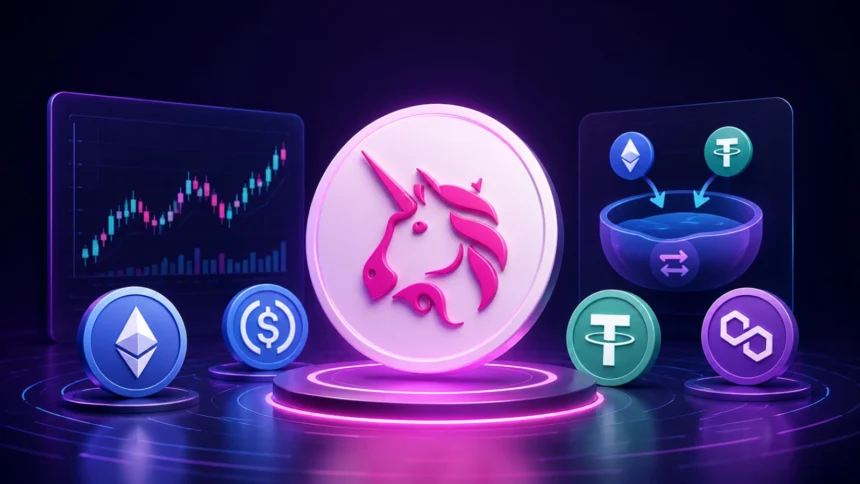
Uniswap uses an automated market maker (AMM) model. Instead of matching buyers with sellers like a traditional exchange, Uniswap uses liquidity pools: pools of two tokens at a mathematical price ratio. When you swap Token A for Token B, you add Token A to the pool and remove Token B. The price adjusts based on the constant product formula. Liquidity providers deposit equal values of both tokens into a pool and earn a share of the swap fees generated by that pool.
Uniswap v3 introduced concentrated liquidity, letting providers deposit capital within a specific price range for higher fee efficiency. v4 extended this with hooks, allowing custom code to execute at each step: before swap, after swap, before liquidity change, and after liquidity change. This enables complex strategies like on-chain limit orders, time-weighted average price execution, and dynamic fees that adjust based on volatility.
Fees
Uniswap swap fees are set per pool, typically 0.01%, 0.05%, 0.3%, or 1% of the swap amount. Stablecoin pairs use 0.01% or 0.05%. Volatile pairs typically use 0.3%. High-volatility pairs use 1%. These fees go entirely to liquidity providers. In addition to pool fees, there are Ethereum gas fees for the transaction itself. On Ethereum mainnet, a swap can cost $5 to $50 in gas depending on network congestion. On Arbitrum or Base, the same swap costs under $0.10 in most conditions.
Security Track Record
Uniswap’s smart contracts have never been exploited. The protocol has been independently audited by Trail of Bits, ABDK, OpenZeppelin, and multiple other firms across its versions. The v3 contracts have been deployed and battle-tested since 2021. v4 received extensive audits before launch including a $15.5M audit competition. This is the strongest audit history of any DEX and is a meaningful differentiator over newer protocols with shorter track records. Smart contract risk is never zero, but Uniswap’s history reduces it to a manageable level compared to alternatives.
Layer 2 Deployment
Using Uniswap on L2s dramatically changes the economics. On Arbitrum, a Uniswap swap costs under $0.05 in gas. The liquidity depth on major pairs like ETH/USDC is comparable to Ethereum mainnet. Base has become one of the highest-volume Uniswap deployments due to its Coinbase user base and low fees. For any trader doing fewer than 10 swaps per day, an L2 Uniswap deployment is almost always the better choice over Ethereum mainnet.
v4 Hooks: What Changes in Practice
Uniswap v4 hooks allow protocols to build on top of Uniswap’s liquidity rather than forking it. A lending protocol can use a hook to automatically rebalance its collateral. A limit order protocol can execute fills directly inside a Uniswap pool. A market maker can implement dynamic fees that widen during high-volatility periods. Most retail users will never interact with hooks directly. The benefit is that liquidity becomes more efficient, which means better prices for all users over time as the hook ecosystem matures.
The TCB View
Uniswap’s dominance comes from a combination of liquidity depth, audit history, and network effects that took years to build. v4 extends the protocol’s lead by enabling an ecosystem of specialized pool behaviors that would previously have required independent protocols. The fee structure is transparent, the noncustodial model is genuine, and the L2 deployments have made the cost barrier largely irrelevant. For Ethereum ecosystem DeFi users, Uniswap is the default DEX and it earns that status in 2026.