Last updated: 9 June 2026
Key Highlights
- Ethereum’s average gas fee for a simple ERC 721 mint peaked at over $100 in Q4 2021, driven by high network congestion.
- OpenSea, the largest NFT marketplace, reported over $31 billion in total trading volume by early 2022.
- Solana offers significantly lower transaction costs, typically under $0.0025 per transaction, making it a cost effective alternative for creators.
- The ERC 721 standard remains the most prevalent for unique digital collectibles on the Ethereum blockchain.
- Lazy minting, offered by platforms like OpenSea, defers gas fees until an NFT’s first sale, reducing upfront costs for creators.
Minting an NFT, or Non Fungible Token, involves the process of publishing your unique digital asset onto a blockchain, transforming it into a verifiable, tamper proof item. This guide will walk you through the essential steps, from selecting the right blockchain and platform to managing gas fees and promoting your creation effectively.
Understanding NFT Minting: The Foundation
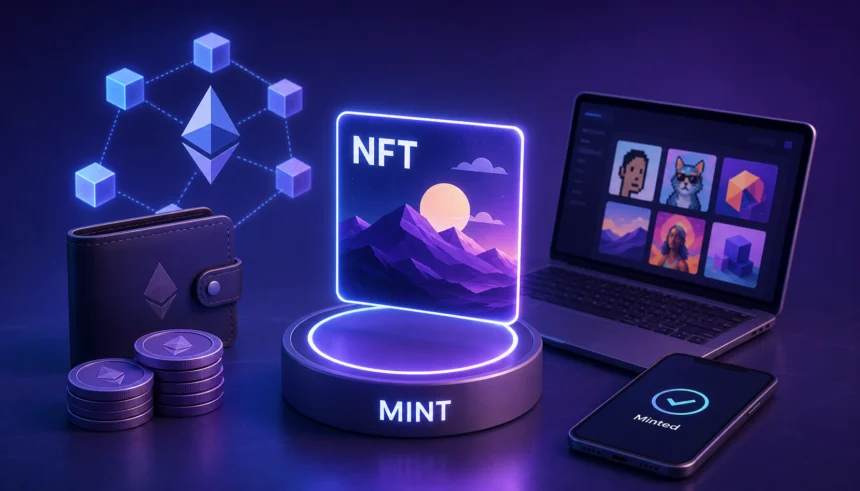
Minting an NFT is akin to publishing a book. You are taking a digital file your artwork, music, or collectible and registering it on a decentralized ledger, typically a blockchain. This act creates a unique digital certificate of ownership, permanently linking your asset to a specific address on the blockchain.
The primary appeal of minting an NFT lies in establishing provable scarcity and ownership for digital items. Unlike traditional digital files which are easily copied, an NFT guarantees that a specific instance of a digital asset is unique and owned by one individual. This opens new avenues for artists, creators, and brands to monetize their work and engage with audiences.
Choosing Your Blockchain and Marketplace
The first critical decision in your minting journey is selecting the right blockchain. Each blockchain offers different trade offs in terms of cost, speed, security, and community. Ethereum, Solana, and Polygon are three of the most popular choices, each with distinct advantages.
Ethereum is the undisputed leader for NFTs, home to iconic collections like CryptoPunks and Bored Ape Yacht Club. It supports the widely adopted ERC 721 and ERC 1155 token standards. However, Ethereum’s popularity often leads to high gas fees, which are transaction costs paid to network validators. During peak periods in 2021, a single NFT mint could cost upwards of $100 in gas, making it expensive for new creators.
Solana presents a compelling alternative with its high transaction throughput and remarkably low fees. The average transaction cost on Solana is consistently below $0.0025, a fraction of Ethereum’s costs. Platforms like Magic Eden are popular on Solana, offering a vibrant marketplace for its native NFTs. Polygon, an Ethereum Layer 2 scaling solution, offers another cost effective option. It is compatible with Ethereum’s ecosystem but processes transactions off the mainnet, resulting in significantly lower gas fees, often just a few cents.
Once you select a blockchain, you will need a marketplace. OpenSea dominates the Ethereum and Polygon ecosystems, offering extensive tools for creating and managing collections. Rarible is another multi chain option supporting Ethereum, Flow, and Tezos. For Solana, Magic Eden is the go to platform. Each marketplace has varying fee structures and user interfaces, so explore a few before committing.
Preparing Your Digital Asset and Crypto Wallet
Before you mint, ensure your digital asset is ready. NFTs can be images JPEG, PNG, GIF, videos MP4, audio files MP3, or even 3D models. Most platforms support common file types, but always check the specific requirements of your chosen marketplace, including maximum file size and dimensions. Consider the metadata you will include. This is descriptive information about your NFT, such as its name, description, properties, and traits. Rich metadata enhances discoverability and adds context for collectors.
Next, you need a crypto wallet. This digital wallet stores your cryptocurrency and NFTs, allowing you to interact with blockchain applications. For Ethereum and Polygon, MetaMask is the most widely used browser extension wallet. For Solana, Phantom is the preferred choice. Download the official wallet extension from its respective website and follow the instructions to set up a new wallet, carefully securing your seed phrase.
Once your wallet is set up, you will need to fund it with the native cryptocurrency of your chosen blockchain. For Ethereum, you need Ether ETH. For Solana, you need SOL. For Polygon, you will need MATIC. These funds cover the gas fees associated with minting and listing your NFT. You can acquire these cryptocurrencies from exchanges like Coinbase, Binance, or Kraken, then transfer them to your newly created wallet address.
The Minting Process: Step by Step
The actual minting process varies slightly depending on whether you use a marketplace or opt for a custom smart contract. For most creators, especially beginners, marketplace minting is the simplest route.
Marketplace Minting Example: OpenSea
On OpenSea, begin by connecting your MetaMask wallet. Navigate to the “Create” button. You will first create a collection, which acts as a folder for your NFTs. Upload a collection logo, banner, and set a name and description. Crucially, set your desired royalty percentage, typically between 5% and 10%. This ensures you receive a portion of future secondary sales of your NFT, offering a passive income stream.
Within your collection, select “Add Item.” Upload your digital asset, give it a name, a detailed description, and add any properties or traits. These traits can include “Background: Blue,” “Eyes: Laser,” or “Clothing: Hoodie,” making your NFT searchable and unique. Finally, choose the blockchain for your NFT Ethereum or Polygon. OpenSea offers “lazy minting,” meaning the NFT is only truly minted on chain when it is first purchased, deferring the gas fee to the buyer. This is a significant advantage for creators unwilling to pay upfront gas costs.
Custom Smart Contract Minting
For more experienced creators or projects requiring advanced features, minting directly through a custom smart contract offers greater control. Tools like Thirdweb or Manifold allow creators to deploy their own contracts without extensive coding knowledge. This method provides complete ownership over the contract, enabling custom logic for aspects like Dutch auctions, whitelists, or specific token utilities. While more complex, it offers unparalleled flexibility and often higher prestige among serious collectors.
Optimizing Gas Fees and Transaction Costs
Managing gas fees is critical, particularly on the Ethereum blockchain. Gas fees fluctuate based on network demand. To minimize costs, consider minting during off peak hours, typically late night or early morning UTC, when fewer users are transacting. Websites like Etherscan provide real time gas price trackers, allowing you to monitor costs.
Another strategy is to use Layer 2 solutions like Polygon, Arbitrum, or Optimism. These networks process transactions faster and cheaper than the Ethereum mainnet, then periodically bundle them to the mainnet for finality. Many marketplaces now support minting directly on these Layer 2s, offering a cost effective way to enter the NFT space without sacrificing access to the broader Ethereum ecosystem.
Promoting Your Newly Minted NFT
Minting is only the first step. Effective promotion is essential for your NFT to find an audience. Social media platforms are your primary tools. X Twitter, Instagram, and Discord are hubs for NFT communities. Share high quality images or videos of your NFT, explain the story behind your creation, and engage directly with potential collectors.
Building a community around your work is paramount. Discord servers dedicated to NFTs are excellent places to connect with collectors and other artists. Participate actively, share your insights, and foster genuine relationships. Consider collaborations with other artists or influencers in the NFT space. Storytelling is also powerful. People connect with narratives. Explain your artistic vision, the inspiration behind your collection, and the value proposition for collectors. A compelling story can significantly increase interest in your digital assets.
The TCB View
TCB believes the long term outlook for NFTs, particularly utility driven assets and those backed by strong communities, remains cautiously optimistic. While the initial speculative frenzy has subsided, the underlying technology continues to mature, offering new avenues for digital ownership and creator empowerment. We see significant opportunity for artists and brands who approach NFTs with a clear strategy, focusing on genuine value and community building rather than fleeting trends. The rise of Layer 2 solutions, with Polygon’s gas fees consistently below $0.01 per transaction, will empower a broader range of creators by removing the barrier of prohibitive costs, benefiting both established artists and emerging talent. Our read is that those who prioritize sustainable engagement and practical use cases for their digital assets will ultimately thrive, while projects lacking substance will fade. Watch for increased enterprise adoption and regulatory clarity, which will serve as a key trigger for the next phase of NFT market expansion, potentially driving overall market capitalization beyond its Q4 2021 highs.