
Last updated: 23 June 2026
A decentralized exchange
Key Highlights
- Uniswap, a popular decentralized exchange (DEX), processed over $1.2 trillion in trading volume in 2022, with its daily active users increasing by 50% in Q4 2022.
- The total value locked (TVL) in DEXs reached an all time high of $180 billion in November 2021, with Curve Finance and SushiSwap being among the top protocols.
- According to a report by Chainalysis, the DEX market grew by 550% in 2021, with the number of unique Ethereum addresses interacting with DEXs increasing from 1.1 million to 6.5 million.
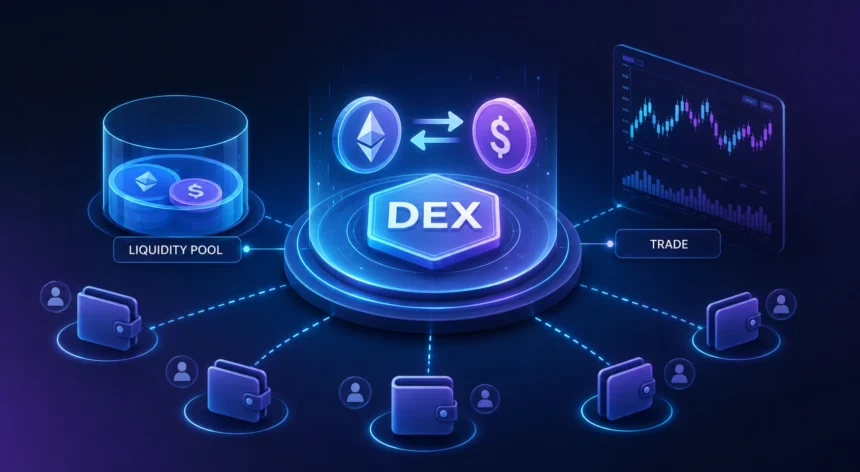
So, what is a decentralized exchange? A decentralized exchange, or DEX, is a type of cryptocurrency exchange that operates on a decentralized network, allowing users to trade assets without the need for a central authority. This is achieved through the use of smart contracts and decentralized liquidity pools, which enable trustless and permissionless transactions. In this article, we will explore the inner workings of DEXs, including Automated Market Maker (AMM) models and order book DEXs, as well as the risks and benefits associated with using these platforms.
Introduction to Decentralized Exchanges
Decentralized exchanges have gained significant traction in recent years, with many users turning to these platforms in search of greater security, transparency, and control over their assets. Unlike centralized exchanges, which are controlled by a single entity and often require users to trust that entity with their funds, DEXs operate on a decentralized network, allowing users to maintain custody of their assets at all times.
This is achieved through the use of smart contracts, which are self executing contracts with the terms of the agreement written directly into lines of code. When a user interacts with a DEX, they are essentially interacting with a smart contract, which facilitates the trade and ensures that the terms of the agreement are enforced.
How Automated Market Maker Models Work
Automated Market Maker (AMM) models are a type of DEX that uses a liquidity pool to facilitate trades. In an AMM model, users deposit assets into a liquidity pool, which is then used to provide liquidity to the market. When a user wants to trade an asset, they interact with the liquidity pool, and the smart contract executes the trade based on the current market price.
The AMM model is designed to provide a more efficient and liquid market, as it allows users to trade assets at any time, without the need for a counterparty. This is in contrast to traditional order book models, which require a buyer and seller to be matched in order for a trade to occur.
One of the most popular AMM models is the Constant Product Market Maker (CPMM) model, which is used by Uniswap and other popular DEXs. The CPMM model uses a simple formula to determine the price of an asset, based on the amount of liquidity in the pool and the amount of assets being traded.
Order Book DEXs
Order book DEXs, on the other hand, use a traditional order book model to facilitate trades. In an order book model, users place buy and sell orders, which are then matched by the exchange. The order book model is more similar to traditional centralized exchanges, but it still maintains the benefits of decentralization, such as greater security and transparency.
Order book DEXs are often more complex than AMM models, as they require a more sophisticated matching engine to match buyers and sellers. However, they also offer more flexibility and control over trades, as users can place specific orders and set their own prices.
Risks of Liquidity Provision
While providing liquidity to a DEX can be a lucrative opportunity, it also comes with significant risks. One of the main risks is the risk of impermanent loss, which occurs when the value of the assets in the liquidity pool changes, resulting in a loss for the liquidity provider.
For example, if a user provides liquidity to a pool with a 50/50 ratio of two assets, and the price of one asset increases significantly, the liquidity provider may be left with a pool that is no longer balanced, resulting in a loss. This risk can be mitigated by using more advanced liquidity provision strategies, such as concentrated liquidity provision.
Security Advantages of DEXs
One of the main advantages of DEXs is their security. Because DEXs operate on a decentralized network, they are less vulnerable to hacking and other security threats. In a centralized exchange, a single point of failure can result in the loss of millions of dollars’ worth of assets. In a DEX, the risk is spread across the entire network, making it much more difficult for hackers to exploit.
Additionally, DEXs often use more advanced security measures, such as multi signature wallets and time locked contracts, to protect user assets. These measures make it much more difficult for hackers to access user funds, even if they are able to gain control of a user’s account.
The Future of DEXs
As the DeFi ecosystem continues to grow and evolve, we can expect to see significant advancements in DEX technology. One of the main areas of focus is the development of more advanced liquidity provision strategies, which can help to mitigate the risks associated with providing liquidity to a DEX.
Another area of focus is the development of more user friendly interfaces, which can make it easier for new users to interact with DEXs. This can help to increase adoption and drive growth in the DeFi ecosystem.
The TCB View
TCB believes that decentralized exchanges are a crucial component of the DeFi ecosystem, offering users greater security, transparency, and control over their assets. We see significant opportunities for growth and innovation in the DEX space, particularly in the development of more advanced liquidity provision strategies and user friendly interfaces. However, we also recognize the risks associated with providing liquidity to a DEX, and we caution users to carefully consider these risks before participating. Watch for the continued growth of DEXs, with a focus on the development of more advanced security measures and the increasing adoption of DEXs by institutional investors, with a potential trigger being the launch of a major institutional grade DEX platform.