
Last updated: 27 June 2026
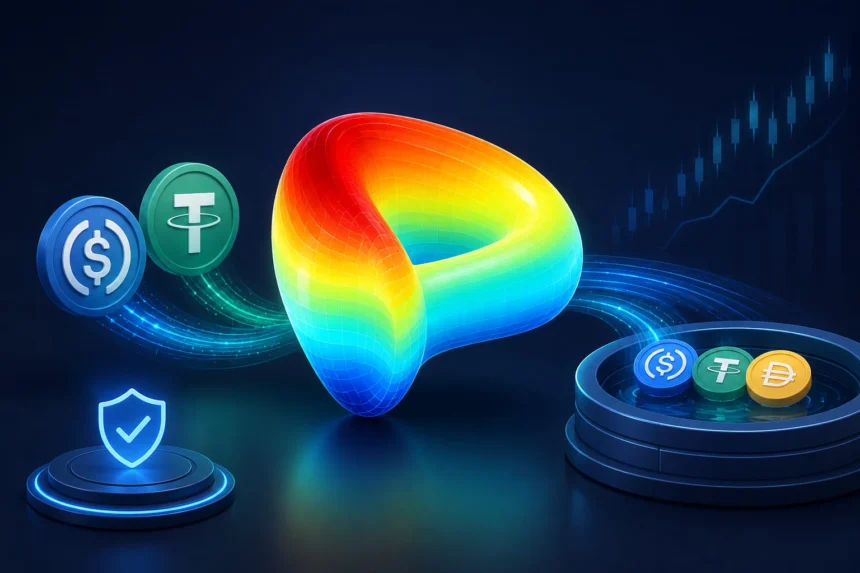
Curve Finance is where the largest stablecoin and pegged-asset swaps happen in DeFi. When a protocol needs to swap $10 million of USDC to USDT, it routes through Curve because no other venue offers comparable depth with as little slippage. Curve’s StableSwap invariant was purpose-built for assets that should trade at nearly the same price, enabling dramatically tighter spreads than standard AMM pools. The protocol has become the foundational liquidity infrastructure that every major DeFi project depends on.
Key Highlights
- Lowest slippage for stablecoin swaps of any DEX at significant trade sizes
- veCRV governance model has shaped incentive design across the entire DeFi ecosystem
- Deployed across Ethereum, Arbitrum, Optimism, Polygon, Avalanche, and other chains
- crvUSD: Curve’s native overcollateralized stablecoin with a novel liquidation mechanism
- $2B+ in daily volume across all deployments in active markets
- Liquidity providers earn swap fees and CRV token rewards
The Verdict
Curve Finance is essential DeFi infrastructure for large stablecoin swaps. Individual retail users swapping under $10,000 will see negligible difference between Curve and Uniswap for stablecoins. At larger sizes, Curve’s price improvement is meaningful. The veCRV governance model is the most sophisticated tokenomics design in DeFi and has been copied by dozens of protocols. The 2023 Vyper exploit demonstrated real smart contract risk that cannot be dismissed. The protocol recovered, but the event is relevant when assessing risk for liquidity providers.
StableSwap and Price Efficiency
Standard AMM pools like Uniswap use a constant product formula that distributes liquidity across all possible prices. For stable pairs that should trade near 1:1, most of that liquidity is sitting at irrelevant price points and is not available for the swaps that actually happen. Curve’s StableSwap formula concentrates liquidity near the peg price, meaning a much larger fraction of deposited capital is actively working for each swap. The result is significantly less slippage on large stable swaps compared to any standard AMM. This is not a marginal improvement: on a $1 million USDC-to-USDT swap, the price impact difference between Curve and Uniswap v3 on Ethereum is measurable in thousands of dollars.
CRV and the Bribe Economy
Curve’s governance model requires locking CRV tokens for up to four years to receive veCRV, which provides voting power and boosted LP rewards. Protocols that need deep Curve liquidity for their tokens can direct CRV emissions to specific pools by convincing veCRV holders to vote for them. This created an entire secondary market, often called the “bribe economy,” where protocols pay veCRV holders directly through platforms like Votium and Hidden Hand to vote for their preferred pool. The veCRV flywheel influenced how Balancer, Frax, and dozens of other protocols designed their governance and incentive systems. Understanding veCRV is foundational knowledge for anyone serious about DeFi protocol economics.
USD Stablecoin
Curve launched crvUSD in 2023, an overcollateralized stablecoin with a novel liquidation mechanism called LLAMMA (Lending-Liquidating AMM Algorithm). Unlike standard collateralized stablecoins where positions are liquidated abruptly when they fall below the threshold, LLAMMA gradually converts collateral to crvUSD as prices decline, reducing liquidation shock and bad debt. This soft liquidation mechanism is technically innovative and addresses a genuine problem with the standard liquidation model used by Aave and MakerDAO. crvUSD has grown steadily as a yield-generating stablecoin for collateral suppliers.
The 2023 Vyper Exploit
In July 2023, a reentrancy bug in specific versions of the Vyper programming language was exploited across several Curve pools, resulting in approximately $70 million in losses. The exploit affected pools using Vyper versions 0.2.15, 0.2.16, and 0.3.0, which had a broken reentrancy guard. The affected pools included the CRV-ETH pool, which created significant stress on Curve founder Michael Egorov’s heavily collateralized positions. Egorov eventually repaid all bad debt through over-the-counter CRV sales to several DeFi protocols. The protocol survived intact, but the event highlighted that smart contract risk extends beyond protocol design to compiler-level vulnerabilities. Curve has since moved most new pools to Vyper versions with verified reentrancy guards and increased the scope of compiler-level audits.
The TCB View
Curve Finance is foundational DeFi infrastructure that the ecosystem cannot replace quickly. Its role in stablecoin liquidity and the veCRV incentive model are structurally embedded in how DeFi protocols operate. The 2023 exploit was a genuine failure that demonstrated compiler-level smart contract risk is real and should not be discounted. For retail users, Curve’s primary value is receiving better execution on large stable swaps. For protocol teams, the veCRV governance architecture remains the most powerful liquidity incentive tool in DeFi. The protocol’s recovery from the 2023 crisis demonstrates resilience. The risk cannot be ignored, but it also should not be overstated relative to the protocol’s track record.