
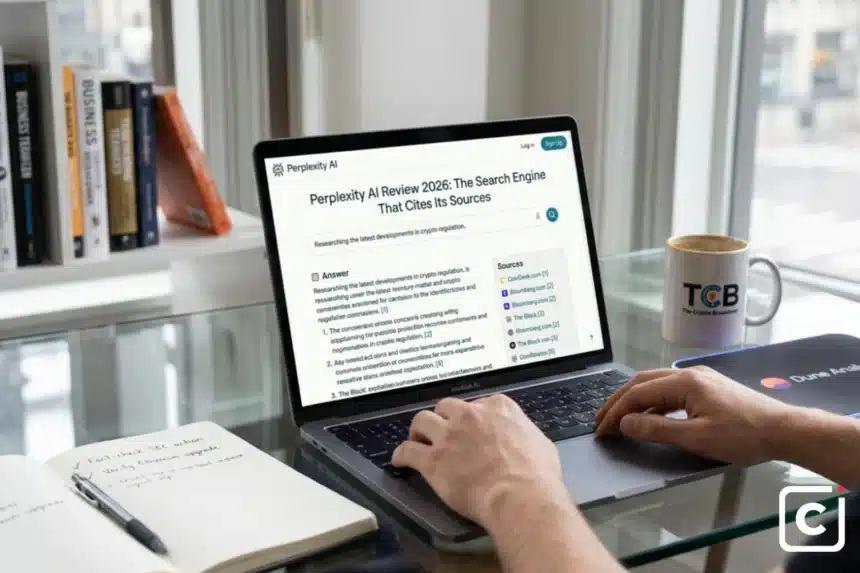
Last updated: 12 September 2026
bounce april: Perplexity AI is the most useful AI search tool for journalists and researchers who need review-2026″>real time, sourced answers. Its citation model makes fact checking smart future faster safer ai”>faster than any AI assistant on the market in 2026.
Key Highlights
- Key Highlight: Every answer includes numbered inline citations linking to the exact source pages, eliminating the need to cross reference answers manually.
- Key Highlight: Real time web search means Perplexity can answer questions about events from the last 24 hours, unlike models with knowledge cutoffs.
- Key Highlight: The Pro plan ($20/month) adds access to GPT-4o, Claude 3.5 Sonnet, and other frontier models as the underlying reasoning engine.
- Key Highlight: “Spaces” feature allows researchers to create persistent research environments with curated sources and shared context.
- Key Highlight: Free tier is genuinely useful, with daily Pro queries included and no account required for basic searches.
Overview
Perplexity AI launched in 2022 as an answer engine rather than a chatbot, and by 2026 it has grown into one of the most trusted research tools among journalists, analysts, and crypto researchers. The core insight behind Perplexity is simple: AI responses are only as good as the sources behind them. Perplexity makes those sources visible and clickable at every step.
Where Google returns ten links that you must evaluate and visit individually, Perplexity synthesizes the best sources into a structured answer and shows you exactly which sentence came from which source. For news and research workflows, this is a fundamental productivity improvement.
Key Features for News Research
The real time search capability is Perplexity’s defining advantage. Ask about the latest Bitcoin price action, a new SEC enforcement action, or this week’s DeFi exploit, and Perplexity pulls from live web sources including CoinDesk, The Block, Bloomberg, and Reuters. Answers arrive with timestamps showing when sources were published, so you can assess recency immediately.
The citation model is particularly valuable for crypto journalism. Every claim in a Perplexity answer is traceable to a specific URL. If you are writing about Ethereum’s latest network upgrade and Perplexity cites a statistic, you can click through directly to the primary source and verify it before publishing. This cuts fact checking time dramatically compared to asking ChatGPT and then searching manually for the underlying source.
The Pro plan unlocks “Deep Research,” a feature that conducts multi step research on a topic by running dozens of searches, synthesizing findings, and producing a structured report with full citations. For building background on a DeFi protocol, tracking a regulatory dossier, or researching a new L2, this feature alone justifies the subscription cost.
Pricing
The free tier offers unlimited basic searches with daily Pro query limits. The Pro plan costs $20 per month and includes unlimited Pro searches, access to multiple underlying AI models, file upload support, and API access. Annual billing reduces the cost to approximately $17 per month.
For researchers running more than ten sourced searches per day, the Pro plan delivers clear value. The ability to switch between GPT-4o and Claude 3.5 Sonnet as the reasoning engine within the same interface is a unique feature at this price point.
Pros
- Inline citations make every answer independently verifiable, which is essential for journalism and finance work
- Real time web search with source timestamps enables research on breaking news and recent data
- Deep Research feature produces structured, sourced reports on complex topics in minutes
- Model flexibility on Pro plan allows switching between GPT-4o and Claude based on the task
- Clean, fast interface with minimal friction between question and answer
Cons
- Cannot run code, analyze uploaded CSV files, or generate images, limiting quantitative research workflows
- Answers can sometimes over rely on a narrow set of high authority sources, missing niche but important content
- Not ideal for long form drafting or complex document generation
- Spaces feature is still maturing and lacks some collaboration depth for team workflows
Who It Is For
Perplexity AI is the right tool for crypto journalists, market analysts, and research professionals who spend significant time verifying facts and tracking fast moving news. If your daily workflow involves checking what happened overnight in DeFi, researching a protocol before writing, or building background on a regulatory development, Perplexity will cut your research time in half compared to any other tool available today.
It is not a replacement for ChatGPT or Claude in tasks that require deep document analysis, coding, or long form content generation. The best workflow combines Perplexity for sourced research with ChatGPT or Claude for synthesis and writing.
The TCB View
Perplexity AI has quietly become one of the most important tools in the modern crypto journalism stack. The citation model is not just a nice feature: it is a structural answer to the hallucination problem that plagues other AI tools. When you cannot afford to publish incorrect information, Perplexity’s approach of showing its work is the right design philosophy. At $20 per month, it is one of the best value purchases a crypto or finance researcher can make in 2026. The risk is over reliance: Perplexity’s answers are only as good as the sources it can find, and for niche onchain data or protocol specific technical details, you will still need to go deeper with specialized tools like Dune Analytics.