
Last updated: 9 June 2026
Cross chain
Key Highlights
-
Total Value Locked (TVL) on Ethereum reached over $300 billion in November 2021, illustrating significant liquidity concentration.
-
The Wormhole bridge facilitated over $35 billion in asset transfers by mid 2022, connecting more than 10 distinct blockchains.
-
The Ronin Bridge suffered a $625 million exploit in March 2022, underscoring the critical security vulnerabilities in cross chain infrastructure.
-
LayerZero Labs secured $120 million in a Series B round in April 2023, achieving a $3 billion valuation for its omnichain solution.
-
Over 260 sovereign blockchains have been developed using the Cosmos SDK by 2024, highlighting the growth of independent ecosystems.
Cross chain interoperability matters deeply for the future of Web3, as it directly addresses the profound fragmentation currently hindering mass adoption and economic efficiency across decentralized networks. Without robust solutions allowing seamless asset and data transfer between disparate blockchains, Web3 risks remaining a collection of isolated digital islands, limiting its utility and user base.
The Fragmentation Problem: A Web3 Bottleneck
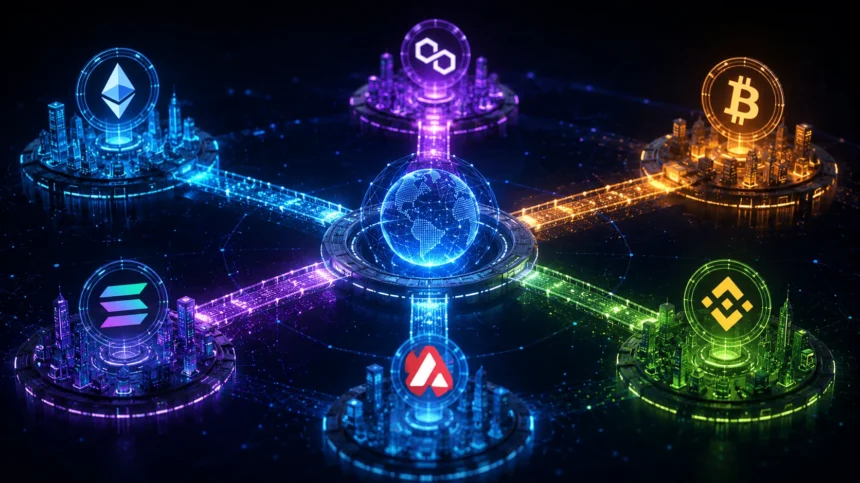
The current Web3 landscape is characterized by a multitude of independent blockchains, each operating as a sovereign ecosystem. Ethereum, Solana, Avalanche, Polygon, and others offer unique features, transaction speeds, and fee structures, but they largely exist in isolation. This creates a fragmented user experience and significant economic inefficiencies.
For users, navigating this fragmented environment means managing multiple wallets, understanding different token standards, and often enduring complex bridging processes that are both time consuming and costly. A user wanting to move assets from Ethereum to Solana, for example, faces a multi step process, often involving intermediate tokens and varying gas fees, which deters mainstream adoption.
Economically, this fragmentation traps liquidity within specific chains. Billions of dollars in Total Value Locked (TVL) on one blockchain, such as Ethereum’s peak of over $300 billion in November 2021, cannot easily interact with applications or liquidity pools on another without specialized tools. This limits capital efficiency and prevents the organic growth of a unified global decentralized economy.
Unlocking Liquidity and Capital Efficiency
One of the primary reasons why cross chain interoperability matters is its potential to unlock vast amounts of currently siloed capital. By enabling assets to flow freely across different blockchains, interoperability solutions can create a more liquid and efficient global market for digital assets. This means a token on Ethereum could be seamlessly used as collateral in a lending protocol on Avalanche or traded on a decentralized exchange on Solana.
This free flow of capital benefits both users and developers. Users gain access to a wider array of financial products and services, optimizing their investment strategies and reducing the need to maintain duplicate positions across multiple chains. Developers can build applications that are not restricted to a single blockchain, tapping into a broader user base and deeper liquidity pools.
Protocols like Aave and Uniswap, which have traditionally thrived on Ethereum, are increasingly exploring cross chain deployments to expand their reach. When a user can easily move their AAVE tokens from Ethereum to an Aave deployment on Polygon, it enhances the overall utility and value proposition of the asset and the protocol. This expanded reach fosters greater innovation and market stability.
Enhancing User Experience and Developer Adoption
Beyond capital efficiency, interoperability dramatically improves the user experience, a critical factor for Web3’s growth beyond its early adopter phase. Imagine a world where a user does not need to know or care which blockchain an application resides on. They simply interact with the application, and the underlying interoperability layer handles the complex asset and data transfers in the background.
This simplification removes significant barriers to entry for new users. The current need to understand different network configurations, bridge security models, and varying gas fee structures is overwhelming for many. A unified Web3 experience, facilitated by interoperability, would be akin to how users interact with the internet today, largely unaware of the underlying server infrastructure or data protocols.
For developers, interoperability offers a more flexible and powerful environment. They can choose the best blockchain for specific components of their application, perhaps using a high throughput chain for gaming transactions and a secure, slower chain for asset storage, all while maintaining a cohesive user interface. This modular approach allows for greater specialization and optimization, accelerating the development of sophisticated decentralized applications.
Key Interoperability Solutions and Their Approaches
Several distinct approaches are being developed to address the challenge of cross chain interoperability, each with its own trade offs regarding security, decentralization, and speed. Understanding these solutions is crucial to grasping why cross chain interoperability matters.
One common method involves blockchain bridges, which are protocols that allow assets and data to be transferred between two specific chains. Bridges like Wormhole, which facilitated over $35 billion in transfers by mid 2022, have proven effective in moving value across networks such as Ethereum, Solana, and Avalanche. However, bridges have also been a frequent target for exploits, with the $625 million Ronin Bridge hack in March 2022 being a stark reminder of their security vulnerabilities.
Layer 0 protocols offer a more fundamental approach by providing a base layer for multiple blockchains to connect and communicate natively. Cosmos with its Inter Blockchain Communication (IBC) protocol allows sovereign blockchains built with the Cosmos SDK to exchange data and assets directly. Over 260 such blockchains have been created by 2024. Polkadot uses a similar parachain model, where specialized blockchains share security and communicate via a central Relay Chain.
Newer solutions like generalized message passing protocols aim to enable arbitrary data exchange, not just asset transfers. LayerZero is a notable example, having raised $120 million in April 2023 at a $3 billion valuation. These protocols allow dApps to exist as “omnichain” applications, interacting seamlessly with smart contracts on any connected chain. This represents a significant leap towards a truly unified Web3 experience.
Security Challenges and the Path Forward
While the benefits of cross chain interoperability are clear, the security challenges remain substantial. The history of bridge exploits, with losses totaling billions of dollars, illustrates the inherent risks. These attacks often exploit vulnerabilities in the bridge’s smart contracts, oracle mechanisms, or multisignature schemes, leading to the unauthorized minting or draining of assets.
Addressing these security concerns is paramount for any interoperability solution to achieve widespread trust and adoption. Developers are exploring various strategies, including more robust cryptographic proofs like zero knowledge proofs for verifying transactions across chains without revealing sensitive information. Decentralized governance models for bridge operations and regular, independent security audits are also becoming standard practice.
The future of secure interoperability may lie in a combination of these approaches: highly decentralized Layer 0 protocols for foundational connectivity, coupled with specialized, audited bridges for specific asset transfers, and generalized message passing layers for complex application logic. Continuous innovation in cryptography and distributed systems is essential to build truly resilient cross chain infrastructure that can withstand sophisticated attacks.
The Vision for a Unified Web3
Ultimately, why cross chain interoperability matters boils down to the vision of a truly unified and accessible Web3. Imagine a future where a user can seamlessly play a blockchain game, purchase an NFT, apply for a DeFi loan, and participate in a DAO, all without ever encountering the friction of different networks or the complexity of bridging assets. This is the promise of robust interoperability.
This vision extends beyond financial applications. Interoperability can enable decentralized identities that work across all platforms, supply chain solutions that track goods from origin to consumer across various corporate ledgers, and even cross chain social media platforms. The potential for innovation explodes when the barriers between digital ecosystems are removed.
Achieving this unified Web3 will require not just technological advancements but also industry wide collaboration and standardization. As more protocols adopt established communication standards, and as security best practices evolve, the fragmented landscape will gradually coalesce into a cohesive digital realm. This will be the true test of Web3’s ability to onboard billions of users and fulfill its potential.
The TCB View
TCB believes that cross chain interoperability is not merely a desirable feature but an existential necessity for Web3’s long term growth. We see the current fragmentation as the single largest bottleneck preventing mainstream adoption and efficient capital allocation. The opportunity lies in unlocking the billions of dollars in trapped liquidity, exemplified by Ethereum’s $300 billion peak TVL, and expanding the user base beyond crypto natives.
Protocols that successfully build secure, user friendly, and truly generalized interoperability layers, such as LayerZero and the Cosmos IBC ecosystem, stand to be significant winners. Conversely, isolated blockchains that fail to integrate or offer seamless cross chain experiences will struggle to compete for users and developer talent. Our read is that the market will increasingly favor interconnected ecosystems over walled gardens.
Watch for a significant reduction in major cross chain bridge exploits, perhaps a 50% decrease in the frequency of incidents comparable to the $625 million Ronin Bridge hack, as a key indicator of maturing security practices. We also anticipate a surge in omnichain application development, signaling a shift towards a truly unified user experience over the next two years.