
Last updated: 27 June 2026
Press Release
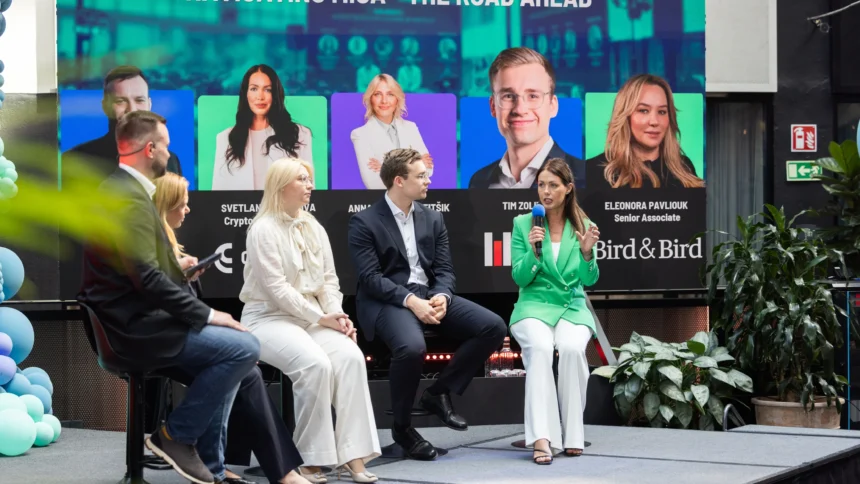
The Nordic Blockchain Conference 2026 brought senior leaders from the world’s largest banks, asset managers, and payment networks onto the same stage as the foundations building public blockchains. Now in its 8th edition, the event ran on May 26 and 27 at Epicenter in Stockholm and gathered 150 speakers and attendees from 50 different countries and more than 400 companies across digital finance, regulation, and emerging technologies.
Organised by Nordic Blockchain Association, the leading blockchain and Web3 conference in Northern Europe has become one of the clearest barometers of how quickly traditional finance and the blockchain industry are converging. This year that shift was impossible to miss. Blockchain technology, once treated as experimental, is increasingly becoming a critical part of mainstream financial services, both globally and across the Nordic region.
Key Highlights
- The 8th Nordic Blockchain Conference ran May 26 and 27, 2026 at Epicenter in Stockholm, Sweden
- 150 speakers and attendees from 50 different countries and more than 400 companies took part
- Global finance was represented by JP Morgan, BlackRock, Visa, Mastercard, Standard Chartered, and Citi
- Nordic banking turned out in force: Danske Bank, Swedbank, SEB, and DNB, alongside The Danish National Bank and Norges Bank
- Protocol foundations included the Ethereum Foundation, Cardano Foundation, Algorand Foundation, and Stellar Development Foundation
- Sessions covered payment rails, tokenization, digital asset investment, and financial market infrastructure
- Organised by Nordic Blockchain Association, established in 2017, with members across all Nordic countries
Wall Street, Nordic Banks, and Central Banks on One Stage
The speaker list read like a cross section of global finance. Executives and decision makers from JP Morgan, BlackRock, Visa, Mastercard, Standard Chartered, and Citi took the stage in Stockholm. JP Morgan and Citi have spent the past year building blockchain settlement infrastructure of their own, and that work was front and center in the conversations on the floor.
The Nordic and Baltic financial sector was represented across the board, with Danske Bank, Swedbank, SEB, and DNB joining the programme. Two central banks, The Danish National Bank and Norges Bank, also took part, a signal of how seriously public monetary authorities in the region now treat digital asset infrastructure.
That mix matters. The presence of major financial, investment, and payment institutions reflects a broader move in which blockchain is shifting from pilot projects to production systems. Voices such as Standard Chartered, which has published bullish digital asset research, sat alongside the builders, underscoring why institutional adoption of crypto keeps accelerating.
Protocol Foundations Shared the Programme
Crucially, the institutions did not have the stage to themselves. Executives from some of the world’s leading protocol foundations took part too, including the Ethereum Foundation, the Cardano Foundation, the Algorand Foundation, and the Stellar Development Foundation, whose network is built for cross border payments.
Putting protocol builders and bank executives in the same rooms is exactly the kind of dialogue the organisers set out to create. It is also where the most useful friction tends to happen, as the two worlds work out which parts of the existing financial stack move on chain and which stay where they are.
What the Nordic Blockchain Conference 2026 Covered
Across the two days, discussions centered on four themes: payment rails, tokenization, digital asset investment, and financial market infrastructure. These are no longer fringe topics. Institutional demand for tokenized assets continues to grow, and names like Goldman Sachs are already moving tokenized real world assets into production.
The participation of two central banks also kept the question of public money in the frame, from settlement infrastructure to the longer running debate over how central bank digital currencies and open networks coexist. Together, these threads pointed to a financial system that is being rebuilt in pieces rather than replaced all at once.
“The Nordics are ready to play a leading role in the next phase of digital financial infrastructure,” said Jakob Mikkel Hansen, CEO of Nordic Blockchain Association, in his closing remarks in Stockholm. “The question is no longer whether financial systems built on blockchain will become part of the global economy, but how they will be implemented. Building that future requires dialogue and collaboration between industry, regulators, and policymakers across our region. And that is exactly what Nordic Blockchain Association is here to facilitate.”
About Nordic Blockchain Association
Nordic Blockchain Association is the leading industry organisation for blockchain, Web3, and digital asset stakeholders in the Nordic and Baltic regions, with more than 100 members and partners. Headquartered in Copenhagen and established in 2017, the association acts as a strategic advisor to Nordic authorities on regulatory matters, including the development of a proposed new tax law for cryptocurrencies in Denmark.
The association brings together businesses, entrepreneurs, investors, and public sector stakeholders to foster collaboration and accelerate adoption across the Nordic blockchain ecosystem. Its work runs through events, industry research, policy engagement, ecosystem development, and three industry working groups made up of 58 leaders from the regional blockchain and digital assets industry, all part of the association’s member base. As of June 2026, Nordic Blockchain Association is also part of the UNDP Blockchain Advisory Group. Its latest industry report found that 2.5 million adults in the Nordics own crypto.
More information is available at the association’s website, nordicblockchain.com, and on LinkedIn at linkedin.com/company/nordicblockchain.
The TCB View
The most telling detail from Stockholm is not any single announcement. It is the guest list. When JP Morgan, BlackRock, Visa, and two Nordic central banks share a programme with the Ethereum and Stellar foundations, the argument about whether blockchain belongs in mainstream finance is effectively settled. What is left is the harder engineering and policy work of deciding how.
That framing lines up with what we saw when the conference first laid out its agenda earlier this year. The Nordics have a real opening here: deep institutional capital, a measured but innovation friendly regulatory culture, and central banks willing to show up in person. Whether the region converts that into durable infrastructure will depend on what comes after the panels, as Europe works through the next phase of crypto regulation beyond MiCA.