
Last updated: 9 June 2026
Key Highlights
-
The Stellar Development Foundation (SDF) was established in 2014 by co founder Jed McCaleb.
-
Stellar transactions settle in 3 to 5 seconds, significantly faster than traditional banking rails.
-
Each operation on the Stellar network costs a fixed fee of 0.00001 XLM, making it one of the cheapest remittance options.
-
The total supply of Stellar Lumens (XLM) is capped at 50 billion, with no new XLM minted since 2019.
-
In 2021, MoneyGram partnered with the Stellar network to enable USDC powered cross border payments.
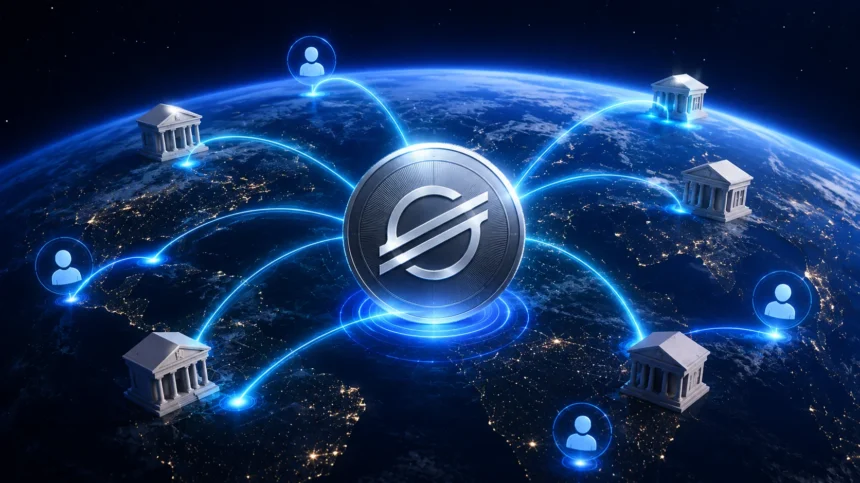
What is Stellar Lumens (XLM)? Stellar Lumens (XLM) is the native cryptocurrency of the Stellar network, an open source, decentralized protocol designed specifically to facilitate fast, low cost cross border payments and asset transfers, particularly for remittances and financial inclusion in developing economies. Unlike many other blockchain platforms, Stellar was built from the ground up with a clear focus: making money move across borders as easily as email, aiming to connect banks, payment systems, and people.
What is Stellar Lumens (XLM)? The Network’s Core Purpose
Stellar is a decentralized network that acts as a bridge between various currencies, both fiat and crypto. Its primary objective is to make cross border transactions more efficient and accessible than traditional banking systems. The network allows for the creation, sending, and trading of digital representations of any currency, known as “tokens,” which are anchored to real world assets.
The Lumen, or XLM, plays a crucial role within this ecosystem. It serves as an anti spam mechanism, requiring a small amount to be held in an account and a tiny fee for each transaction. This prevents malicious actors from flooding the network with frivolous operations. More importantly, XLM can act as a bridge currency in trades between different tokenized assets, facilitating liquidity and enabling direct conversions even when a direct market pair does not exist.
The Stellar Development Foundation (SDF), a non profit organization, guides the development and growth of the Stellar network. Founded in 2014 by Jed McCaleb, who also co founded Ripple and Mt Gox, the SDF aims to unlock the world’s financial potential by making money more fluid, more open, and more equitable. This mission underpins much of Stellar’s design and strategic partnerships.
Stellar’s Architecture: Speed, Low Cost, and Scalability
Stellar achieves its speed and low costs through a unique consensus mechanism called the Stellar Consensus Protocol (SCP). Unlike proof of work or proof of stake, SCP relies on a system of “quorums,” where individual nodes agree on the validity of transactions. This design allows for rapid validation without requiring vast computational power or staking large amounts of capital.
Transactions on the Stellar network typically settle in 3 to 5 seconds. This near instantaneous finality is critical for remittances and other time sensitive payments, where delays can cause significant inconvenience and financial impact. Compared to traditional wire transfers that can take days and incur substantial fees, Stellar offers a compelling alternative.
The transaction fee structure is another hallmark of Stellar’s efficiency. Each operation on the network costs a minuscule 0.00001 XLM. This fee is so low it is practically negligible, making microtransactions and frequent transfers economically viable. This cost effectiveness is central to Stellar’s appeal for individuals and businesses sending smaller amounts of money across borders.
Financial Inclusion: Stellar’s Mission to Bank the Unbanked
One of Stellar’s most compelling angles, and one often overlooked, is its deep commitment to financial inclusion. The network was explicitly designed to serve populations that are underserved by traditional financial institutions, particularly in developing countries. Many individuals in these regions lack access to bank accounts, credit, or affordable remittance services.
Stellar addresses this by enabling “anchors,” which are regulated financial institutions or fintech companies that issue tokenized representations of fiat currency on the Stellar network. These anchors act as on and off ramps, allowing users to convert fiat currency into digital tokens and back again. For example, a user in the Philippines might convert local currency into a stablecoin like USDC via a Stellar anchor, send it to a relative in Mexico, who then converts it back to pesos.
This system bypasses costly intermediaries and lengthy processing times, directly benefiting migrants sending money home to their families. The low fees mean more of the sent money actually reaches the recipient. Stellar aims to create a global financial network where anyone, anywhere, can participate in the digital economy, regardless of their access to traditional banks.
Real World Adoption: Partnerships and Payment Corridors
Stellar’s focus on real world utility has led to significant partnerships with established financial players. A notable example is its collaboration with MoneyGram, announced in 2021. This partnership allows users to send USDC on the Stellar network and have it cashed out for fiat currency at MoneyGram locations in various countries. This creates a powerful bridge between the digital asset world and physical cash infrastructure.
Another key partnership involves Circle, the issuer of USDC. Stellar supports USDC directly, allowing for efficient and stable value transfers across the globe. This integration positions Stellar as a vital layer for stablecoin adoption in cross border payments. Other partnerships include those with financial services firms, remittance companies, and even central banks exploring digital currencies.
These collaborations highlight Stellar’s practical application in creating new payment corridors and improving existing ones. Instead of trying to replace traditional finance entirely, Stellar often seeks to integrate with it, offering a more efficient backend for various financial services. Its robust API and developer friendly tools also encourage new fintech innovators to build on its platform, expanding its utility and reach.
The XLM Token: Utility and Economic Model
The Lumen (XLM) is integral to the Stellar network’s operation, serving several key functions beyond merely being a tradable asset. As mentioned, a small XLM balance is required to open an account on the Stellar network, typically 1 XLM. This minimum balance helps prevent spam accounts. Each transaction also incurs a minimal fee of 0.00001 XLM, which is burned, creating a slight deflationary pressure on the token supply.
The initial supply of XLM was 100 billion, but in November 2019, the Stellar Development Foundation burned over half the supply, reducing the total to 50 billion XLM. This decision was made to improve the network’s efficiency and better reflect its current and future needs. No new XLM will ever be minted, establishing a fixed supply schedule that differs from inflationary cryptocurrencies.
XLM also functions as a bridge currency on Stellar’s built in decentralized exchange (DEX). If a user wants to trade a tokenized fiat currency, say tokenized Euros, for tokenized Mexican Pesos, and no direct market exists, XLM can facilitate the swap. The Euros would first be traded for XLM, and then the XLM for Pesos, all happening seamlessly in a single atomic transaction. This enhances liquidity across disparate assets on the network.
Stellar Versus the Competition: A Niche in Global Payments
When comparing Stellar to other payment focused blockchains, its design philosophy stands out. While Ripple’s XRP Ledger also aims to facilitate fast, low cost cross border payments for financial institutions, Stellar often targets a broader audience, including individuals and smaller businesses, with a stronger emphasis on financial inclusion and open source development. Stellar’s network is designed to be more accessible for anyone to run a node or build an application.
Other blockchains like Ethereum, while capable of supporting stablecoins and payment applications, typically incur higher transaction fees and can experience network congestion, making them less ideal for high volume, low value remittances. Layer 2 solutions on Ethereum aim to address these issues, but Stellar provides an alternative purpose built infrastructure with its own unique consensus and economic model.
Stellar’s strength lies in its ability to connect diverse financial systems and currencies through its network of anchors and its native DEX. It does not seek to displace fiat currency but rather to make its movement more efficient and equitable globally. This focused approach allows Stellar to carve out a distinct and valuable niche in the competitive landscape of digital payments, particularly for remittances and microtransactions.
The TCB View
TCB believes Stellar Lumens (XLM) represents a cautiously optimistic play in the evolving landscape of global payments. Our read is that Stellar’s specific niche in low cost, fast remittances, particularly for underserved populations, gives it a defensible position against larger, more general purpose blockchains. The 2021 MoneyGram partnership for USDC powered payments demonstrated real world utility, but scaling this adoption remains a challenge.
We see a significant opportunity for Stellar to capture a larger share of the $600 billion annual remittance market by continuing to expand its anchor network and integrate with more payment processors. The biggest risk lies in regulatory uncertainty across various jurisdictions and fierce competition from both traditional finance and other crypto projects. Financial institutions and fintechs that can effectively onboard users onto the Stellar network stand to win, while legacy remittance services face continued pressure on their fee structures.
Watch for further expansion of Stellar’s payment corridors, specifically the volume of USDC flowing through the network and the number of active anchors in key remittance regions. A sustained increase in daily transaction volume above 5 million could signal growing traction and wider acceptance of Stellar as a go to network for cross border value transfer.