
Last updated: 27 June 2026
Alchemy provides the infrastructure layer that most Web3 applications run on without their users knowing it. When you interact with a DeFi protocol, an NFT marketplace, or a wallet, there is a high probability that the application’s requests to the blockchain are going through Alchemy nodes. The company powers over $100B in on-chain transactions annually and is the production infrastructure choice for the majority of serious Web3 development teams.
Key Highlights
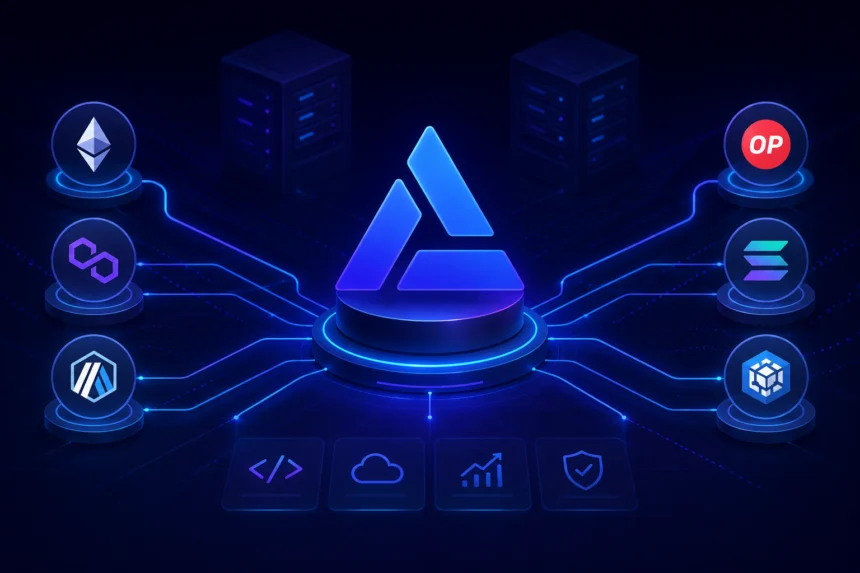
- Most reliable node infrastructure for Ethereum, Polygon, Arbitrum, Optimism, and Solana
- Enhanced APIs: NFT ownership data, token balances, and transaction history without raw RPC complexity
- 300 million compute units free per month: sufficient for most early-stage projects
- 99.9%+ uptime across all supported chains: far more reliable than self-hosted nodes
- Alchemy Notify: webhooks for on-chain activity without polling
- Debug tools: transaction simulations, trace functions, and mempool access
The Verdict
Alchemy is the correct infrastructure choice for any serious Web3 development project. Self-hosted Ethereum nodes require significant maintenance, storage, and engineering overhead. Alchemy eliminates that overhead at a cost that is negligible for funded projects and free for projects at the prototype stage. The enhanced APIs provide data that is prohibitively expensive to build independently. Any team building a serious DeFi or NFT application should evaluate Alchemy as their default infrastructure provider before considering alternatives.
Core Node Infrastructure
At its foundation, Alchemy provides JSON-RPC endpoints for blockchain interaction. You send a request to Alchemy’s endpoint and it forwards to the blockchain, returning the response. The value over a public RPC endpoint is reliability and rate limits: public RPCs are shared across all users, frequently throttle requests, and occasionally go offline. Alchemy’s infrastructure is built for production workloads with dedicated capacity per account tier. Sync time, which can take days for a self-hosted full node, is not a concern since Alchemy maintains continuously synced nodes.
The Supernode architecture routes each request to the fastest available node for that chain state. For latency-sensitive applications like arbitrage bots or liquidation systems in DeFi, the difference between a 30ms and 200ms RPC response is meaningful in competitive on-chain environments.
Enhanced APIs
Standard Ethereum RPC returns raw data that requires significant processing. To get a user’s token balances across all ERC-20 tokens, a raw RPC approach requires calling the transfer event logs and reconstructing balances, which is slow and requires substantial indexing infrastructure. Alchemy’s alchemy_getTokenBalances returns this in a single API call. Similar enhanced endpoints exist for NFT ownership, NFT metadata, transaction history, and asset transfers. These APIs abstract away months of indexing infrastructure work that would otherwise need to be built custom. For most Web3 application teams, the time saved by using enhanced APIs versus building equivalent infrastructure internally represents the largest value Alchemy delivers.
Free Tier
Alchemy provides 300 million compute units per month on the free tier. Compute units are the credit system that determines how many requests you can make. Simple calls like eth_blockNumber cost 10 units. More complex calls like alchemy_getAssetTransfers cost 150 units. At 300 million free CUs per month, most applications at the prototype and early growth stage can operate entirely on the free tier. This makes Alchemy accessible to independent developers and early-stage startups without requiring budget approval or investor backing. The free tier does not require a credit card for signup.
Alchemy Notify and Webhooks
Polling the blockchain for events (repeatedly asking “has anything changed?”) is inefficient and expensive. Alchemy Notify provides webhooks that trigger when specific on-chain events occur: when a wallet receives a transaction, when a smart contract emits a specific event, or when a pending transaction is confirmed. Applications subscribe to events and receive HTTP callbacks when they fire. This is the production pattern used by most serious applications to track user activity, notify users of transactions, and trigger application logic in response to on-chain events without burning API credits on polling.
Alchemy vs Infura vs Self-Hosted
Infura is the main direct competitor and has a longer history in Ethereum infrastructure. Alchemy is generally considered superior on enhanced API depth, dashboard tooling, and developer experience. Infura still has advantages for some enterprise clients with specific compliance requirements. Self-hosting an Ethereum node gives maximum control and zero dependency on a third party, at the cost of 500GB+ of storage, significant maintenance overhead, and slower sync after restarts. For most applications, the economics of self-hosting cannot compete with Alchemy’s free and low-cost tiers, and the enhanced APIs cannot be replicated easily.
The TCB View
Alchemy has become the default infrastructure layer for serious Web3 development in the same way that AWS became the default infrastructure for web applications. The free tier is generous enough that it removes financial barriers for independent developers building in Web3. The enhanced APIs abstract away infrastructure problems that have no business being each team’s individual problem to solve. The reliability track record and the breadth of supported chains make Alchemy the correct default choice for any team that wants to focus on their application rather than their infrastructure. The main risk is vendor dependency, which is mitigated by Alchemy’s RPC compatibility with all standard clients, making migration feasible if required.