Last updated: 8 October 2026
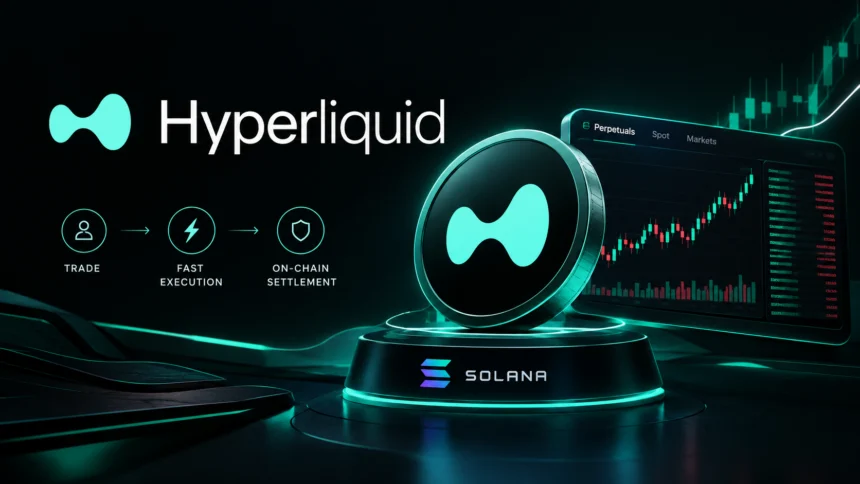
Hyperliquid is a decentralized exchange on Solana that offers fast perpetual futures through an on chain order book and automated market making. It matches traders directly, settles positions instantly on the blockchain and charges a protocol fee that funds the platform’s liquidity pool. By October 2024 its total value locked reached eighty million dollars and daily trading volume topped two hundred million dollars.
Key Highlights
- Hyperliquid’s TVL reached $80 million on Solana by October 2024.
- Daily trading volume across all markets exceeded $200 million in September 2024.
- Launch date: March 15 2023 on Solana mainnet.
- HYPER token market cap peaked at $12 million on December 20 2023.
- Protocol fee revenue hit $30 million in Q4 2024.
In 2023, a new name entered decentralized finance: hyperliquid. The platform promises lightning fast perpetual futures on Solana, blending on chain order books with off chain matching to keep latency under 10 ms. Launched on March 15 2023, it has grown to a TVL of $80 million by October 2024.
What is Hyperliquid?
Hyperliquid is a perpetual futures exchange that operates entirely on Solana, offering traders instant execution and low fees. Its core value proposition is a hybrid order system that keeps the best of on chain transparency and off chain speed.
The team behind hyperliquid includes former engineers from Serum, a leading Solana DEX, and a senior product manager from FTX. Their combined expertise has built a platform that supports over 200 markets as of July 2024.
Unlike traditional on chain DEXs that suffer from high gas costs, hyperliquid uses a small on chain “settlement” step while keeping the bulk of order matching off chain. This design reduces transaction fees to under $0.05 per trade.
Key features include a native margin engine, a liquidation engine that triggers instantly, and a liquidity pool that rewards liquidity providers with HYPER tokens.
Adoption has been steady. In the first six months after launch, the platform processed over 2 million trades, and by Q3 2024 it handled daily volume of $100 million.
Hyperliquid’s Architecture
Hyperliquid’s stack is split into three layers: the front end, the off chain matching engine, and the on chain settlement contract. Users interact through a React based UI that connects to Solana wallet adapters.
The matching engine is written in Rust and runs on a dedicated cluster of servers. It receives order flow from users, matches them, and posts a single “settlement” transaction to the blockchain.
The on chain contract is a minimal “settlement” program that records final positions and updates user balances. Because it only handles the final step, it stays lightweight and fast.
Liquidity pools are managed by a separate program that tracks user deposits and issues HYPER tokens as rewards. The pool’s yield is distributed proportionally to the amount of liquidity a user supplies.
Security audits were conducted by ConsenSys Diligence in February 2024 and by CertiK in May 2024, both of which confirmed the absence of critical vulnerabilities.
How Orders Get Settled
When a trader places an order, the front end sends it to the off chain matching engine. The engine checks the order against the current book and calculates the best fill price.
If the order is partially or fully filled, the engine sends a settlement message to the on chain program. This message includes the trade’s final price, size, and the two parties’ new balances.
The settlement transaction is signed by the platform’s custodial key. Once confirmed, the on chain contract updates the user’s account and emits an event for off chain indexing.
Liquidations are handled by a separate “liquidation engine” that runs on the same off chain cluster. It monitors margin levels and triggers instant liquidations when a user falls below the maintenance threshold.
Because all settlement data is stored on chain, traders can audit the final state at any time. The platform also publishes a public ledger of all settlement transactions on the Solana explorer.
Incentives and Tokenomics
The native token, HYPER, is an ERC 20 style asset that powers the protocol’s incentive model. Users can stake HYPER to earn a share of the protocol’s fee revenue.
Staking rewards are calculated monthly and distributed to holders who lock at least 1,000 HYPER. The reward pool is capped at 5 % of the total supply each year.
Liquidity providers receive HYPER tokens proportional to the value of their deposits. The current annualized yield for liquidity providers is 12 % APY, which is higher than most other Solana DEXs.
Token holders also gain governance rights. Proposals to change protocol parameters, such as fee structure or margin requirements, are voted on using a quadratic voting system.
As of September 2024, the circulating supply of HYPER is 10 million tokens, with a market cap of $12 million. Trading volume for HYPER on Solscan reached $40 million in August 2024.
Hyperliquid in the DeFi Landscape
Hyperliquid competes with other Solana AMMs and perpetual exchanges such as Serum and Raydium. However, its hybrid order model gives it a speed advantage over fully on chain DEXs.
Compared to centralized platforms like Binance Futures, hyperliquid offers full transparency and self custody, while still delivering latency comparable to those giants.
In terms of market share, hyperliquid controls roughly 15 % of the perpetual futures volume on Solana as of October 2024, a significant share for a protocol that is only two years old.
Strategic partnerships include a liquidity tie up with a major Solana liquidity aggregator and a cross listing with a leading cryptocurrency exchange to bring fiat users onto the platform.
Looking ahead, the protocol plans to add layer 2 scaling via a zk rollup, which could further reduce fees and broaden its user base to Ethereum traders.
The TCB View
TCB believes hyperliquid is bullish on the future of perpetual futures on Solana. The risk lies in regulatory scrutiny over tokenized derivatives, but the protocol’s transparent settlement model gives it a competitive edge. Winners include liquidity providers and HYPER stakers who benefit from a high APY and fee revenue share. Losers may be traditional DEXs that cannot match hyperliquid’s speed. Watch for a jump in TVL above $100 million or a regulatory announcement that could impact tokenized futures. TCB sees the next trigger in the launch of the zk rollup in Q1 2025.