
Last updated: 9 June 2026
Zcash held a market capitalization of $1.2 billion in January 2023. That valuation put the privacy focused cryptocurrency among the top assets seeking to provide transaction anonymity. Unlike public ledgers, Zcash transactions can obscure details like sender, receiver, and amount. It’s a key feature setting it apart.
Privacy is its defining characteristic.
Key Highlights
- Zcash employs zero knowledge proofs, specifically zk SNARKs, to verify transactions without revealing their content.
- The Electric Coin Company, led by CEO Zooko Wilcox, maintains Zcash development.
- Users choose between fully transparent or shielded addresses for their transactions.
- Its supply cap matches Bitcoin‘s at 21 million units, maintaining scarcity.
- Regulatory bodies often scrutinize privacy cryptocurrencies, creating adoption challenges.
The Drive for Privacy
Zcash launched in 2016, built upon the Bitcoin protocol codebase but with a significant addition: privacy technology. Its creators wanted to build a digital cash system where financial movements wouldn’t automatically become public record. Think of it like paying with cash instead of a credit card; your transaction is known, but the details aren’t broadcasting to the world.
Financial anonymity remains crucial.
The core innovation behind Zcash is a cryptographic tool called zk SNARKs, which stands for “zero knowledge succinct non interactive arguments of knowledge.” This mouthful of a term describes how Zcash can prove a transaction’s validity without showing any specific information about the transaction itself. It’s like proving you have a secret password without ever actually saying the password aloud.
Proof without exposure. Simple.
Bitcoin’s ledger, in contrast, makes clear every transaction detail for all to see. While addresses appear as pseudonyms, advanced analysis can often link them back to real world identities. That’s not true financial privacy for many. Zcash directly tackles this public visibility problem, aiming to give users true control over their financial data.
Public ledgers aren’t private.
Shielded Transactions Explained
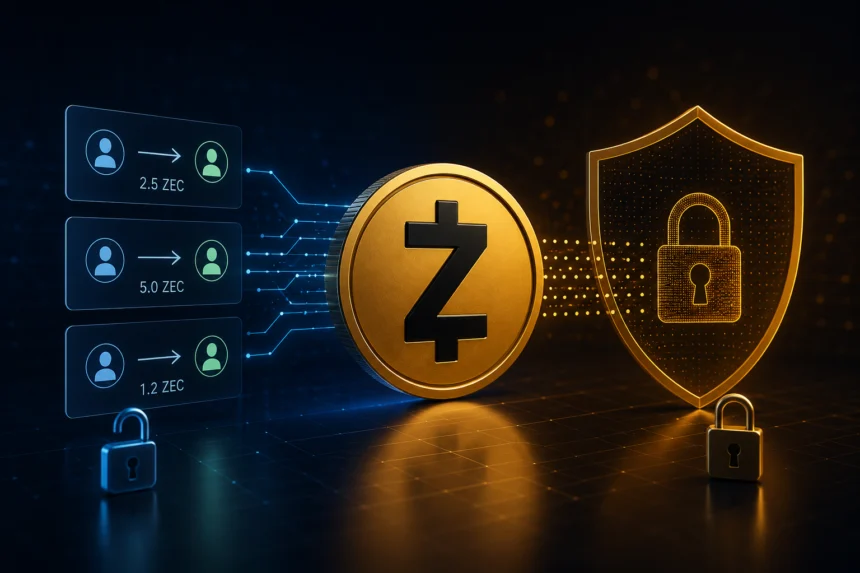
Users interact with Zcash through two main address types: ‘t addresses’ and ‘z addresses’. T addresses are transparent, behaving much like Bitcoin addresses, where all transaction data is visible on the public ledger. Z addresses, still, are shielded. When you send Zcash from one z address to another, all transaction metadata gets encrypted.
User choice drives privacy.
This means if Alice sends Zcash to Bob using shielded addresses, no one observing the blockchain can tell who sent it, who received it, or how much Zcash changed hands. The network still verifies the transaction is legitimate and that Alice had the funds to send. It’s a clever mathematical trick.
Proof without revealing anything.
While the option for transparent transactions exists, Zcash’s distinguishing value comes from its shielded pool. Many users gravitate towards the network precisely for this powerful privacy feature. It’s about empowering individuals with financial confidentiality, a right often taken for granted in traditional cash economies but complicated by digital transactions.
Shielded pools offer real privacy.
Beyond Anonymity: Fungibility Concerns
The privacy provided by Zcash addresses a significant issue in cryptocurrency: fungibility. A truly fungible asset means every unit is interchangeable with another, like how any one dollar bill is worth the same as any other dollar bill. In public ledger cryptocurrencies, if some coins were previously used in illicit activities, they might become “tainted” or less desirable.
Tainted coins lose value.
This “tainting” concern poses a problem for fungibility because it creates a potential distinction between different units of the same currency. A merchant might refuse to accept certain Bitcoin if its history suggests ties to crime, even if the current holder is innocent. Zcash’s shielded transactions prevent this by obscuring history.
History isn’t traceable.
When Zcash enters the shielded pool, its past history becomes unidentifiable from other Zcash in the pool. This means all Zcash that goes through shielded transactions essentially becomes indistinguishable from other Zcash in the pool, ensuring true fungibility. It’s a critical aspect for a truly usable digital cash.
True fungibility matters greatly.
Challenges and The TCB View
Zcash, like other privacy focused cryptocurrencies, faces scrutiny from regulators and law enforcement agencies. Governments worry that these tools could be exploited for money laundering or financing illegal activities, making compliance a difficult balancing act. It’s a tension that continues to define much of the discussion around digital asset regulation.
Regulations create real tension.
Despite the challenges, development continues. The Electric Coin Company regularly works on protocol improvements, including strengthening scalability and performance for shielded transactions. Building out the privacy layer of the internet requires constant innovation and careful consideration of user experience alongside security.
Innovation keeps Zcash going.
The market valuation of $1.2 billion in January 2023 confirms there’s a strong demand for what Zcash offers. But broader adoption hinges on navigating the complex regulatory environment. Education on privacy use cases and technical improvements remain central to its future growth.
Growth needs clear paths.
The TCB View
Our read: Zcash isn’t just a niche project; it’s a fundamental stand for financial privacy in a world moving toward total surveillance. The market valuation in January 2023 tells us investors see its long term potential, despite government headwinds. One concrete risk is direct regulatory action or delisting from major exchanges, which could hit liquidity hard. The opportunity lies in broader enterprise adoption where companies need to protect sensitive business information on a public ledger. The signal to track: continued technical advancements in zk SNARK performance and scalability.