
Last updated: 9 June 2026
Key Highlights
- W3C’s Decentralized Identifiers (DIDs) 1.0 became a Recommendation in July 2022, establishing a foundational standard for Self Sovereign Identity.
- The European Union’s eIDAS 2.0 regulation, passed in February 2024, mandates a digital identity wallet for all EU citizens by 2026, boosting SSI adoption.
- KILT Protocol, a Polkadot parachain, has facilitated the creation of over 1 million DIDs since its mainnet launch in 2021.
- The average cost of a data breach globally reached $4.45 million in 2023, according to IBM, underscoring the urgent need for robust identity solutions.
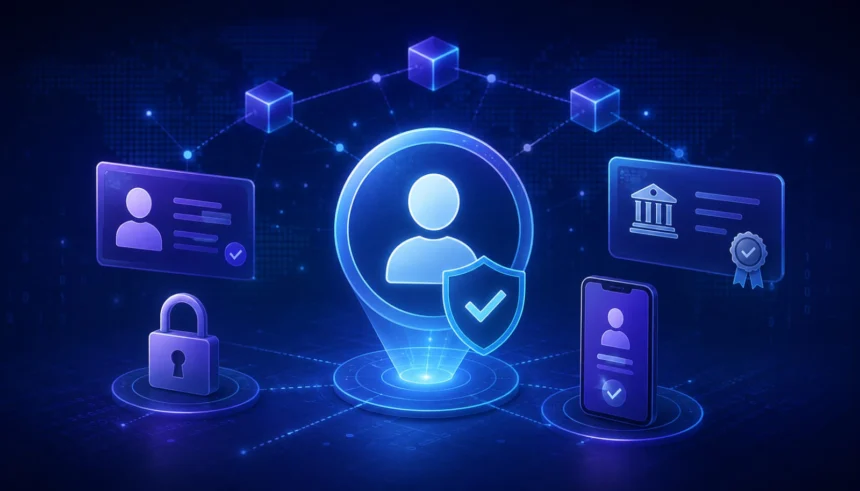
The future of decentralized identity hinges on Self Sovereign Identity (SSI), a paradigm shift empowering individuals with full control over their digital credentials, moving away from centralized authorities that currently manage and often monetize personal data. This transformative approach promises enhanced privacy, security, and a more user centric internet experience, fundamentally reshaping how we interact online and establishing a new foundation for digital trust.
Understanding Self Sovereign Identity (SSI)
Self Sovereign Identity (SSI) represents a fundamental shift in how digital identities are managed. Instead of relying on a single, centralized entity like a government or a tech giant to store and verify personal data, SSI places the individual at the center. Users create and control their own unique identifiers and credentials, choosing precisely what information they share, with whom, and for how long.
The core principle is user empowerment. In traditional systems, our identities are fragmented across countless service providers, each holding a piece of our data. This creates honeypots for hackers and limits our agency over our own information. SSI aims to reverse this by giving individuals cryptographic control over their identity attributes, enabling them to present verifiable proofs without exposing underlying personal data.
The Technical Backbone: DIDs and Verifiable Credentials
At the heart of SSI are two key technical components: Decentralized Identifiers (DIDs) and Verifiable Credentials (VCs). DIDs are new type of globally unique identifier, designed to be cryptographically verifiable and resolvable without requiring a centralized registry. The World Wide Web Consortium (W3C) standardized DIDs 1.0 in July 2022, providing a universal framework for their creation and management.
Verifiable Credentials are tamper evident digital documents that contain claims about an identity. For example, a university could issue a VC proving a user’s degree, or a government could issue one for a driver’s license. These VCs are cryptographically signed by an issuer, held by the user (the holder), and can be presented to a verifier, who can cryptographically confirm their authenticity and integrity without needing to contact the issuer directly.
The interaction works like this: an issuer creates a VC for a holder, signing it with their private key. The holder stores this VC, often in a digital wallet. When a verifier requests proof, the holder presents the VC. The verifier then uses the issuer’s public key, typically found via the issuer’s DID, to confirm the VC has not been altered and was indeed issued by the stated party. This architecture dramatically reduces reliance on intermediaries and enhances privacy through selective disclosure.
Real World Implementations and Protocols
Several significant projects are driving the adoption of SSI. Hyperledger Indy, an open source project, provides tools and libraries for creating and managing DIDs and VCs, forming a foundational layer for many SSI solutions. It emphasizes privacy preserving identity and has been adopted by various governments and enterprises.
KILT Protocol, built as a parachain on Polkadot, offers a blockchain based infrastructure for issuing and revoking VCs. Since its mainnet launch in 2021, KILT has seen over 1 million DIDs created, demonstrating real world utility in areas like credential management for gaming and professional certifications. Similarly, Polygon ID, launched in 2022, uses zero knowledge proofs to enable private and verifiable identity claims on the Polygon network, allowing users to prove attributes without revealing sensitive information.
SpruceID is another notable player, focusing on open standards for Web3 identity. Their solutions enable users to control their data across decentralized applications, offering tools for DID management, VC issuance, and secure data storage. These implementations collectively illustrate the versatility and growing maturity of SSI technology across different blockchain ecosystems.
Navigating the Regulatory Landscape and Adoption Challenges
The regulatory environment is gradually catching up with the advancements in SSI. The European Union’s eIDAS 2.0 regulation, enacted in February 2024, is a landmark development. It mandates that all EU member states provide citizens with a digital identity wallet by 2026, which will support self sovereign principles and allow verifiable credentials. This legislative push is expected to significantly accelerate SSI adoption across the continent.
Despite regulatory tailwinds, several challenges impede widespread adoption. Interoperability remains a key hurdle; ensuring DIDs and VCs issued on one platform can be recognized and verified on another is crucial for a truly global identity layer. User experience also needs refinement; the complexity of managing cryptographic keys and understanding decentralized concepts can be daunting for average users. Beyond that, legal recognition of digital credentials and the establishment of trust frameworks are ongoing processes that require collaboration between technologists, regulators, and legal experts.
The Impact on Digital Trust and Privacy
SSI promises a profound impact on digital trust and personal privacy. By giving individuals control over their data, it drastically reduces the risk of large scale data breaches, which cost organizations an average of $4.45 million in 2023. Users no longer need to entrust their entire identity to a single service provider, mitigating the “honey pot” problem that makes centralized databases attractive targets for cyberattacks.
Privacy is enhanced through selective disclosure. Instead of sharing a full government ID to prove age, an SSI user could present a VC that simply states “over 18” without revealing their birth date or name. This minimal disclosure principle protects sensitive information while still satisfying verification requirements. In the context of Web3 and DeFi, SSI can enable reputation systems and access controls without requiring users to link their on chain activities to their real world identities, fostering a more private and secure digital economy.
The shift towards SSI also empowers individuals in their interactions with institutions. It creates a more equitable power dynamic, allowing users to grant and revoke access to their data on their own terms. This foundational change is essential for building a truly user centric internet, where trust is established cryptographically and privacy is a default setting, not an afterthought.
The TCB View
TCB believes the future of decentralized identity is unequivocally bullish for Self Sovereign Identity, representing a necessary evolution for digital trust and privacy. We see significant opportunities for protocols building foundational layers like KILT and Polygon ID, as well as for enterprises that embrace these standards early for customer onboarding and data management. Traditional identity providers and centralized data brokers stand to lose market share as individuals reclaim control over their digital selves. Our read is that the average cost of a data breach, now at $4.45 million, provides a compelling economic incentive for businesses to adopt SSI. Watch for the full implementation of eIDAS 2.0 by 2026 as a major catalyst for mainstream SSI adoption and a benchmark for other global regulatory bodies.