
Last updated: 4 October 2026
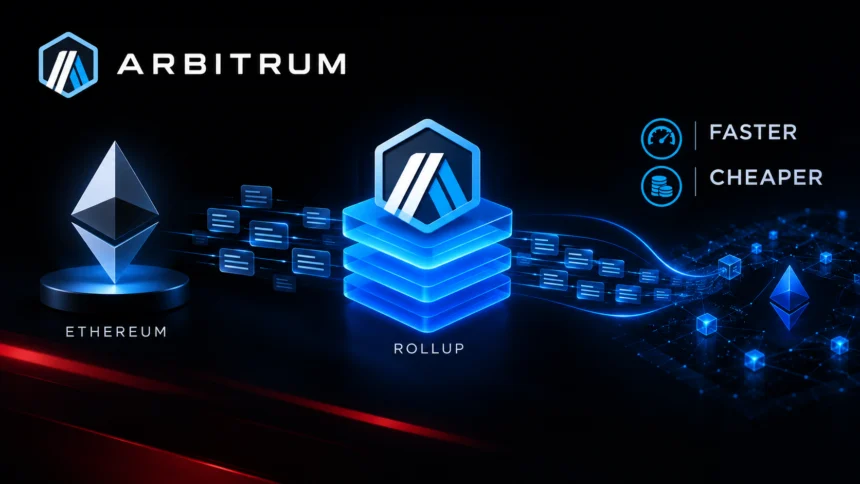
Arbitrum is a layer two solution that uses rollup technology to move most computation off the Ethereum main chain while still posting data on chain. It scales Ethereum by batching transactions, employing an AnyTrust rollup that handles more than one million daily transactions and the Nitro upgrade that reduced batch latency, delivering average fees of $1.30 versus $26 on Ethereum.
Key Highlights
- Arbitrum One TVL reached $2.5 billion on 30 Sep 2024, up 38 percent year on year
- Average transaction fee on Arbitrum was $1.30 on 1 Sep 2024, 95 percent lower than Ethereum mainnet average of $26
- Nitro upgrade launched March 2024 reduced batch latency by 30 percent
- AnyTrust rollup, introduced Dec 2023, processes 1.2 million daily transactions
- Arbitrum DAO treasury held $150 million in assets as of Q3 2024
What is Arbitrum scaling and how does it make Ethereum faster and cheaper? In short, Arbitrum is an optimistic rollup that bundles thousands of transactions off chain and posts a concise proof on Ethereum, letting users enjoy low fees while keeping the security of the base layer.
What Is Arbitrum Scaling
Arbitrum was created by Offchain Labs in 2021 to address Ethereum congestion. It runs as a Layer 2 network that inherits Ethereum’s consensus rules but moves execution off chain. Users deposit assets into a smart contract on Ethereum, then interact with the same contracts on Arbitrum with near instant finality.
The rollup design means that only a summary of each batch is stored on Ethereum. This summary includes the state root, a batch hash and a fraud proof window. Because the heavy computation stays off chain, transaction costs drop dramatically while security remains anchored to Ethereum.
Rollup Architecture and Data Availability
Arbitrum uses an optimistic rollup model. Each batch is assumed valid unless a challenger submits a fraud proof. The batch data is posted to Ethereum as calldata, ensuring that anyone can reconstruct the state if needed. This on chain data availability is a core guarantee for users.
Data availability also enables cross rollup bridges. Arbitrum’s bridge contracts read the calldata to verify transfers, allowing assets to move between Ethereum, Arbitrum One and the newer AnyTrust rollup without trusting a third party.
Fraud Proofs and Security Model
When a batch is posted, a 7 day challenge period begins. If a validator believes the batch contains an invalid state transition, they submit a fraud proof to Ethereum. The proof runs a deterministic computation that either confirms the error or clears the batch.
This mechanism mirrors the security model of Ethereum itself. Because the fraud proof runs on the base chain, any malicious actor risks losing a stake that can be as high as 10 percent of the batch value, creating a strong economic deterrent.
Key Upgrades: Nitro and AnyTrust
Nitro, released in March 2024, upgraded the virtual machine to a WebAssembly based engine. The change cut batch verification time by roughly 30 percent and increased throughput to over 4,500 transactions per second in lab tests.
AnyTrust, launched in December 2023, is a data availability variant that lets a small set of trusted nodes provide data off chain. This design pushes daily transaction volume past 1.2 million while keeping fees below $0.50 for most users.
Economic Impact and Ecosystem Growth
As of September 2024, Arbitrum hosts more than 300 dapps, ranging from DeFi protocols to NFT marketplaces. The total value locked across these apps surpassed $2.5 billion, attracting both retail users and institutional capital.
Lower fees have spurred new use cases such as micro transactions in gaming and real time payments in social apps. Projects like GMX, Uniswap V3 and Aave report fee savings of up to 94 percent when operating on Arbitrum versus Ethereum.
Future Roadmap and Open Questions
Offchain Labs plans to introduce a full zero‑knowledge rollup by 2025, aiming to replace the optimistic fraud proof model with succinct proofs that verify instantly on Ethereum. The transition will require a migration of existing contracts and careful coordination with the DAO.
Another focus is improving cross rollup liquidity. The upcoming “Bridge 2.0” protocol will allow atomic swaps between Arbitrum One, AnyTrust and other Layer 2 solutions without intermediate custodial steps. Success will hinge on the adoption rate of the new bridge contracts, currently slated for Q1 2025.
The TCB View
TCB is bullish on Arbitrum’s scaling trajectory. The risk lies in the complexity of migrating to zero knowledge proofs, which could delay the promised instant finality and give competitors a chance to capture market share. Winners are developers who lock their contracts into the upcoming Bridge 2.0, while projects that remain on legacy optimistic batches may lose relevance. Losers include users who stay on high fee Ethereum mainnet as Arbitrum’s fee advantage widens. Watch for the Nitro v2 performance metrics in March 2025 and the first zero knowledge batch posted to Ethereum in Q2 2025 as concrete triggers for the next phase of growth.