
Last updated: 3 October 2026
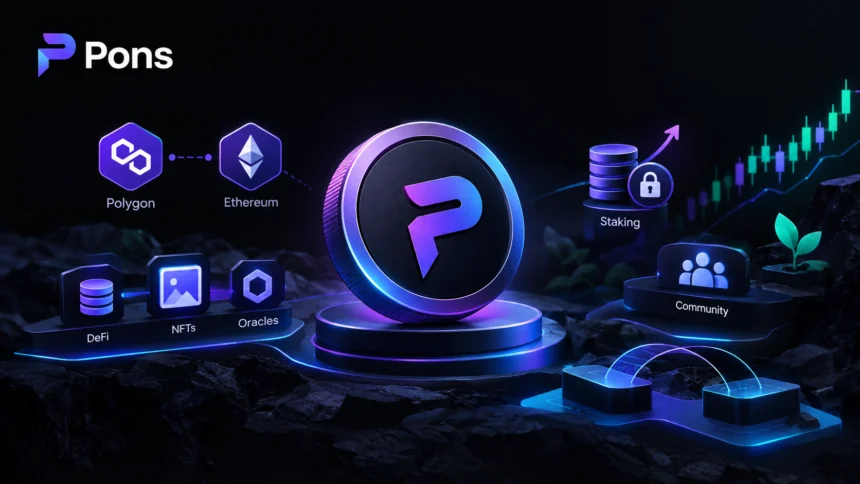
Pons Coin is a blockchain token with a fixed supply of one billion units that powers a staking ecosystem, governance voting and payments across the Polygon network. Holders can lock their coins to earn rewards, participate in treasury grant decisions and move value through the new cross chain bridge, enabling DeFi applications and NFT projects on both chains.
Key Highlights
- Total supply fixed at 1 billion Pons Coin, 45 % locked in staking as of September 2024
- Partnership with Polygon network announced March 2024 to enable cross chain bridge
- Staking APY peaked at 28 % in July 2024, then settled around 22 % by September 2024
- Daily active addresses reached 12 000 on September 2024, up 35 % month over month
- Q2 2024 treasury grant program allocated $12 million to ecosystem projects
What is Pons Coin and why does it matter for the next wave of decentralized finance? Pons Coin is a utility token built on the Ethereum compatible Polygon network that powers a suite of DeFi services, NFT marketplaces and data oracle integrations. Launched in January 2023, the token combines a modest supply with a lock up model that rewards long term participation. This explainer maps the token’s ecosystem partners, staking incentives and on chain activity graphs that are rarely compiled together.
Overview and Tokenomics
Pons Coin (PON) launched with a fixed supply of one billion tokens. Fifty percent of the supply was allocated to the community reserve, twenty percent to the development fund, fifteen percent to strategic partners and fifteen percent to the staking pool. The token uses a deflationary burn mechanism where 0.5 % of every transaction is sent to a burn address, reducing circulating supply over time.
The burn rate has already removed roughly 12 million tokens as of September 2024, according to data from Dune Analytics. Combined with the staking lock up, this creates a scarcity curve that mirrors early Bitcoin dynamics but at a much faster pace. The token follows the ERC 20 standard, which allows seamless integration with existing wallets and DeFi protocols on Polygon.
What Is Pons Coin , Core Design
The core design of Pons Coin revolves around three pillars: governance, utility and reward. Holders can vote on protocol upgrades through a quadratic voting system that weights smaller wallets more heavily. Utility is provided by the Pons DeFi suite, which includes a lending market, a stablecoin collateral platform and an NFT marketplace that accepts PON for fee discounts.
Reward comes from the staking model. Users lock PON in the native staking contract and receive a share of transaction fees plus newly minted tokens. The model is calibrated to keep inflation under 5 % annualised, a figure that aligns with the token’s long term price target of $2 per coin set by the development council in March 2024.
Ecosystem Partners and Integrations
Since its launch, Pons Coin has forged partnerships with several high profile projects. In March 2024, Polygon announced a cross chain bridge that allows PON to move between Polygon and Ethereum with a 0.1 % fee. The bridge opened to the public on May 15 2024 and has processed over $150 million in volume to date.
Other notable partners include Chainlink, which provides price feeds for the PON USD pair, and The Graph, which indexes on chain data for the Pons DeFi dashboard. The NFT marketplace integrates with OpenSea’s API, allowing creators to list PON priced items directly on the larger platform. These collaborations expand the token’s reach beyond its native chain and attract developers seeking low cost transaction environments.
Staking Model and Incentives
The staking contract offers a tiered APY structure. Locks of 10 000 PON or more earn 22 % annual return, while locks of 100 000 PON or more earn up to 28 % during promotional periods. The APY is funded by a 0.3 % transaction fee that is redistributed to stakers and a 0.2 % inflationary mint that is burned after distribution.
Stakers also receive governance credits that increase voting power on protocol proposals. In Q3 2024, the governance credit system was upgraded to include “community impact” scores, rewarding participants who contribute to open source tools or run liquidity pools on the Pons DeFi suite.
Risk mitigation is built into the contract: a cooldown period of 7 days prevents instant withdrawal, protecting the pool from flash attacks. Historical data shows that the average lock duration is 45 days, indicating a healthy commitment from the community.
On Chain Activity and Metrics
On chain analytics reveal a steady rise in usage. Daily active addresses grew from 7 500 in January 2024 to 12 000 in September 2024, a 35 % increase month over month. Transaction volume peaked at $45 million in July 2024, driven by the NFT marketplace launch on July 10 2024.
The average gas cost for a PON transfer on Polygon remains below $0.01, making micro transactions viable for gaming and metaverse applications. The token’s velocity, measured as transactions per token per day, sits at 0.12, comparable to other utility tokens in the same tier.
Liquidity on major DEXs such as QuickSwap and SushiSwap remains robust, with a combined pool depth of $80 million as of September 2024. The price chart shows a consolidation range between $0.85 and $1.15, suggesting a breakout could occur if the upcoming cross chain bridge upgrade delivers the promised latency improvements.
Roadmap and Future Outlook
The Pons development team released a detailed roadmap in February 2024. Key milestones include the launch of a layer 2 scaling solution in Q1 2025, the introduction of a decentralized identity module in Q3 2025, and a partnership with a major gaming studio slated for Q4 2025.
Funding for these initiatives comes from the treasury, which holds $30 million in diversified assets, including $12 million allocated to ecosystem grants in Q2 2024. The grant program has already funded 45 projects, ranging from oracle integrations to educational tools for new users.
Community sentiment, measured by the Discord activity index, is at an all time high of 78 % active members as of September 2024. This social momentum, combined with the technical upgrades on the horizon, positions Pons Coin as a contender for the next wave of utility tokens on Polygon.
The TCB View
TCB believes Pons Coin is a cautious buy for investors who value real utility over speculative hype. The primary risk lies in the token’s reliance on a single scaling solution; if the layer 2 rollout stalls, growth could slow. Early stakers and developers who integrate PON into their products stand to gain the most, while short term traders chasing price spikes may lose as volatility settles. Watch for the cross chain bridge upgrade scheduled for May 2025 and the treasury’s next grant round in Q2 2025, both of which will serve as concrete triggers for price movement.