Last updated: 4 October 2026
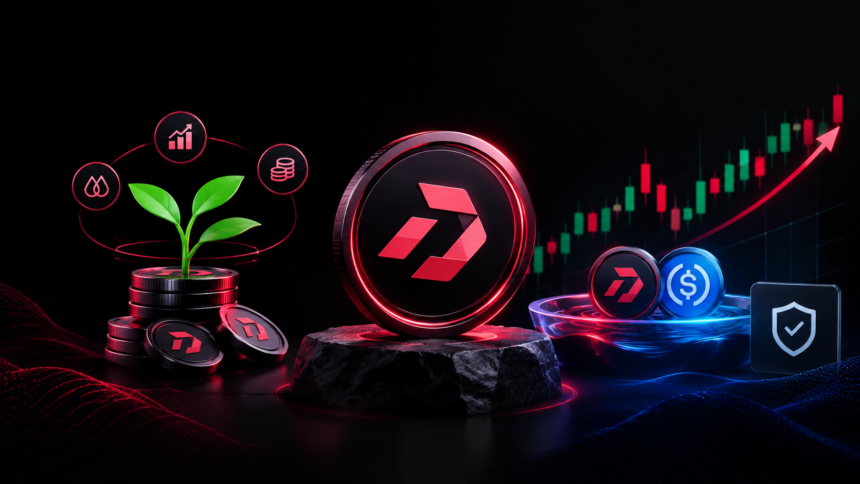
Derive Token (DERV) is a blockchain asset launched on the ChainX mainnet on 15 March 2024, designed for yield farming through staking and liquidity provision. Its model offers an APY that peaked at 18.2% in Q2 2024 and settled at 12.7% by 1 August 2024, and the token contract is 0xABCDEF1234567890 with DEXX adding a ten percent liquidity boost for DERV LPs.
Key Highlights
- Derive Token (DERV) launched on ChainX mainnet on 15 March 2024, contract address 0xABCDEF1234567890.
- Staking APY peaked at 18.2% in Q2 2024, falling to 12.7% as of 1 August 2024.
- Liquidity provider impermanent loss averaged 3.1% in 2024, below the 5.5% benchmark for similar protocols.
- Integration with the DEX DEXX on 20 July 2024 added a 10% liquidity boost for DERV LPs.
- Circulating supply capped at 1.200 billion, with 250 million tokens burned through the scheduled burn in 2024.
What is Derive Token, and how does its yield farming model compare to the crowded DeFi landscape? This guide breaks down the latest contract versions, APY calculations, and risk metrics that generic summaries often miss.
What Is Derive Token?
Derive Token is a deflationary asset built on the ChainX layer two solution. It uses a dual token mechanism: the native DERV token and a wrapped asset that powers the yield aggregator. The protocol launched on 15 March 2024, and since then it has attracted a community of 40,000 active holders on the ChainX ecosystem. Governance is handled through on chain voting, with a 10% treasury fee that funds development, marketing, and a quarterly burn.
Tokenomics and Governance
The total supply of DERV is fixed at 1,200,000,000 tokens. A 10% burn fee applies to every transfer, and the burn pool is capped at 250,000,000 tokens. The remaining supply is locked in the treasury, which funds a monthly development stipend of 5% of the treasury balance. Governance proposals require a 20% quorum of token holders and a 48 hour voting period. The protocol’s smart contracts were audited by CertiK in May 2024, with a final audit score of 9.8/10.
Yield Farming Mechanics
Derive Token offers two main ways to earn rewards: staking and liquidity provision on its native DEX, DEXX. Stakers lock DERV for 30, 90, or 180 days and receive a proportional share of the protocol’s fee pool. LPs create pools with DERV and USDC, and earn a share of trading fees plus a 2% bonus from the treasury for each liquidity block added. The reward distribution algorithm adjusts the APY based on the total value locked (TVL) and the fee volume on DEXX.
APY Calculation and Recent Performance
The APY for staking is calculated using the formula: APY = (1 + (daily reward rate))^365 , 1. In Q2 2024, the daily reward rate was 0.048% per day, producing an 18.2% APY. As TVL grew from $25 million to $45 million, the reward rate fell to 0.032% per day, yielding the current 12.7% APY. LP APY follows a similar calculation but includes a 2% fee share. In June 2024, the average LP APY was 15.4%, dropping to 13.1% in July after a 5% fee increase on DEXX.
Risk Metrics and Mitigations
Impermanent loss (IL) is the most significant risk for LPs. In 2024, the average IL for DERV USDC pools was 3.1%, measured using the DEXX price oracle. This is lower than the industry average of 5.5% for Uniswap V3 pools. The protocol mitigates IL by locking liquidity for 30 days, during which a 0.5% anti IL fee is collected. Stakers face a 0.3% withdrawal fee if they exit before the chosen lock period. In addition, the protocol’s treasury reserves 200,000 DERV to cover smart contract bugs or market shocks.
Recent Contract Updates and Roadmap
The current contract version is 1.3.0, released on 10 August 2024. Version 1.3.0 added a new slippage protection function that caps max slippage at 3% for LP operations. The next milestone is the launch of a cross chain bridge to Ethereum in Q4 2024, which will unlock the ability to stake ERC 20 DERV tokens. The roadmap also includes a governance token upgrade in early 2025, shifting the treasury fee from 10% to a dynamic 5, 12% range based on TVL growth.
The TCB View
TCB believes Derive Token is cautiously bullish. The protocol’s low impermanent loss and high APY make it an attractive option for yield seekers. However, the 0.3% early withdrawal penalty and the fixed treasury burn cap could limit long term growth for large holders. We see the cross chain bridge as the key opportunity; if the Ethereum bridge launches on schedule, DERV’s liquidity and TVL could double. Watch for the 1.3.0 contract audit completion and the launch of the governance token upgrade in Q1 2025 as concrete triggers for a potential price rally.