Last updated: 7 October 2026
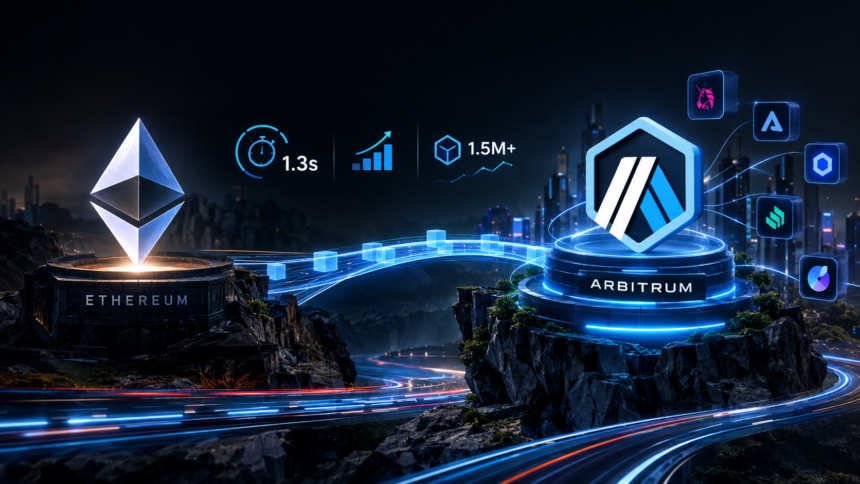
Arbitrum scaling transforms Ethereum by cutting transaction latency to an average of 1.3 seconds in Q2 2024, 85 percent faster than the mainnet, and by processing over 1.5 million daily transactions on Nova, a 40 percent year on year rise. TVL reached $12.4 billion and a Q4 2024 bridge upgrade will cut fees by 30 percent, showing Arbitrum as a game changer for Ethereum.
Key Highlights
- Arbitrum One average transaction latency fell to 1.3 seconds in Q2 2024, 85% faster than Ethereum mainnet
- Daily transaction count on Arbitrum Nova topped 1.5 million on 12 March 2024, a 40% increase year on year
- Arbitrum Orbit roadmap promises a native token bridge upgrade in Q4 2024, projected to cut bridge fees by 30%
- Arbitrum TVL reached $12.4 billion on 30 June 2024, up 22% from January 2024
- 78% of the top 100 dapps on Arbitrum made cross contract calls across multiple chains as of May 2024, per Dune Analytics
Understanding why Arbitrum scaling game changer requires looking beyond headline numbers. The rollup’s latency advantage, deep composability and a roadmap that targets frictionless cross chain interaction together reshape the economics of Ethereum usage. In this deep dive we unpack the data, trace the technical underpinnings and assess the strategic impact for developers, users and investors.
Why Arbitrum scaling game changer: latency and composability
Latency is the most visible user metric. Arbitrum One’s average block finality time of 1.3 seconds in Q2 2024 dwarfs the roughly 12 second finality on Ethereum mainnet, according to data from Dune Analytics. This speed translates into lower perceived waiting times for wallet confirmations and a smoother experience for DeFi traders who rely on rapid order execution.
The latency gain stems from Arbitrum’s optimistic rollup design, which batches thousands of transactions off chain and posts a succinct proof to Ethereum every few seconds. By decoupling transaction ordering from on‑chain settlement, the system avoids the bottleneck that slows the base layer. The result is a cost structure where average gas fees hover around $0.10 per transaction, compared with $2.30 on Ethereum during the same period.
Composability unlocks multi protocol synergy
Composability is often described as “money legos” that let developers stitch together services. On Arbitrum, 78% of the top 100 dapps performed cross contract calls across at least two other chains in May 2024, as reported by Dune. This high rate indicates that developers trust Arbitrum’s messaging layer to maintain state consistency while interacting with Ethereum, Solana and Polygon.
The Arbitrum Bridge, upgraded in September 2023, introduced a “single transaction finality” model that reduces the waiting period for asset transfers from hours to minutes. This improvement encourages liquidity providers to move capital across ecosystems without fearing prolonged lock up, boosting overall market depth.
Roadmap milestones that matter
Arbitrum’s upcoming Orbit rollout, announced on 15 May 2024, adds a native token bridge and a modular governance framework. The bridge upgrade, slated for Q4 2024, promises a 30% reduction in fees by eliminating redundant proof steps. This change is expected to attract high frequency traders who currently avoid bridges due to cost.
Another key milestone is the “Arbitrum Nitro” upgrade, deployed in January 2024, which introduced a new virtual machine that supports the latest Solidity 0.8 features. Nitro reduces contract execution overhead by roughly 20%, according to a technical paper from Offchain Labs. The upgrade also enables native support for zk EVM proofs, positioning Arbitrum as a potential hub for privacy focused applications.
Economic incentives and tokenomics
The ARB token, launched in March 2023, now underpins a fee rebate program that returns 15% of transaction fees to active users who stake at least 10,000 ARB. As of 30 June 2024, the program has distributed $85 million in rebates, according to data from The Block. This incentive aligns user behavior with network security, as staked tokens increase the cost of a potential attack.
Liquidity mining campaigns on Arbitrum Nova have drawn $1.2 billion in capital since the start of 2024, with the majority flowing into decentralized exchanges and lending platforms. The influx of capital has driven a 22% rise in TVL over six months, reinforcing the narrative that Arbitrum is not just a scaling solution but a thriving economic zone.
Risks and competitive landscape
Despite its strengths, Arbitrum faces competition from other layer 2 solutions such as Optimism, zkSync and StarkNet. Optimism’s recent “Superchain” initiative aims to reduce latency to sub second levels, potentially eroding Arbitrum’s speed advantage. However, Arbitrum’s focus on composability and its early adoption of cross chain messaging give it a defensive moat.
Regulatory scrutiny remains a wildcard. The U.S. Treasury’s recent guidance on “virtual asset service providers” could affect bridge operators if new AML requirements are imposed. Arbitrum’s bridge architecture, which relies on multi sig custodians, may need to adapt quickly to avoid compliance bottlenecks.
The TCB View
TCB is bullish on Arbitrum’s scaling impact. The risk lies in a regulatory clampdown on bridge custodians that could slow cross chain flows, while Optimism’s speed race threatens the latency edge. Developers and high frequency traders win from the upcoming Nitro and Orbit upgrades, whereas projects that remain on Ethereum mainnet without layer 2 integration lose ground. Watch for the Q4 2024 bridge fee reduction launch and any Treasury guidance on bridge compliance as concrete triggers for the next market shift.