
Last updated: 27 June 2026
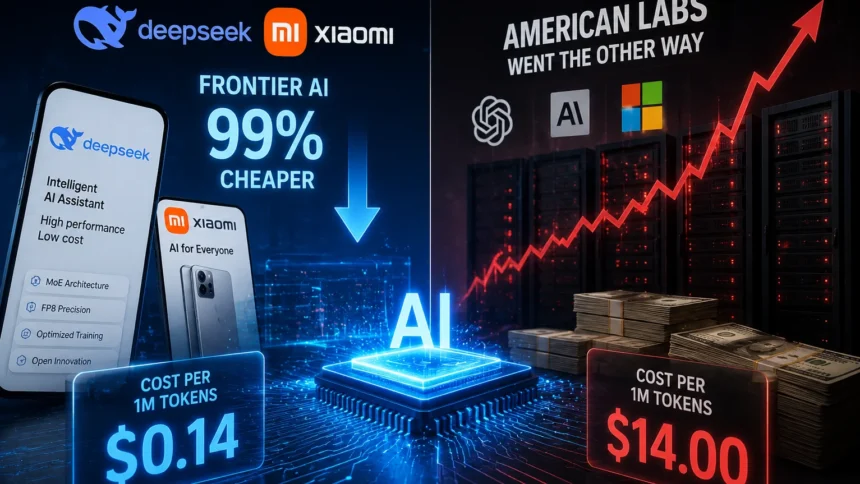
DeepSeek and Xiaomi have dramatically reduced the cost of frontier AI development by an estimated 99%, releasing powerful open source models that challenge the proprietary approach of leading American laboratories.
Key Highlights
- DeepSeek V2, a new Mixture of Experts (MoE) model from DeepSeek AI, offers performance comparable to GPT-4 Turbo at a significantly lower inference cost.
- The model is reportedly 99% cheaper to run than leading proprietary models, making advanced AI capabilities widely accessible.
- Xiaomi, a major Chinese tech conglomerate, has also released its own open source large language model (LLM), Xiaomi MiLM 8B, further contributing to the accessible AI landscape.
- This move by DeepSeek and Xiaomi contrasts sharply with the strategy of major American AI labs, which primarily focus on closed, high cost, proprietary models.
- DeepSeek V2 is designed to support up to 256,000 tokens, enabling extensive context windows for complex tasks.
DeepSeek, Xiaomi Just Made Frontier AI Accessible
DeepSeek AI, a research firm backed by Chinese tech giant DeepGlint, recently unveiled DeepSeek V2, an open source Mixture of Experts (MoE) model. This release marks a pivotal moment, offering advanced capabilities at a fraction of the traditional cost. The model is engineered for efficiency, providing performance on par with OpenAI’s GPT-4 Turbo while drastically cutting inference expenses. This cost reduction, reportedly as high as 99% compared to existing frontier models, could democratize access to powerful AI.
The architecture of DeepSeek V2 is optimized for resource efficiency. It employs a Sparse MoE design, allowing it to activate only a subset of its parameters for any given query. This design minimizes computational overhead, translating directly into lower operational costs for developers and businesses. The model’s capacity to handle up to 256,000 tokens means it can process vast amounts of information, making it suitable for complex analytical and generative tasks.
In parallel, Xiaomi has also entered the fray with its own open source large language model, Xiaomi MiLM 8B. This 8 billion parameter model, while smaller than DeepSeek V2, further signals a strategic shift towards open and accessible AI development from Chinese tech firms. Xiaomi’s contribution underscores a growing trend to foster innovation through shared resources, rather than exclusive, proprietary systems.
Divergent Strategies: China vs. US in AI
The releases from DeepSeek and Xiaomi highlight a significant divergence in AI development philosophy between Eastern and Western tech giants. American AI leaders like OpenAI, Google, and Anthropic have predominantly pursued a closed source, high investment model. Their flagship products, such as GPT-4, Gemini, and Claude, are powerful but come with substantial API costs and often restrict direct access to their underlying architectures. This approach prioritizes proprietary control and monetization.
Conversely, Chinese firms appear to be leaning into an open source strategy for frontier AI. This approach fosters a collaborative environment, potentially accelerating innovation across a wider developer base. By making advanced models cheaper and more accessible, these companies aim to integrate AI into a broader range of applications and industries, potentially creating a new wave of AI driven services and products.
This strategic contrast could reshape the global AI landscape. While American labs focus on pushing the absolute boundaries of AI with massive, proprietary models, the Chinese strategy emphasizes widespread adoption and cost effectiveness. The long term implications for market share, regulatory frameworks, and global technological leadership remain to be seen as these two approaches compete.
Implications for AI Development and Innovation
The dramatic cost reduction offered by models like DeepSeek V2 significantly lowers the barrier to entry for AI development. Startups, independent researchers, and smaller enterprises can now access capabilities previously exclusive to well funded corporations. This shift could unleash a new wave of innovation, allowing for experimentation and application development that was previously cost prohibitive.
For Web3 applications and decentralized AI projects, this accessibility is particularly impactful. Cheaper, powerful open source models can be integrated into decentralized autonomous organizations (DAOs), smart contracts, and on chain applications, fostering more intelligent and autonomous systems without relying on expensive, centralized cloud services. This aligns with the Web3 ethos of decentralization and democratized access.
The availability of such models also encourages greater transparency and scrutiny in AI development. With open source models, researchers can examine the underlying code, identify biases, and contribute to improvements, leading to more robust and ethical AI systems. This collaborative model contrasts with the “black box” nature of many proprietary AI offerings.
The TCB View
The releases of DeepSeek V2 and Xiaomi MiLM 8B represent a critical inflection point for the AI industry. The move by DeepSeek and Xiaomi to make frontier AI 99% cheaper is a direct challenge to the Western model of proprietary, high cost AI. This shift will democratize access to advanced AI capabilities, potentially fueling an explosion of innovation, especially within the Web3 space where decentralization and accessibility are paramount. However, this accessibility also brings risks, including the potential for misuse of powerful models and increased competition that could strain existing infrastructure. We must watch closely how American labs respond to this open source offensive and whether regulatory bodies will adapt to the rapid proliferation of advanced, accessible AI.