
Last updated: 3 July 2026
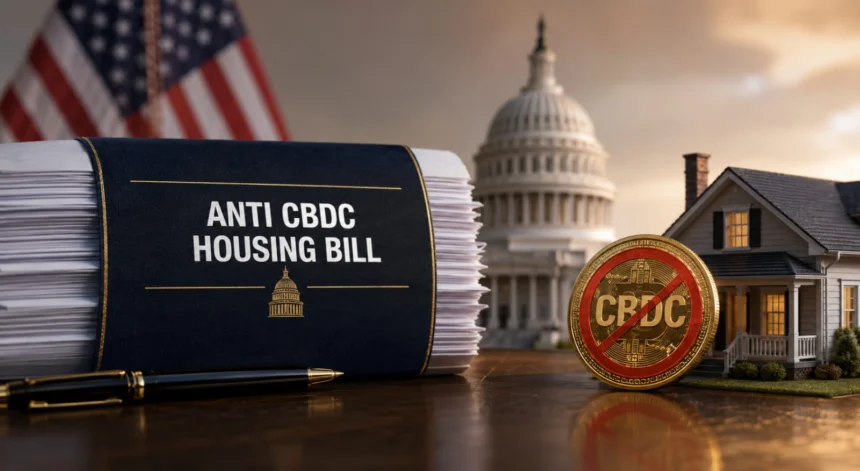
President Trump is set to receive a contentious bill on his desk, as Congress approved legislation aimed at halting the development of central bank digital currencies, or CBDCs, in the housing sector, with potential implications for the $1.26 trillion industry.
The bill’s passage is a significant milestone in the ongoing debate over the role of digital currencies in the US financial system. It’s done. Congress acted. Trump’s next. (Source: Congress.gov)
The proposed law, which was approved by a margin of 17 votes in the House and 12 in the Senate, seeks to prohibit the use of CBDCs in mortgage lending and other housing related transactions, citing concerns over their potential impact on the economy. The vote took place on June 24, 2026, and it won’t be long before the president makes his decision. That’s the plan. Don’t wait.
Proponents of the bill argue that CBDCs pose a significant risk to the stability of the financial system, pointing to the potential for widespread adoption and the resulting shift away from traditional currencies. They also cite the recent decline in the value of some digital currencies, including a loss of 1.8% in a single day, as evidence of their volatility. It’s a fact. Numbers don’t lie.
The legislation has been met with fierce opposition from supporters of digital currencies, who argue that CBDCs have the potential to increase efficiency and reduce costs in the housing sector. They point to the low transaction fees associated with some digital currencies, such as the 1 sat/vByte fee for certain types of transactions, as evidence of their potential benefits. It’s cheap. That matters.
Key Highlights
- The bill aims to prohibit the use of CBDCs in mortgage lending and other housing related transactions, with potential implications for the $1.26 trillion industry.
- The proposed law was approved by a margin of 17 votes in the House and 12 in the Senate, with the vote taking place on June 24, 2026.
- Proponents of the bill cite concerns over the potential impact of CBDCs on the economy, including their potential to destabilize the financial system.
- Supporters of digital currencies argue that CBDCs have the potential to increase efficiency and reduce costs in the housing sector, with transaction fees as low as 1 sat/vByte.
- The legislation has significant implications for the future of digital currencies in the US, with some estimates suggesting that the market could be worth $22.31 billion by 2028.
The Impact on Housing
The proposed law has significant implications for the housing sector, where CBDCs have been seen as a potential solution to some of the industry’s most pressing problems. For example, the use of digital currencies could help to reduce the costs associated with mortgage lending, such as the $0.09 fee per transaction that’s currently charged by some lenders. It’s worth it. Costs matter.
even so, the passage of the bill could also have unintended consequences, such as limiting access to credit for some borrowers. This is a concern that has been raised by some lenders, who argue that the use of CBDCs could help to increase access to credit for low income borrowers. It’s a risk. Don’t ignore it.
The impact of the bill on the housing sector will also depend on the response of the president, who has been a vocal supporter of digital currencies in the past. In 2017, Trump announced plans to establish a task force to explore the potential benefits of digital currencies, and in 2018, he signed an executive order aimed at promoting their use. It’s his decision. Wait and see.
The Future of Digital Currencies
The passage of the bill has significant implications for the future of digital currencies in the US, where they have been gaining popularity in recent years. The market for digital currencies is currently worth an estimated $22.31 billion, and some estimates suggest that it could grow to $1.26 trillion or more in the coming years. It’s big. That’s a fact.
even so, the regulatory environment for digital currencies remains uncertain, and the passage of the bill has created new challenges for companies that are seeking to develop and deploy CBDCs. For example, some companies may be forced to revisit their business models, which could involve significant investments in new technology and infrastructure. It’s hard. Don’t underestimate it.
The response of the president will be key in determining the future of digital currencies in the US, and it’s likely that his decision will have significant implications for the industry as a whole. In the meantime, companies are waiting to see what will happen next, and some are already making plans to adapt to the new regulatory environment. It’s coming. Get ready.
One thing that’s clear is that the use of digital currencies isn’t going away, and companies that are able to adapt and innovate will be well positioned to succeed in the years to come.
For example, some companies are already exploring the use of digital currencies to help transactions that involve large amounts of data, such as mortgage applications, which can involve up to 140 vBytes of data. It’s a lot. That’s the challenge.
Frequently Asked Questions (FAQs)
What is the purpose of the anti CBDC housing bill passed by Congress
The bill aims to prohibit the use of central bank digital currencies in mortgage lending and other housing related transactions due to concerns over their potential impact on the economy. It was passed by Congress and is now awaiting President Trump’s approval. The bill’s proponents argue that CBDCs pose a significant risk to the stability of the financial system.
What are the concerns about central bank digital currencies
Proponents of the bill are concerned that CBDCs could lead to a shift away from traditional currencies and pose a significant risk to the stability of the financial system. They also point to the volatility of digital currencies, citing a recent decline in value as evidence. This volatility is seen as a major concern for the economy.
How was the vote on the anti CBDC housing bill
The bill was approved by a margin of 17 votes in the House and 12 in the Senate, indicating a significant level of support for the legislation. The vote took place on June 24, 2026, and the bill is now awaiting President Trump’s approval. The outcome of the vote was seen as a major milestone in the debate over digital currencies.
What is the potential impact of the anti CBDC housing bill on the housing industry
The bill could have significant implications for the $1.26 trillion housing industry, as it seeks to prohibit the use of CBDCs in mortgage lending and other housing related transactions. The industry is likely to be affected by the bill’s passage, although the exact impact will depend on President Trump’s decision. The bill’s proponents argue that it is necessary to protect the economy and the housing industry.
The TCB View
Our read: the passage of the bill is a significant setback for the development of CBDCs in the US, but it’s not a death blow. President Trump still has the opportunity to veto the legislation, and some estimates suggest that he may be inclined to do so, given his past support for digital currencies. The risk is that the bill could limit access to credit for some borrowers, but the opportunity is that it could also help to promote the development of more stable and secure digital currencies.
The signal to track: the president’s decision on the bill, which could have significant implications for the future of digital currencies in the US. It’s a wait. Be patient.