
Last updated: 23 June 2026
Key Highlights
- AI algorithms in crypto trading are projected to manage over $500 billion in digital assets by 2027, up from an estimated $120 billion in early 2024.
- Decentralized AI networks like Fetch.ai and Render Network have seen a combined market capitalization surge over 250% in Q1 2024, driven by demand for verifiable, on chain AI computation.
- Leading blockchain security firms, including CertiK and PeckShield, report a 35% increase in AI driven smart contract audits, significantly reducing exploit vectors discovered post deployment in 2023.
- The integration of AI in DeFi protocols is accelerating, with platforms leveraging machine learning for dynamic lending rates and risk assessment, targeting a 15% improvement in capital efficiency by 2026.
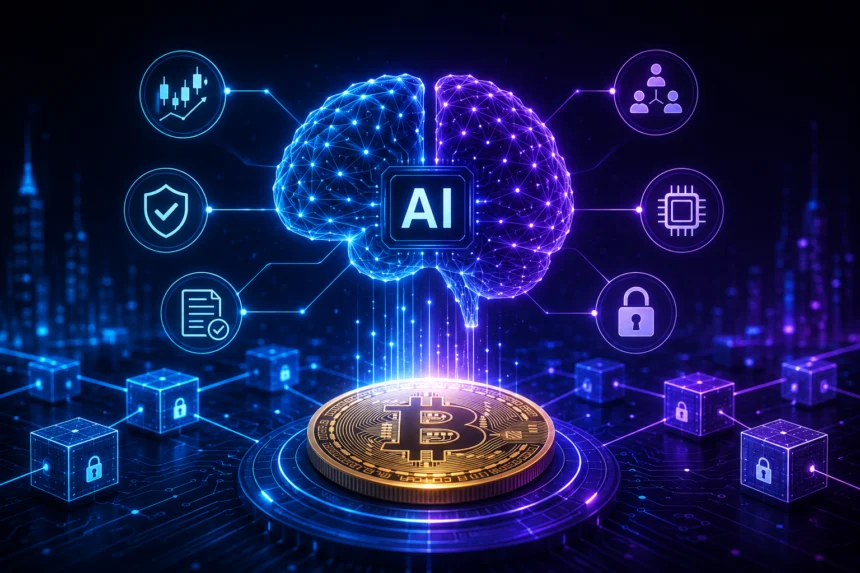
Artificial intelligence in crypto refers to the application of AI technologies across the blockchain and digital asset ecosystem, enhancing everything from trading strategies and security protocols to smart contract development and the very architecture of decentralized networks.
This powerful synergy moves beyond mere theoretical concepts, manifesting in tangible tools and platforms that address critical pain points and unlock new efficiencies within the crypto space. From sophisticated market analysis to robust fraud detection, AI is increasingly becoming an indispensable component.
AI Driven Trading and Market Intelligence
One of the most immediate and impactful applications of AI in crypto lies within trading and market analytics. AI algorithms can process vast amounts of data, including price movements, trading volumes, social media sentiment, and on chain metrics, at speeds human traders cannot match.
These AI powered trading bots are designed to identify patterns, predict price movements, and execute trades autonomously, often leveraging machine learning models trained on historical data. For instance, platforms like Numerai use a decentralized network of data scientists to build predictive models, rewarding participants in their native NMR token for accurate forecasts.
Beyond execution, AI excels at market intelligence. It can perform real time sentiment analysis across platforms like X and Reddit, providing early indicators of market shifts. This capability allows traders to gauge public perception of specific assets or projects, offering an edge in volatile markets.
Some quantitative hedge funds specializing in digital assets, such as Pantera Capital and Paradigm, are reportedly deploying proprietary AI systems to optimize portfolio allocation and risk management. These systems continuously adjust positions based on complex market dynamics, aiming to maximize returns while mitigating downside exposure.
Fortifying Blockchain Security with AI
The inherent immutability of blockchain, while a core strength, also means that vulnerabilities in smart contracts can lead to catastrophic losses. AI offers a powerful new layer of defense against these threats, significantly bolstering security within the crypto ecosystem.
AI driven auditing tools can scan smart contract code for common vulnerabilities, logical errors, and potential exploits far more efficiently and comprehensively than manual reviews. Companies like CertiK and AnChain.AI employ machine learning to identify suspicious patterns in code and transaction flows, flagging potential rug pulls or flash loan attacks before they happen or as they unfold.
Beyond that, AI is crucial for real time fraud detection. By analyzing transaction histories and user behavior patterns, AI algorithms can detect anomalies indicative of malicious activity, such as money laundering or illicit transfers. This capability is vital for regulatory compliance and protecting users from scams.
For example, blockchain analytics firms use AI to trace stolen funds across multiple chains, assisting law enforcement and recovery efforts. This proactive and reactive security posture, powered by AI, is becoming a standard expectation for robust decentralized applications and protocols.
Revolutionizing Smart Contract Development and Optimization
The development of smart contracts, particularly complex ones, is a meticulous and error prone process. AI is beginning to transform this landscape, making smart contract creation more efficient, secure, and accessible.
AI assisted development environments can suggest code improvements, automatically generate boilerplate code, and even translate high level specifications into functional smart contract logic. This reduces development time and minimizes human error, a critical factor given the immutable nature of deployed contracts.
Post development, AI tools can optimize smart contract performance. This includes identifying opportunities to reduce gas fees, streamline execution paths, and enhance overall efficiency. For instance, AI could analyze historical transaction data to predict optimal gas prices for contract deployment or interaction.
The future may see AI agents autonomously writing, auditing, and deploying smart contracts based on predefined parameters, ushering in an era of highly automated and self optimizing decentralized applications. This shift promises to lower entry barriers for innovators and accelerate the pace of development across the industry.
The Rise of Decentralized AI Networks
Beyond applying AI to existing crypto functions, a new paradigm is emerging: decentralized AI networks. These projects aim to build AI infrastructure directly on blockchain technology, creating open, transparent, and censorship resistant platforms for AI development and deployment.
Projects like Fetch.ai are building decentralized machine learning networks where AI agents can autonomously interact and exchange data and services. This approach aims to democratize access to AI, preventing monopolization by large tech corporations and fostering a more equitable AI economy.
Other decentralized AI initiatives focus on providing verifiable computational resources. Render Network, for example, allows users to lend their GPU power for rendering and AI tasks, creating a global, distributed supercomputer. This provides a more cost effective and scalable solution for demanding AI workloads, paid for in crypto tokens.
These networks are also tackling the challenge of AI model ownership and data privacy. By using zero knowledge proofs and federated learning techniques, decentralized AI can enable collaborative model training without exposing sensitive underlying data, a critical step towards privacy preserving AI applications.
Challenges and Future Trajectories
Despite its immense potential, the integration of AI in crypto faces significant hurdles. Scalability remains a key concern; running complex AI models directly on chain is often prohibitively expensive and slow due to blockchain’s inherent limitations on computational throughput.
Data quality and bias are also critical considerations. AI models are only as good as the data they are trained on. In a decentralized environment, ensuring the integrity and impartiality of training data is a complex challenge, with potential implications for fairness and accuracy in AI driven decisions.
Looking ahead, the convergence of AI and crypto is set to deepen. We anticipate the emergence of fully autonomous AI agents operating within DAOs, making governance decisions and managing treasuries based on predefined objectives and real time data analysis. This could lead to truly self governing digital organizations.
Beyond that, AI will play a pivotal role in creating more personalized and adaptive DeFi experiences, from dynamic interest rates tailored to individual risk profiles to AI driven recommendations for yield farming strategies. The development of AI powered oracles will also become crucial, feeding verified, real world data into smart contracts with unprecedented accuracy.
The TCB View
TCB believes the confluence of AI and crypto presents an overwhelmingly bullish long term outlook, poised to redefine efficiency and security across the digital asset landscape. We see AI as an accelerant for mature blockchain adoption, moving beyond speculative trading to deliver tangible utility and robust infrastructure. The primary opportunity lies in AI driven automation and enhanced security, significantly reducing human error and malicious exploits, which currently cost the industry billions annually, as evidenced by the $1.8 billion lost to hacks in 2023 alone.
While early adopters and innovative protocols integrating AI will capture significant market share, traditional finance firms that fail to embrace this synergy risk being outmaneuvered by agile, AI enabled crypto native entities. The main risk remains the black box nature of some AI models, which could introduce new vectors for systemic risk if not transparently audited and governed. Watch for the growth of decentralized AI networks, particularly those focused on verifiable computation and privacy preserving data sharing, as their combined market capitalization surpasses $50 billion by late 2025, signaling mainstream enterprise adoption.