
Last updated: 21 June 2026
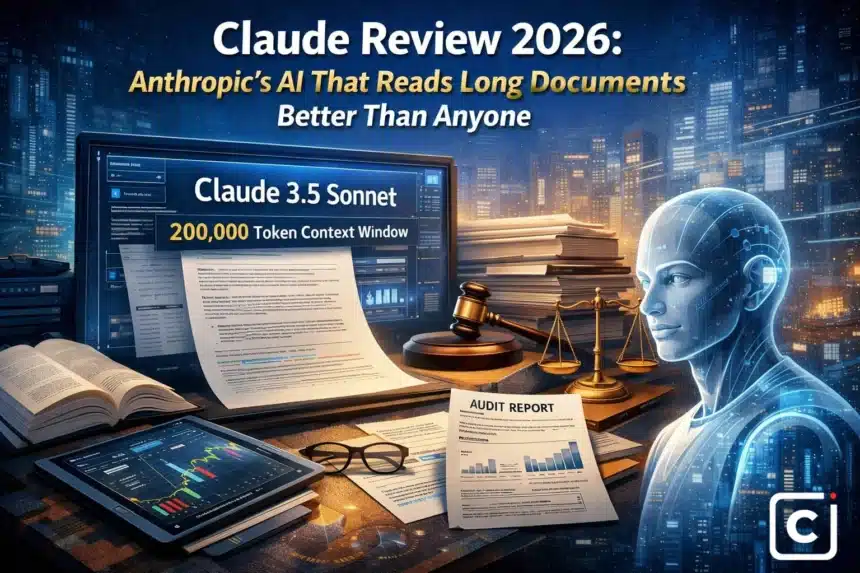
bounce april: Claude 3.5 Sonnet is the best AI model available in 2026 for reading and analyzing long documents. Its 200,000 token google gemini personal intelligence free”>context window and safety focused design make it the top choice for researchers working with whitepapers, legal filings, and crypto classify financial instrument”>financial reports.
Key Highlights
- Key Highlight: 200,000 token context window, equivalent to roughly 150,000 words, allows users to upload entire books, annual reports, or audit documents in a single session.
- Key Highlight: Claude 3.5 Sonnet scores highest among frontier models on several legal and financial reasoning benchmarks as of early 2026.
- Key Highlight: Anthropic’s Constitutional AI framework produces responses that are notably more careful about uncertainty and less likely to fabricate citations.
- Key Highlight: Pro plan at $20/month includes unlimited Claude 3.5 Sonnet access, priority during peak hours, and early access to new features.
- Key Highlight: Available via API with competitive pricing, making it accessible for developers building crypto and finance research tools.
Overview
Anthropic, the AI safety company founded in 2021 by former OpenAI researchers including Dario Amodei and Daniela Amodei, built Claude with a different philosophy than most AI labs. The goal was not just capability but reliability. In a research context, that distinction matters enormously.
Claude 3.5 Sonnet, released in mid 2024 and iterated through early 2026, represents the current peak of Anthropic’s work. It is widely regarded as the best model for tasks that require sustained attention across very long documents, nuanced reasoning, and careful handling of uncertainty.
Key Features for Document Analysis
The 200,000 token context window is Claude’s most distinguishing technical feature. In practical terms, this means you can upload a full DeFi protocol audit report, a 200 page SEC filing, or an entire academic paper on cryptographic systems, and ask Claude to analyze specific sections, compare claims across the document, or identify risks buried in footnotes. No other major AI assistant maintains coherent analysis across documents this long.
Anthropic’s training approach makes Claude particularly honest about what it does not know. Where GPT-4o will sometimes confidently state a figure that turns out to be fabricated, Claude is more likely to say “I am not certain about this specific number and recommend verifying against the primary source.” For finance and crypto research where accuracy is critical, this behavioral difference has real consequences for the reliability of your work.
Claude also performs extremely well on nuanced regulatory and legal analysis. Upload the full text of a proposed stablecoin bill, the GENIUS Act, or a new CFTC framework, and ask Claude to identify the key compliance requirements for a DeFi protocol. The quality of the resulting analysis matches or exceeds what you would get from a first pass legal review.
Pricing
Claude is available free with usage limits at claude.ai. The Pro plan costs $20 per month and provides unlimited access to Claude 3.5 Sonnet, priority compute, and early access to new model releases. API access for developers is priced per million tokens, with Sonnet at $3 per million input tokens and $15 per million output tokens as of early 2026.
For teams, Anthropic offers a Team plan starting at $25 per user per month. Enterprise pricing is available for organizations requiring data privacy guarantees and custom deployment options.
Pros
- Best in class long document analysis with 200,000 token context that remains coherent across entire books and lengthy filings
- More honest about uncertainty than competing models, reducing the risk of publishing fabricated statistics
- Excellent at regulatory, legal, and technical reasoning relevant to crypto and DeFi
- Strong API performance makes it accessible for building custom research and compliance tooling
- Clean, focused interface without feature bloat that can distract from deep analysis work
Cons
- No real time web search on the standard interface, meaning it cannot answer questions about events after its training cutoff without external tools
- Image generation is not available natively in Claude
- The conservative safety training sometimes produces overly cautious responses on legitimate finance or market analysis topics
- Weaker than ChatGPT for tasks requiring multi modal input like chart reading or image analysis
Who It Is For
Claude is the tool of choice for analysts and researchers whose primary workflow involves reading and synthesizing long, dense documents. If you regularly work with crypto project whitepapers, protocol audits, regulatory filings, or annual reports, Claude’s context window and analytical reliability make it the most productive tool available.
It is also the right choice for compliance and legal teams working in the crypto space who need an AI that will accurately surface risks and uncertainties rather than paper over them with confident but potentially wrong answers.
The TCB View
Anthropic has built something genuinely different with Claude. The 200,000 token window is not just a spec sheet talking point: it changes what is possible in a single research session. Being able to upload an entire DeFi project’s documentation, audit reports, and tokenomics papers into one conversation and ask cross cutting questions is a qualitative leap in research capability.
The safety focus, sometimes criticized as overly cautious, is actually a feature in high stakes financial analysis where wrong answers have real consequences. For The Central Bulletin’s deep dive and analysis workflows, Claude is the primary tool for document heavy research. It is not replacing ChatGPT for everything, but for the specific task of reading, analyzing, and reasoning across long documents, nothing in 2026 comes close.